Gormley Michael, O'Neill Desmond
School of Psychology, Trinity College Dublin, University of Dublin, Dublin, Ireland.
Centre for Ageing, Neuroscience and the Humanities, Trinity College Dublin, University of Dublin, Dublin, Ireland.
Front Psychol. 2019 Jun 6;10:1329. doi: 10.3389/fpsyg.2019.01329. eCollection 2019.
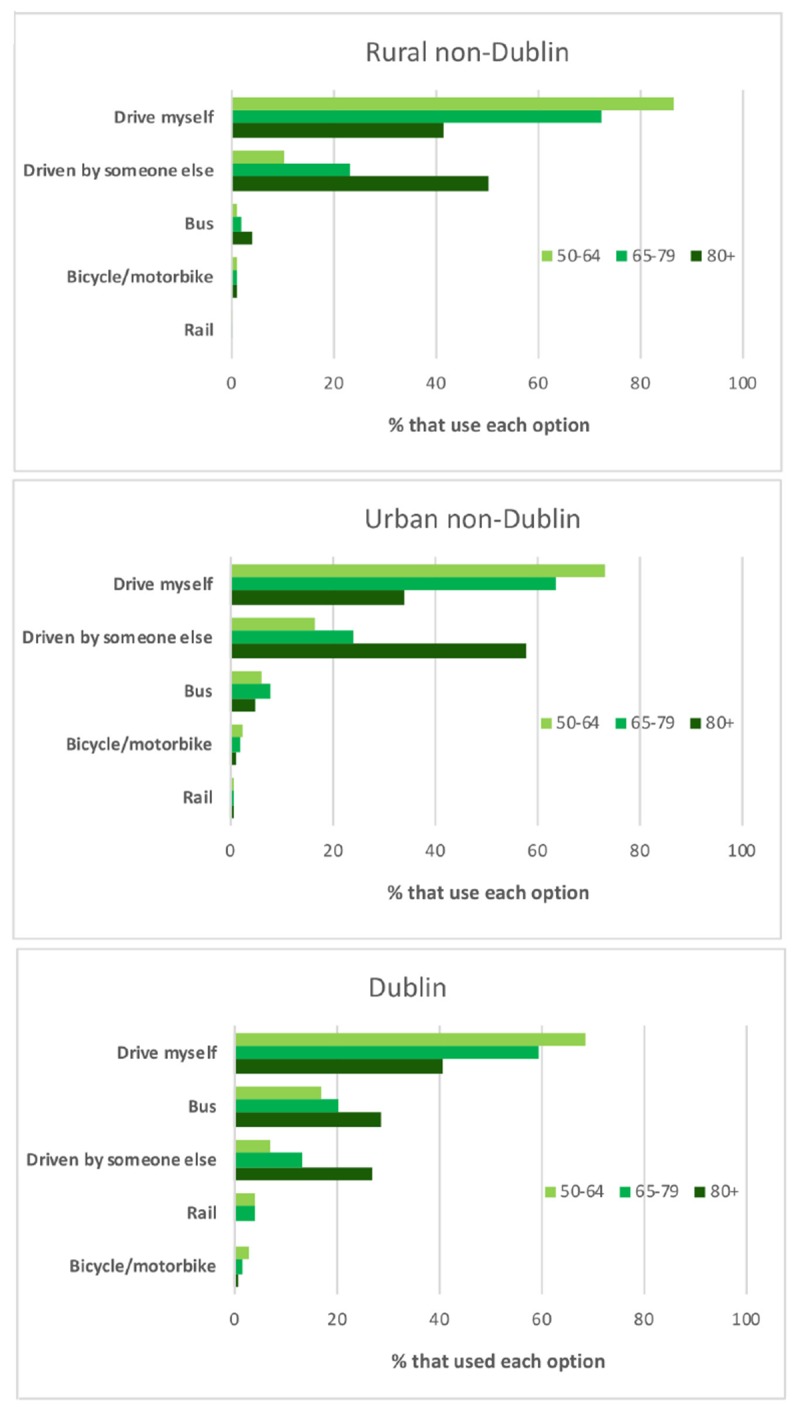
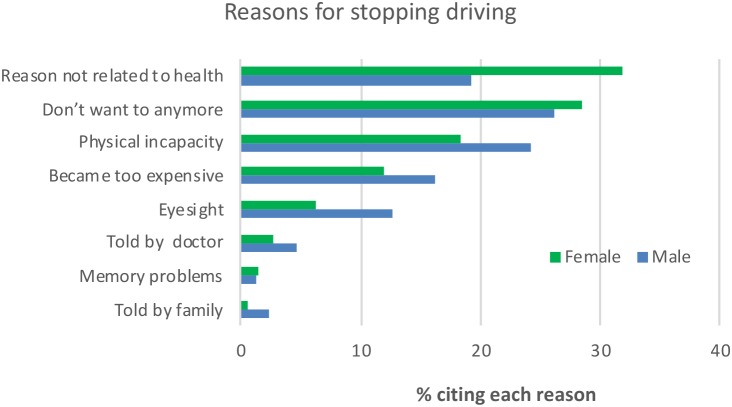
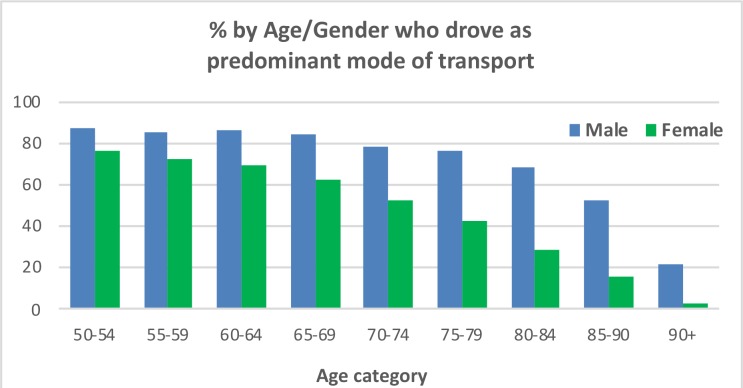
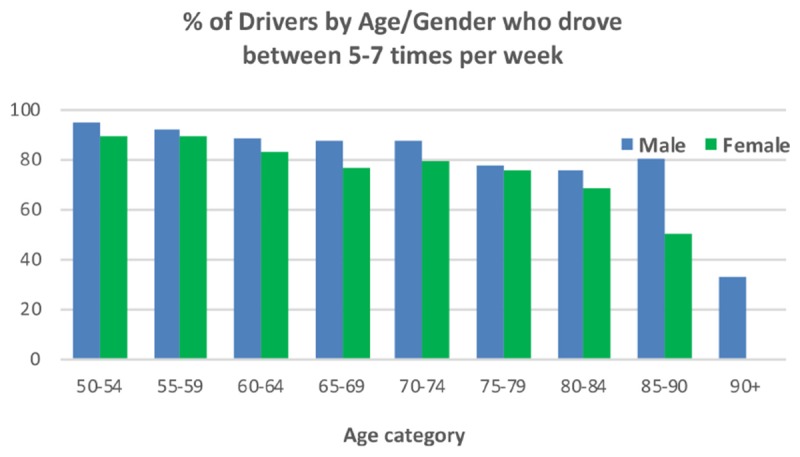
The role of transport in the health and wellbeing of older people is increasingly recognized: driving is the main form of personal transportation across the adult life-span. Patterns of changed mobility and driving cessation are an important focus of research. We investigated cross-sectional changes in driving as the main form of transportation and the frequency of such driving. The impact of Gender and Marital Status on Driver Status was also examined along with the reasons cited for ceasing driving. The impact that Driver Status had on Quality of Life and Loneliness was also assessed. Questionnaire based data from the Irish longitudinal study on aging (TILDA), a stratified clustered sample of 8163 individuals representative of the community dwelling population aged 50 years and over between 2009 and 2011 were examined. Driving oneself was identified by 76.1% as their most frequently used form of transport. Only for 80+ participants in Rural and Urban non-Dublin was it the second most popular option, being replaced by Being driven by someone else. Less women identified Driving oneself as their most frequently used option and they experienced an almost linear decline in uptake with Age. The uptake reported by men remained high up to 69 and only after this point did it begin to decline. A greater proportion of men were Current drivers with a similar pattern being shown by women in relation to Never drivers. Irrespective of Gender, married participants were more likely to drive. A greater proportion of women cited a reason other than health for giving up driving. Three reasons for giving up were impacted by Age category of which Physical incapacity was not one. Driving status impacted positively on Quality of Life and Loneliness. The results are discussed in light of the advantages to society of older drivers continuing to drive.
在整个成年期,驾车是个人交通的主要形式。出行方式的变化和停止驾车是研究的一个重要焦点。我们调查了作为主要交通方式的驾车情况的横断面变化以及此类驾车的频率。还研究了性别和婚姻状况对驾驶状态的影响以及停止驾车的原因。同时评估了驾驶状态对生活质量和孤独感的影响。我们分析了来自爱尔兰老龄化纵向研究(TILDA)基于问卷的数据,该研究是2009年至2011年间对8163名年龄在50岁及以上的社区居住人口的分层整群抽样。76.1%的人将自己驾车视为最常用的交通方式。只有在农村和都柏林以外城市地区80岁及以上的参与者中,它才是第二受欢迎的选择,被他人驾车取代。较少女性将自己驾车视为最常用的选择,并且随着年龄增长,她们选择自己驾车的比例几乎呈线性下降。男性报告的自己驾车比例在69岁之前一直很高,只有在这之后才开始下降。更大比例的男性是当前驾驶者,女性在从不驾驶者方面也呈现出类似模式。无论性别如何,已婚参与者更有可能驾车。更大比例的女性给出了除健康之外放弃驾车的理由。放弃驾车的三个原因受到年龄组别的影响,其中身体无能力并非原因之一。驾驶状态对生活质量和孤独感有积极影响。我们根据老年驾驶者继续驾车对社会的益处来讨论这些结果。