Su Qiang, Zhu Emily C, Qu Yao-Long, Wang Di-Ya, Qu Wei-Wei, Zhang Chen-Guang, Wu Ting, Gao Zu-Hua
Department of Oncology, Beijing Friendship Hospital, Capital Medical University, Beijing, 100050, China.
Desautels Faculty of Management, McGill University, Montreal, Quebec, H3A 1G5, Canada.
J Cancer. 2018 Oct 11;9(21):3991-3999. doi: 10.7150/jca.27697. eCollection 2018.
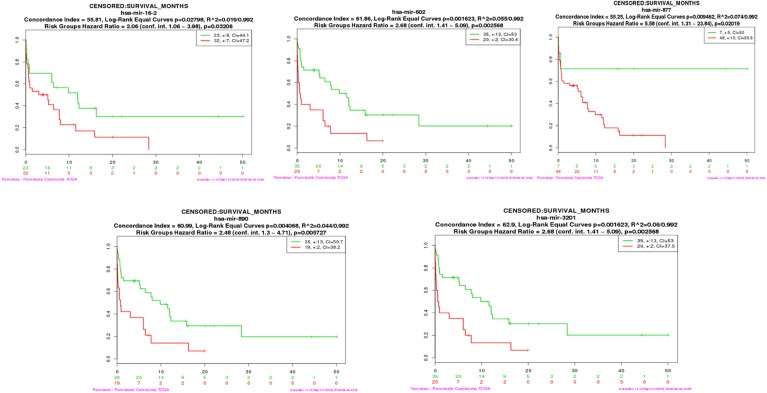
Sensitive and specific non-invasive biomarkers are urgently needed in order to improve the survival of patients with pancreatic ductal adenocarcinoma (PDAC), which is the fourth leading cause of cancer-related death. We aim to identify serum hub miRNAs as potential diagnostic and prognostic biomarkers for PDAC. A total of 2578 serum miRNA expression data from 88 PDAC patients and 19 healthy subjects were downloaded from the Gene Expression Omnibus database. Weighted gene co-expression network analysis (WGCNA) was constructed and significant modules were extracted from the network by WGCNA R package. Network modules and hub miRNAs closely related to PDAC were identified. The prognostic value of hub miRNAs was assessed by Kaplan-Meier overall survival analysis. Two modules strongly associated with PDAC were identified by WGCNA, which were labeled as turquoise and brown respectively. Within each module, twenty hub miRNAs were found. At the functional level, turquoise module was mainly associated with tumorigenesis pathways such as P53 and WNT signaling pathway, while the brown module was mostly related to the pathways of cancer such as RNA transport and MAPK signaling pathway. Utilizing overall survival analyses, five "real" miRNAs were able to stratify PDAC patients into low-risk and high-risk groups. The association of specific Hub miRNAs with the development of pancreatic cancer was established by WGCNA analysis. Five miRNAs (mir-16-2-3p, mir-890, mir-3201, mir-602, and mir-877) were identified as potential diagnostic and prognostic biomarkers for PDAC.
为了提高胰腺导管腺癌(PDAC)患者的生存率,迫切需要敏感且特异的非侵入性生物标志物,PDAC是癌症相关死亡的第四大主要原因。我们旨在鉴定血清核心微小RNA(miRNA)作为PDAC潜在的诊断和预后生物标志物。从基因表达综合数据库下载了88例PDAC患者和19名健康受试者的总共2578个血清miRNA表达数据。构建加权基因共表达网络分析(WGCNA),并通过WGCNA R包从网络中提取显著模块。鉴定了与PDAC密切相关的网络模块和核心miRNA。通过Kaplan-Meier总生存分析评估核心miRNA的预后价值。WGCNA鉴定出两个与PDAC强烈相关的模块,分别标记为绿松石色和棕色。在每个模块中,发现了20个核心miRNA。在功能水平上,绿松石色模块主要与P53和WNT信号通路等肿瘤发生途径相关,而棕色模块大多与RNA转运和MAPK信号通路等癌症途径相关。利用总生存分析,5个“真正的”miRNA能够将PDAC患者分为低风险和高风险组。通过WGCNA分析确定了特定核心miRNA与胰腺癌发生的关联。5个miRNA(mir-16-2-3p、mir-890、mir-3201、mir-602和mir-877)被鉴定为PDAC潜在的诊断和预后生物标志物。