Tan Rachel, Cvetkovski Biljana, Kritikos Vicky, Yan Kwok, Price David, Smith Peter, Bosnic-Anticevich Sinthia
Quality Use of Respiratory Medicines Group, Woolcock Institute of Medical Research, University of Sydney. Sydney (Australia).
Quality Use of Respiratory Medicines Group, Woolcock Institute of Medical Research, University of Sydney. Sydney, NSW (Australia).
Pharm Pract (Granada). 2018 Jul-Sep;16(3):1332. doi: 10.18549/PharmPract.2018.03.1332. Epub 2018 Sep 26.
Community pharmacists have a key role to play in the management of allergic rhinitis (AR). Their role is especially important because the majority of medications used to treat AR are available for purchase over-the-counter (OTC), allowing patients to self-select their own medications and bypass the pharmacists. Patients' self-selection often results in suboptimal treatment selection, undertreated AR and poor clinical outcomes. In order for pharmacists to optimise the care for AR patients in the pharmacy, pharmacists need to be able to identify patient cohorts who self-select and are at high risk of mismanagement.
This study aimed to compare the demographics, clinical characteristics and medication selected, between pharmacy customers who choose to self-select and those who speak with a pharmacist when purchasing medication for their AR in a community pharmacy and identify factors associated with AR patients' medication(s) self-selection behaviour.
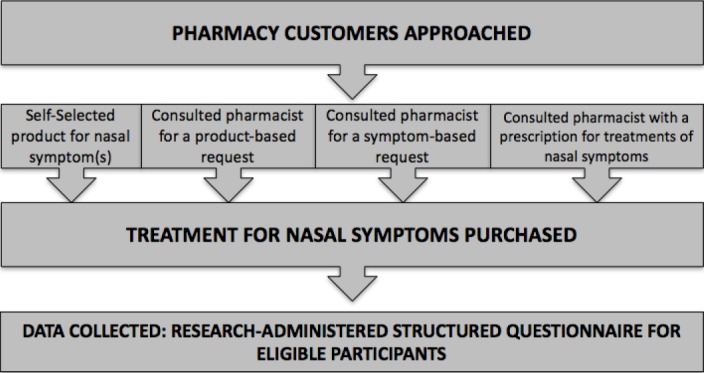
A cross-sectional observational study was conducted in a convenience sample of community pharmacies from the Sydney metropolitan area. Demographics, pattern of AR symptoms, their impact on quality of life (QOL) and medication(s) selected, were collected. Logistic regressions were used to identify factors associated with participants' medication self-selection behaviour.
Of the 296 recruited participants, 202 were identified with AR; 67.8% were female, 54.5% were >40 years of age, 64.9% had a doctor's diagnosis of AR, and 69.3% self-selected medication(s). Participants with AR who self-select were 4 times more likely to experience moderate-severe wheeze (OR 4.047, 95% CI 1.155-14.188) and almost 0.4 times less likely to experience an impact of AR symptoms on their QOL (OR 0.369, 95% CI 0.188-0.727).
The factors associated with AR patients' self-selecting medication(s) are the presence of wheeze and the absence of impact on their QOL due to AR symptoms. By identifying this cohort of patients, our study highlights an opportunity for pharmacists to engage these patients and encourage discussion about their AR and asthma management.
社区药剂师在过敏性鼻炎(AR)的管理中发挥着关键作用。他们的作用尤为重要,因为大多数用于治疗AR的药物都可以非处方(OTC)购买,这使得患者能够自行选择药物,而绕过药剂师。患者的自行选择往往导致治疗选择不佳、AR治疗不足以及临床效果不佳。为了使药剂师在药房中优化对AR患者的护理,药剂师需要能够识别自行选择且管理不当风险高的患者群体。
本研究旨在比较在社区药房为AR购买药物时选择自行选择的药房顾客与与药剂师交谈的顾客之间的人口统计学、临床特征和所选药物,并确定与AR患者药物自行选择行为相关的因素。
在悉尼大都市地区的社区药房便利样本中进行了一项横断面观察研究。收集了人口统计学、AR症状模式、其对生活质量(QOL)的影响以及所选药物。使用逻辑回归来确定与参与者药物自行选择行为相关的因素。
在招募的296名参与者中,202名被确定患有AR;67.8%为女性,54.5%年龄大于40岁,64.9%有医生诊断的AR,69.3%自行选择药物。自行选择的AR参与者出现中度至重度喘息的可能性高4倍(OR 4.047,95%CI 1.155 - 14.188),AR症状对其QOL产生影响的可能性低近0.4倍(OR 0.369,95%CI 0.188 - 0.727)。
与AR患者自行选择药物相关的因素是喘息的存在以及AR症状对其QOL没有影响。通过识别这一患者群体,我们的研究突出了药剂师接触这些患者并鼓励讨论其AR和哮喘管理的机会。