Gonçalo Moniz Institute, Oswaldo Cruz Foundation, Salvador, Brazil.
School of Nursing, State University of Bahia, Salvador, Brazil.
PLoS One. 2018 Nov 12;13(11):e0206726. doi: 10.1371/journal.pone.0206726. eCollection 2018.
The World Health Organization has recommended the introduction of HPV vaccines into national immunization programme (NIP), but vaccination coverage remains low worldwide. We assessed the coverage and the parental acceptance of female and male HPV vaccination in Brazil after its introduction into the NIP.
We conducted a random-digit-dial survey of parents in seven major Brazilian cities from July-2015 to October-2016. A knowledge, attitude and practices questionnaire was developed and validated by expert analysis, semantic analysis, and pre-testing.
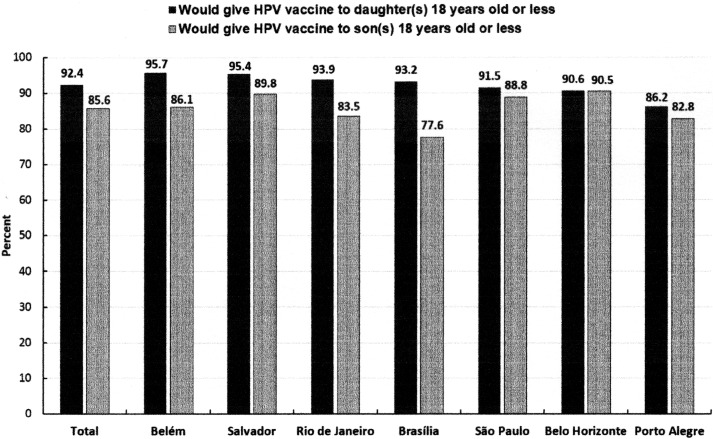
826 out of 2,324 (35.5%) eligible parents completed the interview. Parental acceptance of the HPV vaccine for daughters and sons 18 years of age or less was high (92% and 86%, respectively). Parents refusing vaccination were less likely to know that: HPV is sexually transmitted and causes genital warts, HPV vaccination is more beneficial before sexual debut, and HPV vaccine reactions are minor, and they were more likely to believe HPV vaccination can cause severe adverse events. Parents accepting HPV vaccine for daughters but not forsons were more likely to ignore that the vaccine is recommended for boys. Attitudes associated with HPV vaccine acceptance included: general belief in vaccines, trust in the NIP and in the HPV vaccine efficacy. Among girls eligible for HPV vaccination through the NIP, 58.4% had received a two-dose scheme and 71.1% at least one dose. "No vaccination/missed vaccination at school" was the most common reason for missed HPV vaccination in theNIP.
One year after introduction in the NIP, most parents surveyed in Brazil accepted HPV vaccination for their daughters and sons. Low coverage in the NIP seemed to be due to challenges in adolescent vaccine delivery and HPV vaccination barriers at health-care centers, rather than to vaccine refusal.
世界卫生组织建议将 HPV 疫苗纳入国家免疫规划(NIP),但全球疫苗接种覆盖率仍然较低。本研究评估了巴西引入 HPV 疫苗后 NIP 对女性和男性 HPV 疫苗的接种率和家长接受度。
我们于 2015 年 7 月至 2016 年 10 月在巴西七个主要城市进行了一项随机数字拨号调查,调查对象为父母。通过专家分析、语义分析和预测试,开发并验证了一份知识、态度和实践问卷。
在 2324 名符合条件的父母中,有 826 名(35.5%)完成了访谈。家长对接种女儿和 18 岁以下儿子 HPV 疫苗的接受程度很高(分别为 92%和 86%)。拒绝接种疫苗的父母不太可能知道 HPV 是通过性传播的,会导致生殖器疣;HPV 疫苗在有性行为之前接种效果更好;HPV 疫苗反应较小;更有可能认为 HPV 疫苗接种会引起严重不良反应。家长同意为女儿接种 HPV 疫苗但不同意为儿子接种的原因可能是他们忽略了 HPV 疫苗也推荐用于男孩。与 HPV 疫苗接种接受度相关的态度包括:对疫苗的普遍信任、对 NIP 和 HPV 疫苗有效性的信任。在符合 NIP 接种条件的女孩中,58.4%已接种两剂方案,71.1%至少接种了一剂。在 NIP 中,“未接种/学校漏种”是 HPV 疫苗漏种的最常见原因。
在 NIP 引入一年后,巴西调查的大多数家长都接受了为女儿和儿子接种 HPV 疫苗。NIP 中接种率低可能是由于青少年疫苗接种实施困难和卫生保健中心 HPV 疫苗接种障碍,而不是疫苗拒绝。