Bureau of Nutritional Sciences, Food Directorate, Health Products and Food Branch, Health Canada, Ottawa, ON K1A 0K9, Canada.
Department of Food Science and Technology, University of Nebraska-Lincoln, Lincoln, NE 68588-6205, USA.
Nutrients. 2018 Nov 12;10(11):1738. doi: 10.3390/nu10111738.
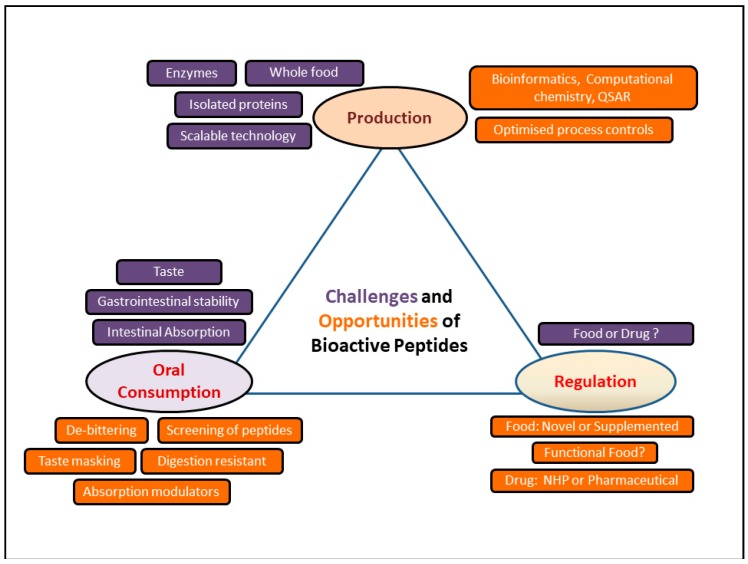
Recent scientific evidence suggests that food proteins not only serve as nutrients, but can also modulate the body's physiological functions. These physiological functions are primarily regulated by some peptides that are encrypted in the native protein sequences. These bioactive peptides can exert health beneficial properties and thus are considered as a lead compound for the development of nutraceuticals or functional foods. In the past few decades, a wide range of food-derived bioactive peptide sequences have been identified, with multiple health beneficial activities. However, the commercial application of these bioactive peptides has been delayed because of the absence of appropriate and scalable production methods, proper exploration of the mechanisms of action, high gastro-intestinal digestibility, variable absorption rate, and the lack of well-designed clinical trials to provide the substantial evidence for potential health claims. This review article discusses the current techniques, challenges of the current bioactive peptide production techniques, the oral use and gastrointestinal bioavailability of these food-derived bioactive peptides, and the overall regulatory environment.
最近的科学证据表明,食物蛋白质不仅是营养物质,还可以调节身体的生理功能。这些生理功能主要是由天然蛋白质序列中加密的一些肽来调节的。这些生物活性肽具有有益健康的特性,因此被认为是开发营养保健品或功能性食品的先导化合物。在过去的几十年中,已经鉴定出了广泛的源自食物的生物活性肽序列,具有多种有益健康的活性。然而,由于缺乏适当和可扩展的生产方法、对作用机制的适当探索、高胃肠道消化率、可变吸收率,以及缺乏精心设计的临床试验来为潜在的健康声称提供实质性证据,这些生物活性肽的商业应用一直受到阻碍。本文综述了当前的技术、当前生物活性肽生产技术的挑战、这些源自食物的生物活性肽的口服使用和胃肠道生物利用度,以及整体监管环境。