Department of Pharmacy, University of Napoli Federico II, Via D. Montesano, 49 -, 80131, Naples, Italy.
AIFA - Agenzia Italiana del Farmaco, Via del Tritone, 181 -, 00187, Rome, Italy.
Br J Clin Pharmacol. 2018 Apr;84(4):659-672. doi: 10.1111/bcp.13496. Epub 2018 Feb 14.
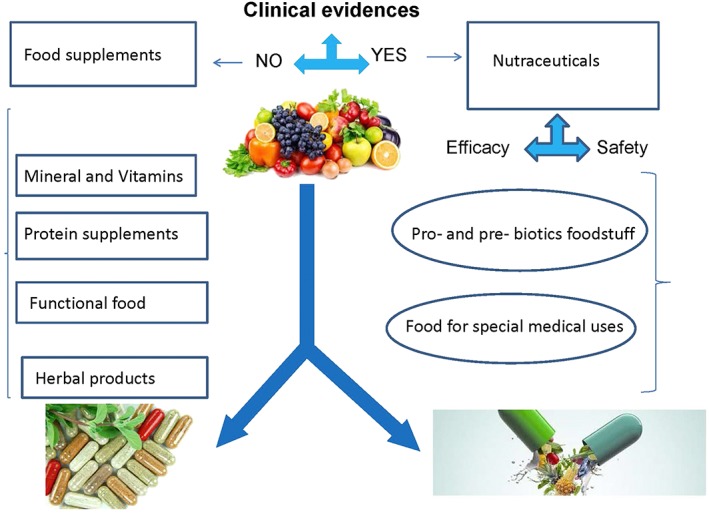
Currently, nutraceuticals do not have a specific definition distinct from those of other food-derived categories, such as food supplements, herbal products, pre- and probiotics, functional foods, and fortified foods. Many studies have led to an understanding of the potential mechanisms of action of pharmaceutically active components contained in food that may improve health and reduce the risk of pathological conditions while enhancing overall well-being. Nevertheless, there is a lack of clear information and, often, the claimed health benefits may not be properly substantiated by safety and efficacy information or in vitro and in vivo data, which can induce false expectations and miss the target for a product to be effective, as claimed. An officially shared and accepted definition of nutraceuticals is still missing, as nutraceuticals are mostly referred to as pharma-foods, a powerful toolbox to be used beyond the diet but before the drugs to prevent and treat pathological conditions, such as in subjects who may not yet be eligible for conventional pharmaceutical therapy. Hence, it is of utmost importance to have a proper and unequivocal definition of nutraceuticals and shared regulations. It also seems wise to assess the safety, mechanism of action and efficacy of nutraceuticals with clinical data. A growing demand exists for nutraceuticals, which seem to reside in the grey area between pharmaceuticals and food. Nonetheless, given specific legislation from different countries, nutraceuticals are experiencing challenges with safety and health claim substantiation.
目前,营养保健品与其他源自食品的类别(如食品补充剂、草药产品、益生菌和益生元、功能性食品和强化食品)之间没有明确的定义区别。许多研究已经了解了食物中含有的具有药用活性成分的潜在作用机制,这些成分可能改善健康状况,降低患病风险,同时提高整体幸福感。然而,目前缺乏明确的信息,而且常常是声称的健康益处可能没有得到安全性和有效性信息或体外和体内数据的适当证实,这可能会产生虚假的期望,使产品无法达到预期的效果。由于营养保健品大多被称为药食同源,是一种在药物之前用于预防和治疗疾病的强大工具,如在可能尚未符合传统药物治疗标准的人群中,因此,营养保健品仍然缺乏官方认可的、公认的定义,以及相关的共享法规。因此,对营养保健品进行明确、统一的定义和相关规定显得尤为重要。用临床数据评估营养保健品的安全性、作用机制和疗效似乎也是明智的。人们对营养保健品的需求不断增长,它们似乎介于药品和食品之间的灰色地带。尽管如此,由于不同国家的具体法规,营养保健品在安全性和健康声称方面仍面临挑战。