Frías-Osuna Antonio, Moreno-Cámara Sara, Moral-Fernández Lourdes, Palomino-Moral Pedro Ángel, López-Martínez Catalina, Del-Pino-Casado Rafael
Departamento de Enfermería, Facultad de Ciencias de la Salud, Universidad de Jaén, Jaén, España.
Departamento de Enfermería, Facultad de Ciencias de la Salud, Universidad de Jaén, Jaén, España.
Aten Primaria. 2019 Dec;51(10):637-644. doi: 10.1016/j.aprim.2018.06.010. Epub 2018 Nov 10.
To identify and analyze the motives that lead people to take care of a dependent relative and their perceptions of the care situation.
Phenomenological qualitative study.
The study was conducted in the Jaén-Norte Sanitary District, during 2013 and 2014.
A total of 13 primary caregivers of dependent elderly relatives with a minimum experience of one year in care participated, selected by intentional sampling.
Discourse analysis of 13 in-depth interviews considering the semantic and pragmatic content and field notes. Triangulation was performed in the analysis to favor the credibility of the study.
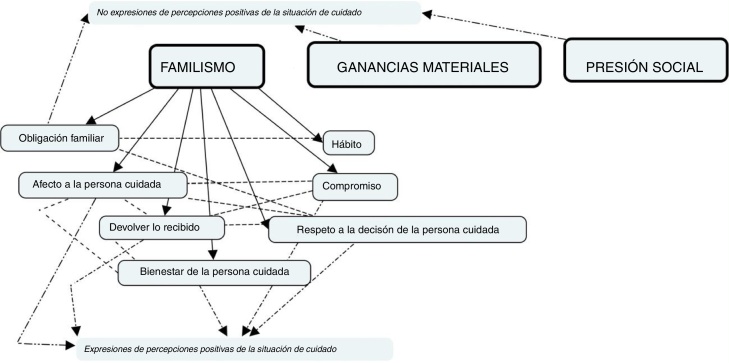
The motives for caring for a dependent relative are:'Familism','Material gains' and'Social pressure'. In turn, the'Familism' include 7 dimensions/motives:'Family obligation','Affection to the person taken care of','Return the received','Well-being of the person taken care of','Respect to the decision of the person taken care of','Agreement','Habit'. When the main motive to take care of is the'Family obligation', the'Material gains' or the'Social pressure' caregivers do not manifest positive perceptions for caring, and vice versa.
This study has identified that'Familism','Material gains' and'Social pressure' are reasons why people care for a dependent relative in our sociocultural environment, as well as the relationship with the perception of the care situation. This will facilitate the identification of caregivers with greater predisposition to suffer negative consequences for caring and the development of interventions aimed at the prevention of such consequences.
识别并分析促使人们照顾受抚养亲属的动机以及他们对护理情况的看法。
现象学定性研究。
该研究于2013年至2014年在哈恩-北卫生区进行。
通过立意抽样选取了13名主要照顾受抚养老年亲属的人,他们至少有一年的护理经验。
对13次深度访谈进行话语分析,考虑语义和语用内容以及实地记录。分析过程中采用了三角互证法以提高研究的可信度。
照顾受抚养亲属的动机有:“家庭主义”、“物质利益”和 “社会压力”。其中,“家庭主义”包括7个维度/动机:“家庭义务”、“对被照顾者的感情”、“回报所获”、“被照顾者的幸福”、“尊重被照顾者的决定”、“认同”、“习惯”。当照顾的主要动机是“家庭义务”、“物质利益”或“社会压力”时,照顾者对护理没有积极的看法,反之亦然。
本研究确定,在我们的社会文化环境中,“家庭主义”、“物质利益”和“社会压力”是人们照顾受抚养亲属的原因,以及它们与对护理情况看法的关系。这将有助于识别更易因护理而遭受负面后果的照顾者,并有助于制定旨在预防此类后果的干预措施。