Dornquast Christina, Willich Stefan N, Reinhold Thomas
Institute for Social Medicine, Epidemiology and Health Economics, Charité - Universitätsmedizin, Berlin, Germany.
Front Cardiovasc Med. 2018 Oct 30;5:158. doi: 10.3389/fcvm.2018.00158. eCollection 2018.
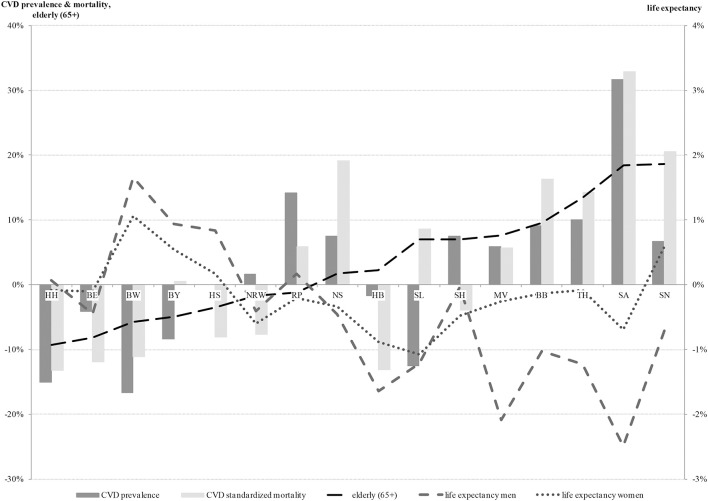
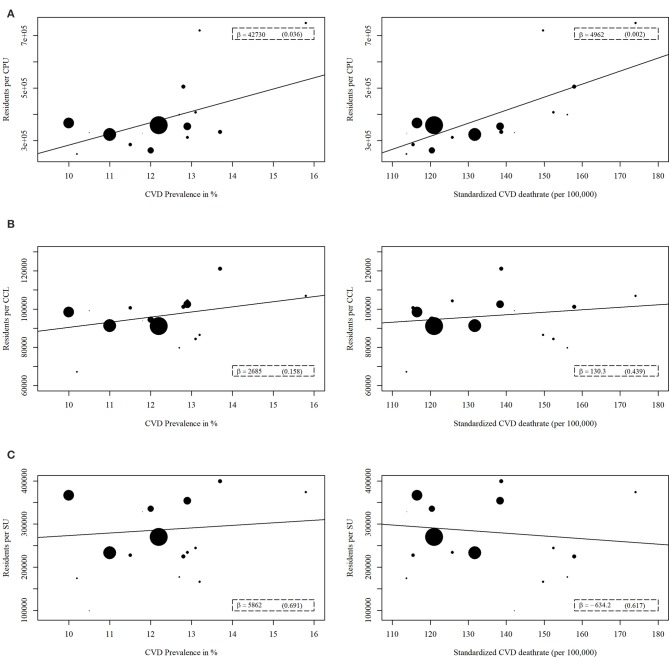
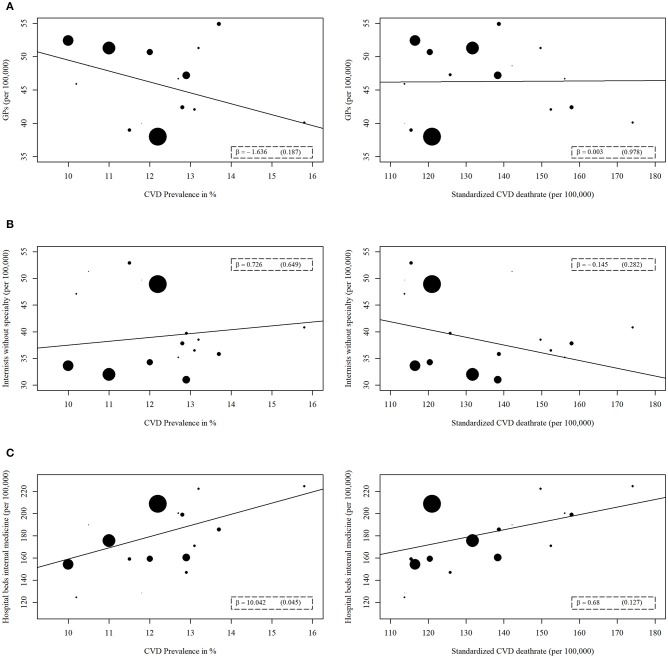
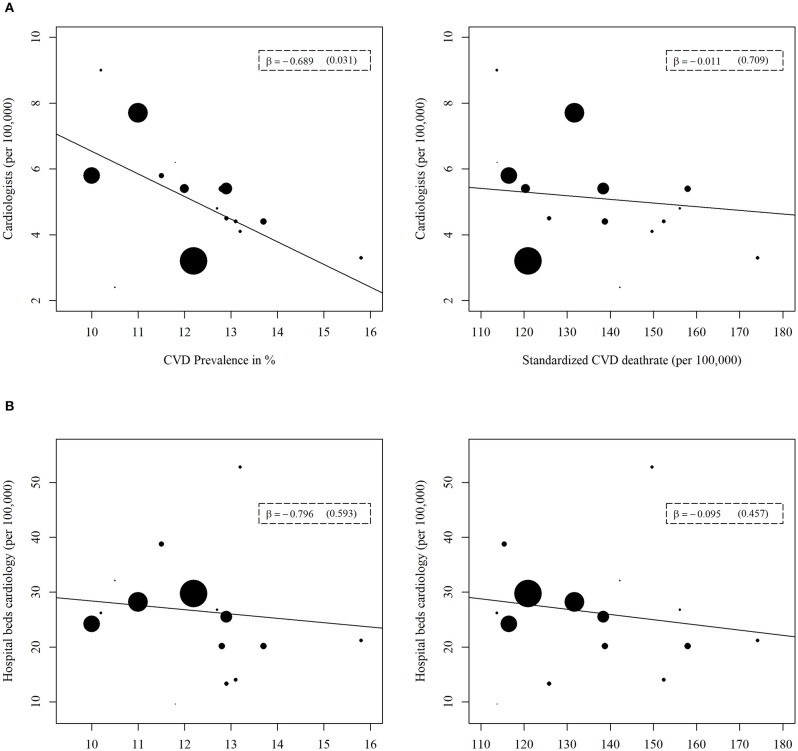
There are regional differences in the morbidity of major cardiovascular disease between the 16 federal states of Germany. An association between the morbidity and the health care supply has been described in international studies. The aim of the present analysis was to examine the relationship between the prevalence or mortality of major cardiovascular disease and several key indicators of health care supply in Germany. Life expectancy and the proportion of over 65-year old persons were included as characteristics to depict the general health. Indicators of health care supply were the number of general practitioners, internists, and cardiologists, number of internal medicine and cardiology beds, chest pain units (CPU), cardiac catheterization laboratories (CCL) and stroke units. In the form of an ecological analysis, we compared the cardiovascular disease prevalence and mortality with these indicators and performed a weighted linear regression. Regional variations between the federal states were found in general health and health care supply. The regression analysis yielded significant associations of the prevalence of major cardiovascular disease with the number of internal medicine hospital beds (β = 10.042, = 0.045), cardiologists (β = -0.689, = 0.031), and the number of residents per chest pain unit (β = 42,730, = 0.036). Additionally, the relationship between cardiovascular mortality and also the number of residents per chest pain unit appeared to be significant (β = 4,962, = 0.002). For all other indicators, no significant association was observed. We detected regional differences in the general health and health care supply between the 16 German federal states as well as several significant associations between cardiovascular morbidity and health care supply indicators. Especially the decreasing number of cardiologists and rising number of residents per chest pain unit with an increasing prevalence of major cardiovascular disease should lead to a discussion about the structure of the Germany health care system, such as the needs-based planning mechanism of physicians. The results of this study may also aid in future development of other health care systems.
德国16个联邦州之间主要心血管疾病的发病率存在地区差异。国际研究中描述了发病率与医疗保健供应之间的关联。本分析的目的是研究德国主要心血管疾病的患病率或死亡率与医疗保健供应的几个关键指标之间的关系。将预期寿命和65岁以上人口的比例作为描述总体健康状况的特征纳入分析。医疗保健供应指标包括全科医生、内科医生和心脏病专家的数量,内科和心脏病床位数量,胸痛单元(CPU)、心脏导管实验室(CCL)和卒中单元的数量。我们以生态分析的形式,将心血管疾病的患病率和死亡率与这些指标进行比较,并进行加权线性回归。在总体健康状况和医疗保健供应方面发现了联邦州之间的地区差异。回归分析得出,主要心血管疾病的患病率与内科医院床位数(β = 10.042,P = 0.045)、心脏病专家数量(β = -0.689,P = 0.031)以及每个胸痛单元的居民数量(β = 42,730,P = 0.036)之间存在显著关联。此外,心血管疾病死亡率与每个胸痛单元的居民数量之间的关系似乎也很显著(β = 4,962,P = 0.002)。对于所有其他指标,未观察到显著关联。我们发现德国16个联邦州在总体健康状况和医疗保健供应方面存在地区差异,以及心血管疾病发病率与医疗保健供应指标之间的几个显著关联。特别是随着主要心血管疾病患病率的增加,心脏病专家数量减少,每个胸痛单元的居民数量增加,这应该引发对德国医疗保健系统结构的讨论,例如基于需求的医生规划机制。本研究结果也可能有助于其他医疗保健系统的未来发展。