Department of Internal Medicine B, University Medicine Greifswald, Ferdinand-Sauerbruch-Straße, Greifswald, Germany.
DZHK (German Centre for Cardiovascular Research), partner site Greifswald, Greifswald, Germany.
ESC Heart Fail. 2021 Aug;8(4):2546-2555. doi: 10.1002/ehf2.13407. Epub 2021 May 4.
Heart failure (HF) is the most common primary inpatient diagnosis in Germany. We examined temporal trends of HF hospitalization within Germany focusing on regional differences.
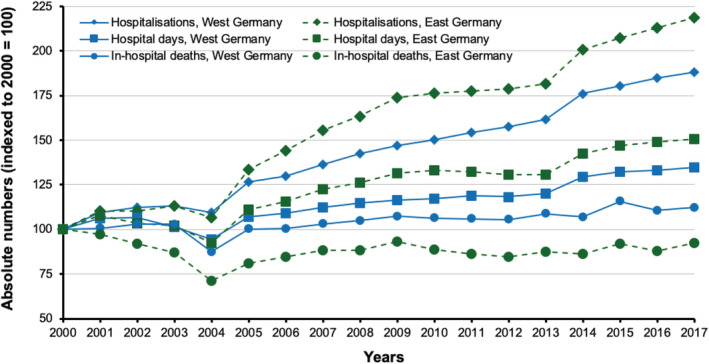
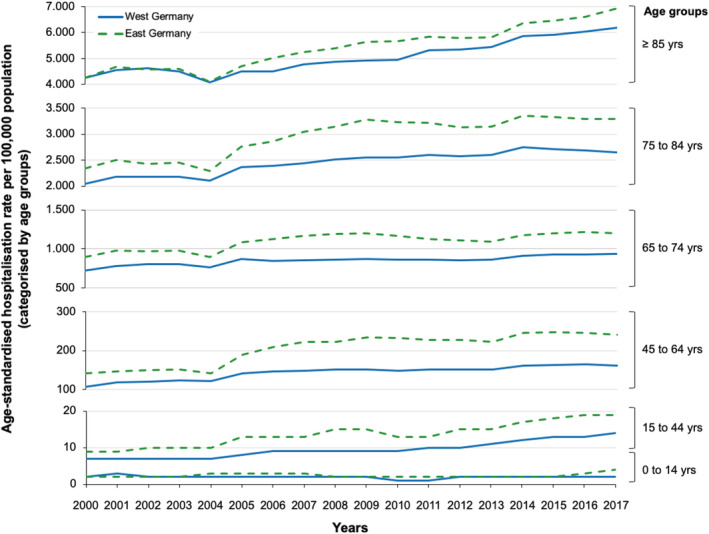
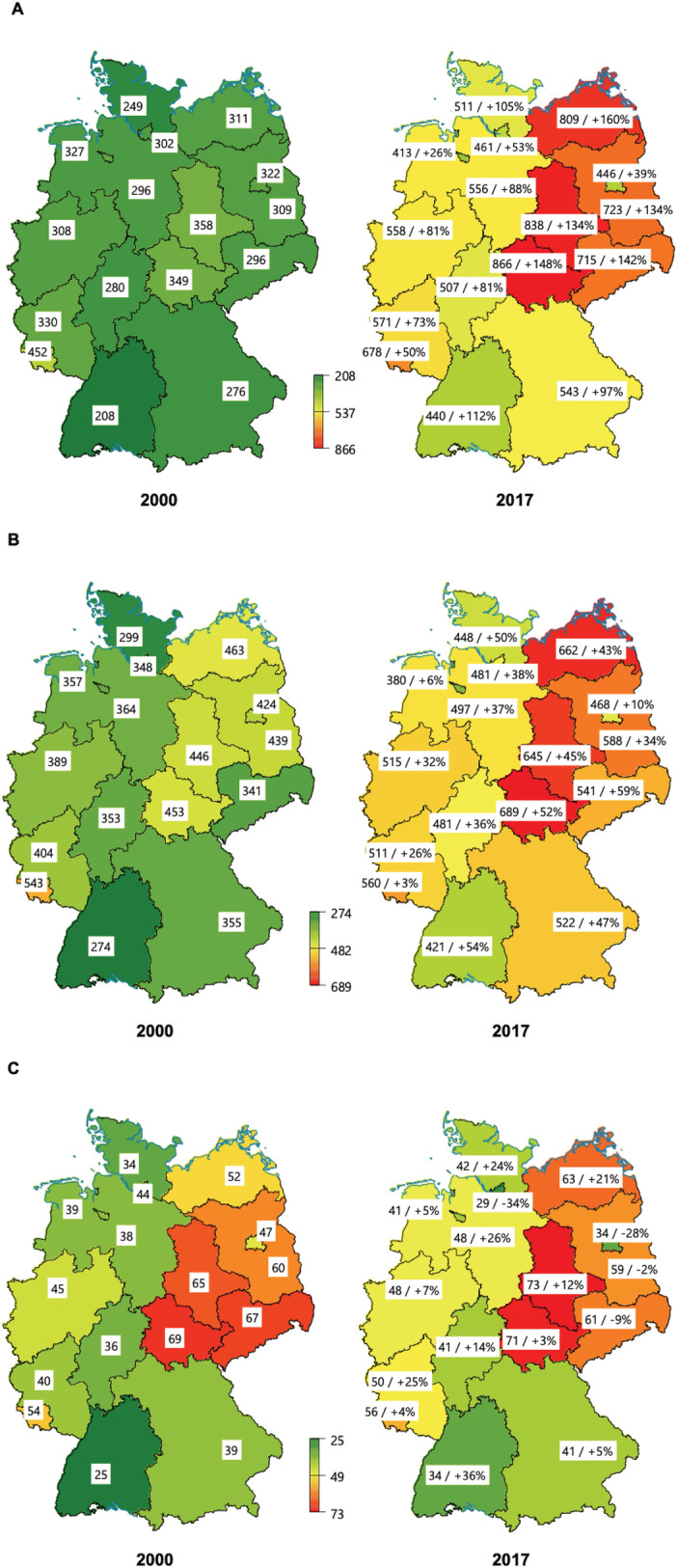
We analysed aggregated data of more than 320 million hospitalizations in Germany from 2000 to 2017. Temporal trends of HF-related parameters were analysed, focusing on regional differences between the federal states. The absolute number of HF-related hospitalizations throughout Germany increased continuously and almost doubled (from 239 694 to 464 724 cases, +94%) with the relative increase being higher in East Germany compared with West Germany (119% vs. 88%). These regional differences persisted after age standardization with 609 and 490 cases per 100 000 population, respectively. The length of stay decreased continuously across Germany (from 14.3 to 10.2 days; -29%), while the total number of HF-related hospital days increased by 51% in East Germany and 35% in West Germany. In 2017, HF remained the leading cause of in-hospital death (8.9% of all cases), with a markedly higher rate in East vs. West Germany (65 vs. 43 deaths per 100 000 population).
Heart failure remains the most common cause of hospitalization and in-hospital death throughout Germany. The increase in HF-related morbidity and mortality was much higher in East Germany compared with West Germany during the observation period. A more detailed understanding of these striking disparities 30 years after the German reunification requires further investigations. There is an urgent need for action with regard to stronger control of risk factors and improvement of both chronic HF management and healthcare structures.
心力衰竭(HF)是德国最常见的主要住院诊断。我们研究了德国心力衰竭住院治疗的时间趋势,重点关注区域差异。
我们分析了 2000 年至 2017 年德国超过 3.2 亿例住院治疗的汇总数据。分析了与 HF 相关的参数的时间趋势,重点关注联邦州之间的区域差异。德国全国与 HF 相关的住院治疗绝对数量持续增加,几乎翻了一番(从 239694 例增加到 464724 例,增加了 94%),东德的相对增加高于西德(119%比 88%)。这些区域差异在年龄标准化后仍然存在,分别为每 10 万人中有 609 例和 490 例。德国各地的住院时间持续缩短(从 14.3 天减少到 10.2 天,减少了 29%),而与 HF 相关的住院天数在东德增加了 51%,在西德增加了 35%。2017 年,HF 仍然是住院死亡的主要原因(占所有病例的 8.9%),东德的死亡率明显高于西德(每 10 万人中有 65 例和 43 例死亡)。
心力衰竭仍然是德国最常见的住院和院内死亡原因。在观察期间,东德与 HF 相关的发病率和死亡率的增加明显高于西德。在德国统一 30 年后,需要进一步调查这些惊人差异的更详细情况。需要采取行动,加强危险因素的控制,改善慢性心力衰竭的管理和医疗保健结构。