State key Laboratory of Bioelectronics, Jiangsu Key Laboratory for Biomaterials and Devices, School of Biological Sciences & Medical Engineering, Southeast University, Nanjing, 210096, China.
Collaborative Innovation Center of Suzhou Nano-Science and Technology, Southeast University, Suzhou 215123, China.
Theranostics. 2018 Sep 9;8(18):4870-4883. doi: 10.7150/thno.27466. eCollection 2018.
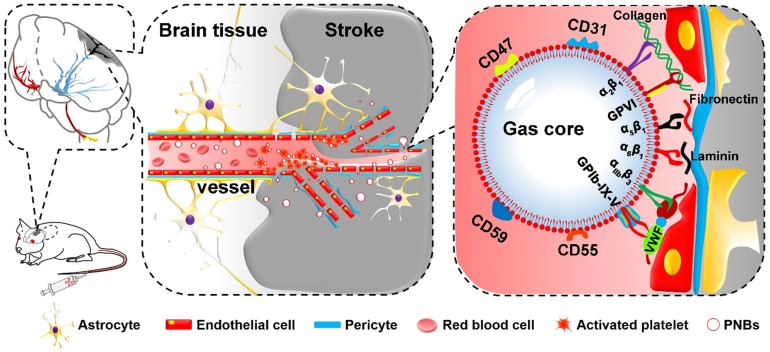
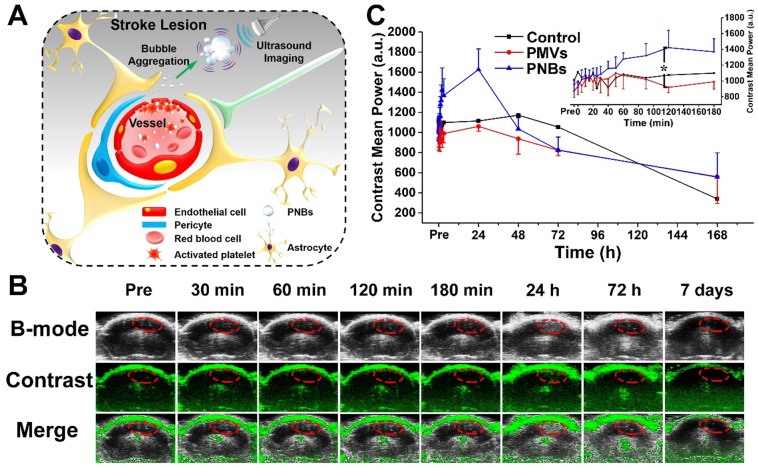
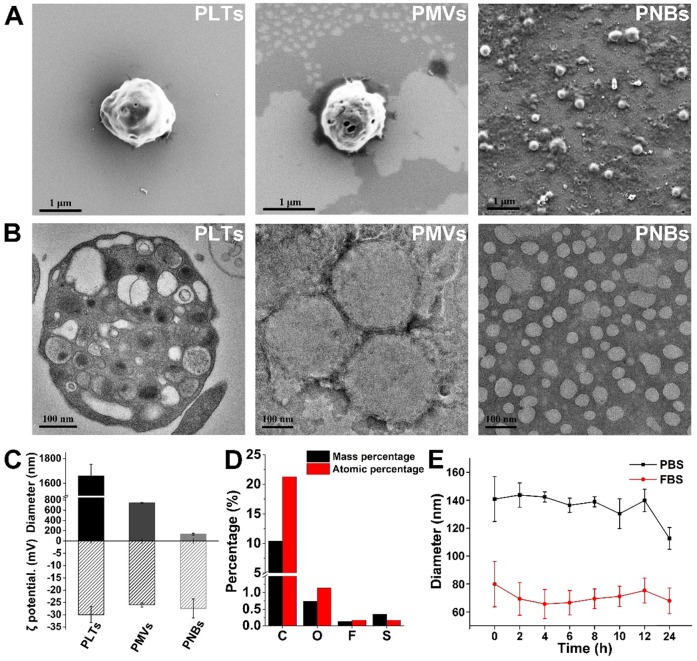
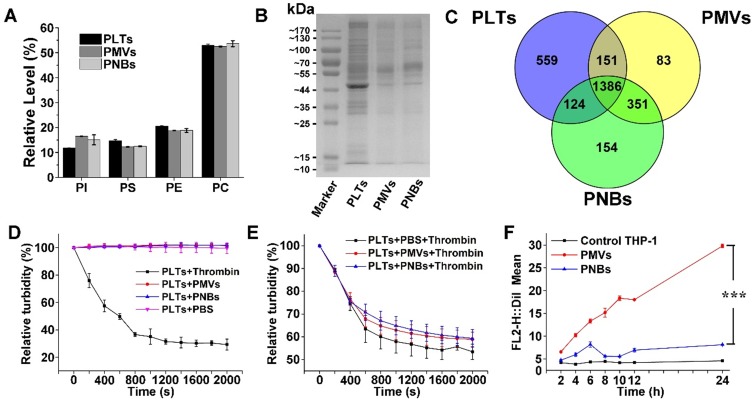
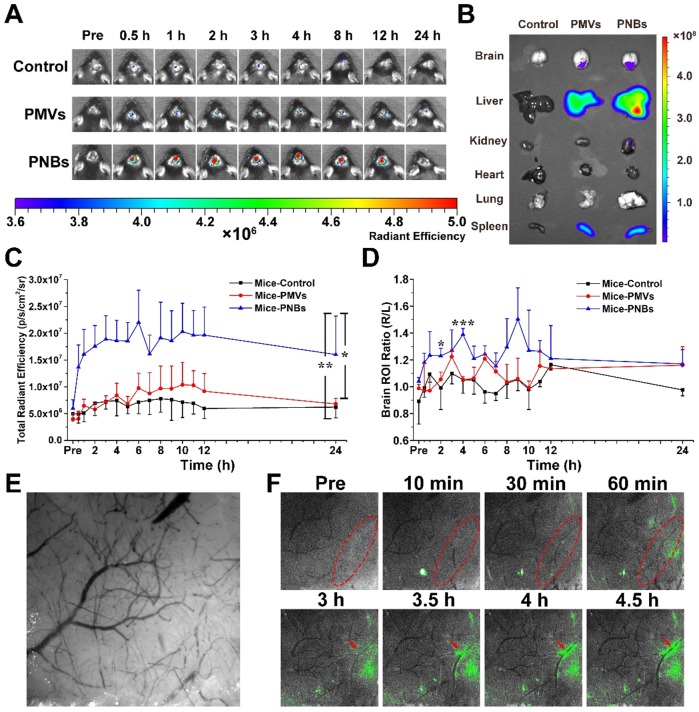
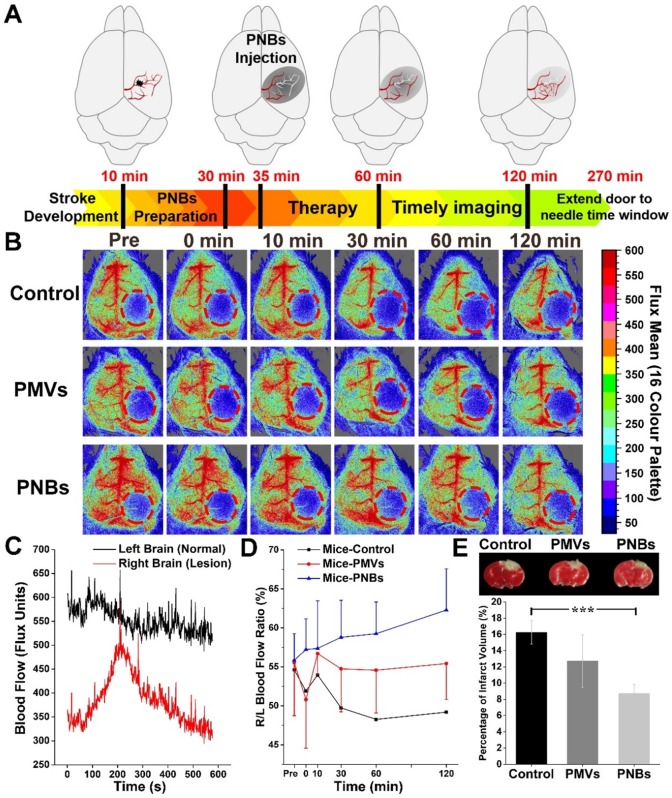
Since the expected therapeutic results of ischemic stroke are strictly time dependent, early and accurate diagnosis as well as short intervals between diagnosis and treatment are key factors for the survival of stroke patients. In this study, we fabricated platelet (PLT) membrane-derived biomimetic nanobubbles (PNBs) for timely perfusion intervention and ultrasound imaging of acute ischemic stroke. The PNBs are fabricated by sonication-assisted reassembly of repeatedly freeze-thawed live platelet-derived PLT membrane vesicles (PMVs). The TEM, SEM, EDS and DLS were used to analyze the morphology and physicochemical properties of PNBs. The HPLC and LC-MS/MS were applied to confirm the lipid and protein compositions of PNBs. The macrophage uptake and platelet aggregation of PNBs were designed to examine the immune escape and thrombotic response characteristics. Furthermore, based on a photothrombotic ischemic stroke mouse model, the biodistribution, stroke microvascular network change, as well as cerebral blood flow of PNBs were studied by using near-infrared fluorescence imaging, multimodal optical imaging, and full-field laser perfusion imager. Finally, we assessed the brain ultrasound imaging of PNBs with a high-resolution micro-imaging system using both B-mode and contrast mode. The natural lipid and protein components isolated from PLT membrane endow the PNBs with accurate lesion-targeting ability. The preferentially accumulated PNBs exhibit microvascular bio-remodeling ability of the stroke lesion, which is critical for recanalization of the obstructed vessels to protect the neural cells around the ischemic region of the stroke. Furthermore, with the increased accumulation of PNBs clusters in the lesion, PNBs in the lesion can be monitored by real-time contrast-enhanced ultrasound imaging to indicate the severity and dynamic development of the stroke. In summary, platelet membrane-based nanobubbles for targeting acute ischemic lesions were developed as microvascular recanalization nanoformulation for acute ischemic stroke lesion theranostics. This biomimetic PNBs theranostic strategy will be valuable for ischemic stroke patients in the future.
由于缺血性中风的预期治疗效果严格依赖于时间,因此早期、准确的诊断以及诊断与治疗之间的短暂间隔是中风患者生存的关键因素。在这项研究中,我们制备了血小板(PLT)膜衍生仿生纳米泡(PNB),用于急性缺血性中风的及时灌注干预和超声成像。PNB 是通过反复冻融活血小板衍生 PLT 膜囊泡(PMV)的超声辅助再组装制备的。TEM、SEM、EDS 和 DLS 用于分析 PNB 的形态和物理化学性质。HPLC 和 LC-MS/MS 用于确认 PNB 的脂质和蛋白质组成。巨噬细胞摄取和 PNB 的血小板聚集被设计用于检查免疫逃逸和血栓反应特性。此外,基于光血栓性缺血性中风小鼠模型,通过近红外荧光成像、多模态光学成像和全场激光灌注成像仪研究了 PNB 的生物分布、中风微血管网络变化以及脑血流。最后,我们使用高分辨率微成像系统通过 B 模式和对比模式评估了 PNB 的脑超声成像。从 PLT 膜中分离出的天然脂质和蛋白质成分赋予 PNB 准确的病变靶向能力。优先积累的 PNB 表现出中风病变的微血管生物重塑能力,这对于阻塞血管的再通以保护中风缺血区域周围的神经细胞至关重要。此外,随着病变中 PNB 团簇的积累增加,病变中的 PNB 可以通过实时对比增强超声成像进行监测,以指示中风的严重程度和动态发展。总之,针对急性缺血性病变的基于血小板膜的纳米泡被开发为急性缺血性中风病变治疗学的微血管再通纳米制剂。这种仿生 PNB 治疗策略对未来的缺血性中风患者将具有重要价值。