Department of Laboratory Medicine, Chonnam National University Medical School & Hospital, Gwangju, Korea.
Department of Laboratory Medicine, Soonchunhyang University Hospital Cheonan, Soonchunhyang University College of Medicine, Cheonan, Korea.
Ann Lab Med. 2019 Mar;39(2):115-120. doi: 10.3343/alm.2019.39.2.115.
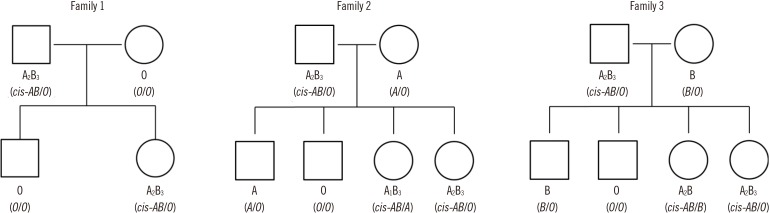
-AB, a rare ABO variant, is caused by a gene mutation that results in a single glycosyltransferase enzyme with dual A and B glycosyltransferase activities. It is the most frequent ABO subgroup in Korea, and it occurs more frequently in the East Asian region than in the rest of the world. The typical phenotype of -AB is A₂B₃, but it can express various phenotypes when paired with an or allele, which can lead to misclassification in the ABO grouping and consequently to adverse hemolytic transfusion reactions. While -AB was first discovered as having an unusual inheritance pattern, it was later found that both A and B antigens are expressed from the same allele inherited from a single parent; hence, the name -AB. Earlier studies relied on serological and familial investigation of -AB subjects, but its detection has become much easier with the introduction of molecular methods. This review will summarize the serological variety, genetic basis and inheritance pattern, laboratory methods of investigation, clinical significance, and the blood type of choice for transfusion for the -AB blood group.
AB 血型是一种罕见的 ABO 血型变异,由基因突变引起,导致单一糖基转移酶具有双重 A 和 B 糖基转移酶活性。它是韩国最常见的 ABO 亚型,在东亚地区比在世界其他地区更为常见。-AB 的典型表型为 A₂B₃,但与 或 等位基因配对时可表达各种表型,这可能导致 ABO 分组的错误分类,并进而导致不良的溶血性输血反应。虽然 -AB 最初被发现具有异常的遗传模式,但后来发现 A 和 B 抗原均由从单亲遗传的同一等位基因表达;因此,称为 -AB。早期的研究依赖于对 -AB 受试者的血清学和家族调查,但随着分子方法的引入,其检测变得更加容易。本综述将总结 -AB 血型的血清学多样性、遗传基础和遗传模式、实验室研究方法、临床意义以及输血选择的血型。