de M Barbosa Raquel, Ribeiro Ligia N M, Casadei Bruna R, da Silva Camila M G, Queiróz Viviane A, Duran Nelson, de Araújo Daniele R, Severino Patrícia, de Paula Eneida
Biochemistry and Tissue Biology Department, Institute of Biology, University of Campinas, Campinas 13083-862, SP, Brazil.
Pharmacy Department, UNINASSAU-Natal College, Natal 59080-400, RN, Brazil.
Pharmaceutics. 2018 Nov 14;10(4):231. doi: 10.3390/pharmaceutics10040231.
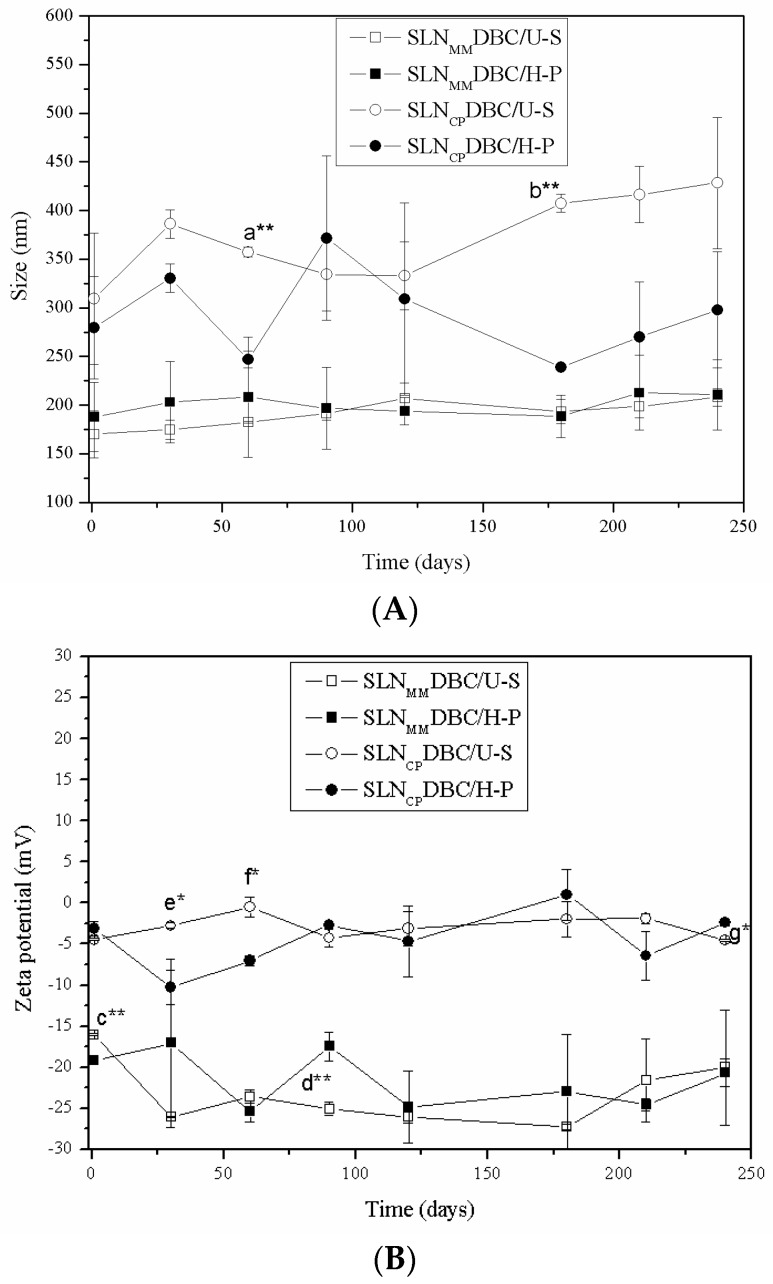
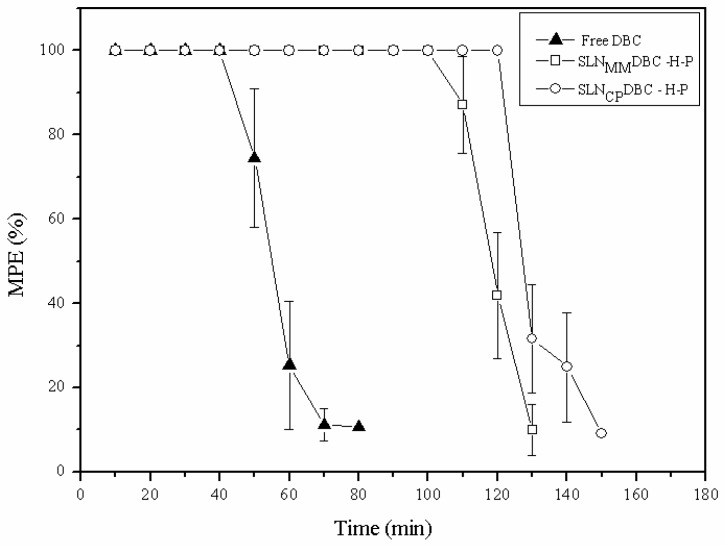
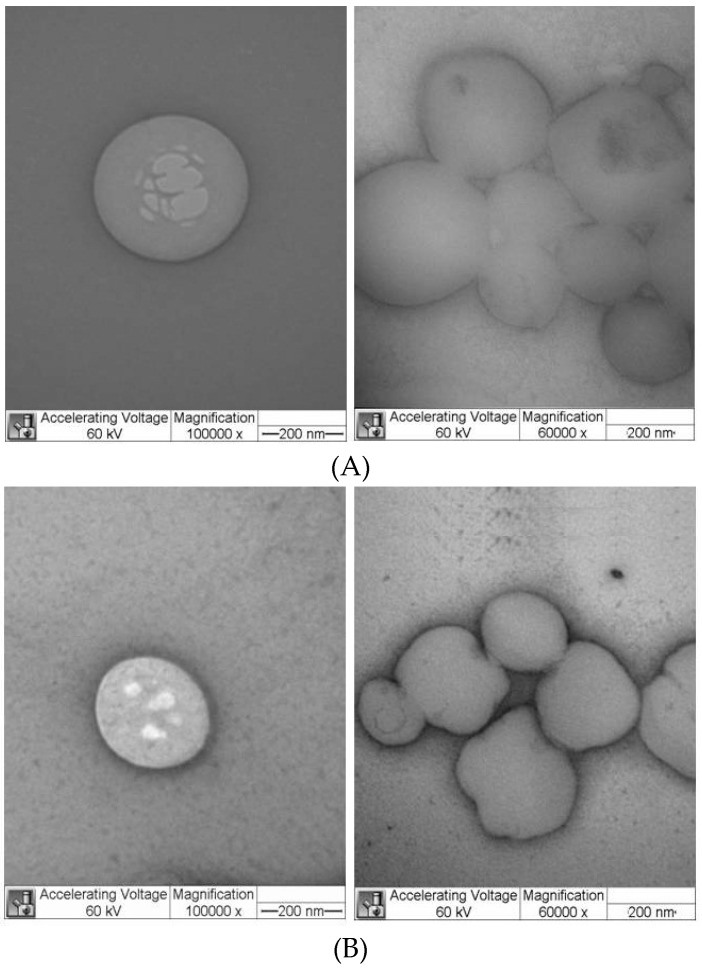
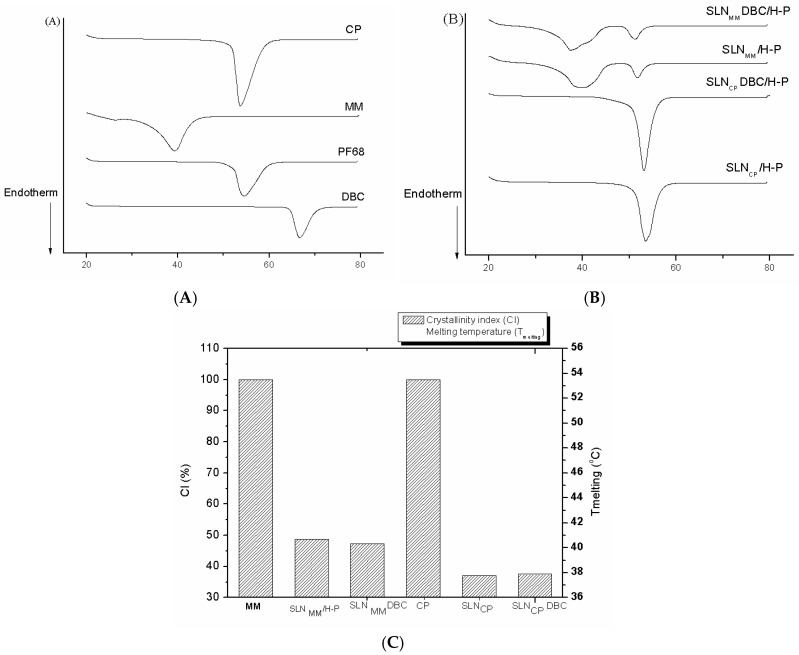
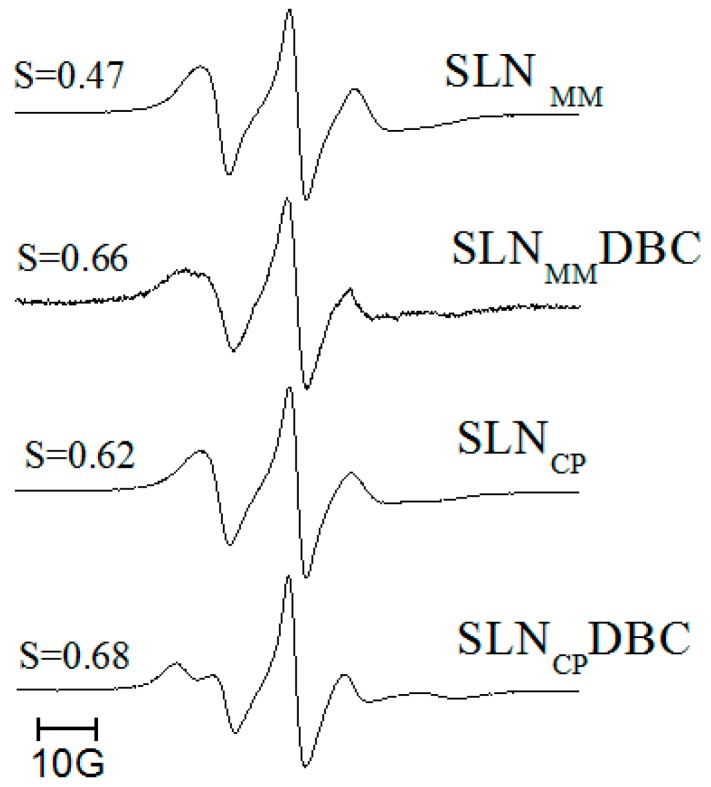
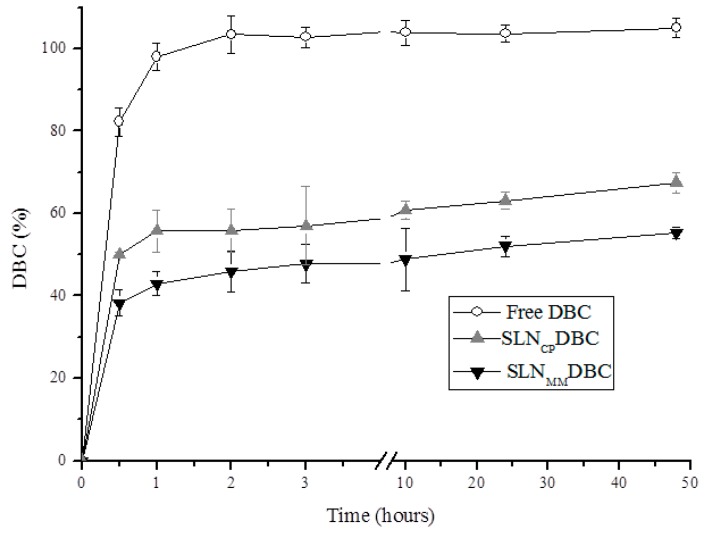
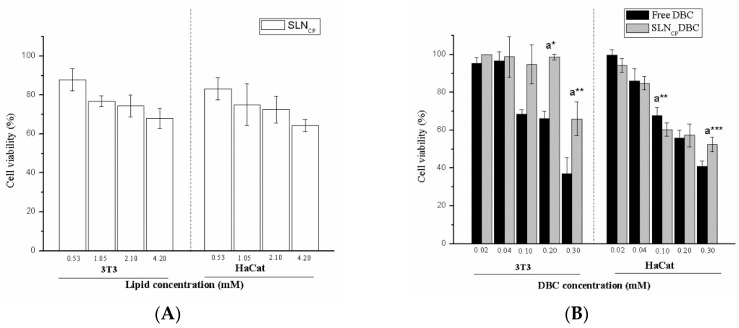
Dibucaine (DBC) is among the more potent long-acting local anesthetics (LA), and it is also one of the most toxic. Over the last decades, solid lipid nanoparticles (SLN) have been developed as promising carriers for drug delivery. In this study, SLN formulations were prepared with the aim of prolonging DBC release and reducing its toxicity. To this end, SLN composed of two different lipid matrices and prepared by two different hot-emulsion techniques (high-pressure procedure and sonication) were compared. The colloidal stability of the SLN formulations was tracked in terms of particle size (nm), polydispersity index (PDI), and zeta potential (mV) for 240 days at 4 °C; the DBC encapsulation efficiency was determined by the ultrafiltration/centrifugation method. The formulations were characterized by differential scanning calorimetry (DSC), electron paramagnetic resonance (EPR), and release kinetic experiments. Finally, the in vitro cytotoxicity against 3T3 fibroblast and HaCaT cells was determined, and the in vivo analgesic action was assessed using the test in rats. Both of the homogenization procedures were found suitable to produce particles in the 200 nm range, with good shelf stability (240 days) and high DBC encapsulation efficiency (~72⁻89%). DSC results disclosed structural information on the nanoparticles, such as the lower crystallinity of the lipid core vs. the bulk lipid. EPR measurements provided evidence of DBC partitioning in both SLNs. In vitro (cytotoxicity) and in vivo () experiments revealed that the encapsulation of DBC into nanoparticles reduces its intrinsic cytotoxicity and prolongs the anesthetic effect, respectively. These results show that the SLNs produced are safe and have great potential to extend the applications of dibucaine by enhancing its bioavailability.
丁卡因(DBC)是较强效的长效局部麻醉药之一,也是毒性最大的药物之一。在过去几十年中,固体脂质纳米粒(SLN)已被开发成为有前景的药物递送载体。在本研究中,制备SLN制剂的目的是延长丁卡因的释放并降低其毒性。为此,比较了由两种不同脂质基质组成并通过两种不同热乳化技术(高压法和超声法)制备的SLN。在4℃下对SLN制剂的胶体稳定性进行了240天的跟踪,监测指标包括粒径(nm)、多分散指数(PDI)和zeta电位(mV);采用超滤/离心法测定丁卡因的包封率。通过差示扫描量热法(DSC)、电子顺磁共振(EPR)和释放动力学实验对制剂进行表征。最后,测定了对3T3成纤维细胞和HaCaT细胞的体外细胞毒性,并使用大鼠试验评估了体内镇痛作用。发现两种均化程序都适合制备200nm范围内的颗粒,具有良好的储存稳定性(240天)和较高的丁卡因包封率(约72%-89%)。DSC结果揭示了纳米颗粒的结构信息,如脂质核的结晶度低于本体脂质。EPR测量提供了丁卡因在两种SLN中分配的证据。体外(细胞毒性)和体内()实验表明,将丁卡因包封到纳米颗粒中分别降低了其固有细胞毒性并延长了麻醉效果。这些结果表明,所制备的SLN是安全的,并且通过提高其生物利用度在扩展丁卡因的应用方面具有巨大潜力。