• 文献检索
  • 文档翻译
  • 深度研究
  • 学术资讯
  • Suppr Zotero 插件Zotero 插件
  • 邀请有礼
  • 套餐&价格
  • 历史记录
应用&插件
Suppr Zotero 插件Zotero 插件浏览器插件Mac 客户端Windows 客户端微信小程序
定价
高级版会员购买积分包购买API积分包
服务
文献检索文档翻译深度研究API 文档MCP 服务
关于我们
关于 Suppr公司介绍联系我们用户协议隐私条款
关注我们

Suppr 超能文献

核心技术专利:CN118964589B侵权必究
粤ICP备2023148730 号-1Suppr @ 2026

文献检索

告别复杂PubMed语法,用中文像聊天一样搜索,搜遍4000万医学文献。AI智能推荐,让科研检索更轻松。

立即免费搜索

文件翻译

保留排版,准确专业,支持PDF/Word/PPT等文件格式,支持 12+语言互译。

免费翻译文档

深度研究

AI帮你快速写综述,25分钟生成高质量综述,智能提取关键信息,辅助科研写作。

立即免费体验

在基层医疗机构急性基孔肯雅热感染期间筛查抑郁情绪。

Screening for Depressive Mood During Acute Chikungunya Infection in Primary Healthcare Settings.

机构信息

Instituto Mexicano del Seguro Social, Departamento de Epidemiología, Unidad de Medicina Familiar No. 19, Av. Javier Mina 301, Col. Centro, CP 28000 Colima, Mexico.

Programa de Doctorado en Ciencias Médicas, Facultad de Medicina, Universidad de Colima, Av. Universidad 333, Col. Las Víboras, CP 28040 Colima, Mexico.

出版信息

Int J Environ Res Public Health. 2018 Nov 14;15(11):2552. doi: 10.3390/ijerph15112552.

DOI:10.3390/ijerph15112552
PMID:30441808
原文链接:https://pmc.ncbi.nlm.nih.gov/articles/PMC6266459/
Abstract

We aimed to screen for depressive mood experienced during acute chikungunya (CHIKV) infection, and to evaluate the association of several exposures with the risk of depressive symptoms. A cross-sectional analysis of a multicenter cohort study took place and data from 354 adult individuals with confirmed CHIKV infection were analyzed. Participants were recruited in primary health care settings and the Patient Health Questionnaire-2 (PHQ-2) was used. Prevalence odds ratios (OR) and 95% confidence intervals (CIs) estimated by means of logistic models were used. Depressive mood (PHQ-2 score 3 or higher) was reported by 44.1% of individuals. Subjects with articular effusion (OR = 3.37, 95% CI 1.77⁻8.11), gastrointestinal manifestations (diarrhea, vomiting or abdominal pain, OR = 1.97, 95 CI 1.21⁻3.19), and higher length of severe arthralgia (reference ≤ 14 days: 15⁻30 days, OR = 3.38, 95% CI 1.78⁻6.41; ≥ 30 days, OR = 1.69, 95% CI 0.95⁻3.01) were more likely to self-report depressive mood. Increasing age (≥ 40 years old, OR = 0.55, 95% CI 0.31⁻0.95) and rash (OR = 0.54, 95% CI 0.30⁻0.98) were associated with a decreased risk of depressive mood. Depressive mood seemed to be a frequent event among analyzed individuals, and markers associated with its risk were identified.

摘要

我们旨在筛查急性基孔肯雅热(CHIKV)感染期间经历的抑郁情绪,并评估几种暴露因素与抑郁症状风险的关系。进行了一项多中心队列研究的横断面分析,分析了 354 名确诊 CHIKV 感染的成年个体的数据。参与者在基层医疗保健环境中招募,使用患者健康问卷-2(PHQ-2)进行评估。使用逻辑模型估计患病率比值比(OR)和 95%置信区间(CI)。44.1%的个体报告有抑郁情绪(PHQ-2 评分 3 或更高)。有关节积液(OR=3.37,95%CI 1.77⁻8.11)、胃肠道表现(腹泻、呕吐或腹痛,OR=1.97,95%CI 1.21⁻3.19)和较长时间严重关节痛(参考≤14 天:15⁻30 天,OR=3.38,95%CI 1.78⁻6.41;≥30 天,OR=1.69,95%CI 0.95⁻3.01)的患者更有可能自我报告抑郁情绪。年龄较大(≥40 岁,OR=0.55,95%CI 0.31⁻0.95)和皮疹(OR=0.54,95%CI 0.30⁻0.98)与抑郁情绪风险降低相关。抑郁情绪似乎是分析人群中常见的事件,并且确定了与风险相关的标志物。
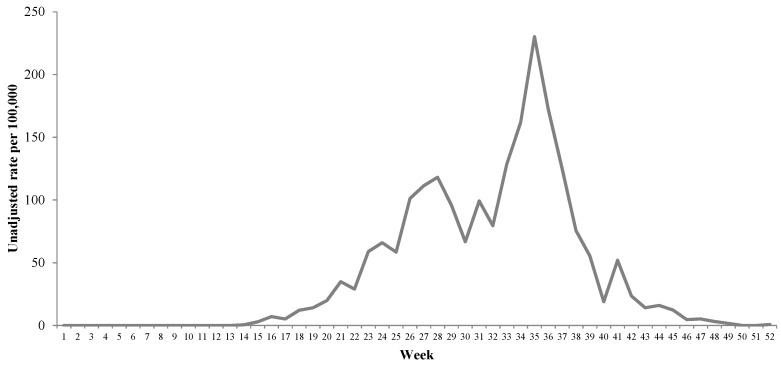
https://cdn.ncbi.nlm.nih.gov/pmc/blobs/ad0c/6266459/88592d6f71e3/ijerph-15-02552-g001.jpg

相似文献

1
Screening for Depressive Mood During Acute Chikungunya Infection in Primary Healthcare Settings.在基层医疗机构急性基孔肯雅热感染期间筛查抑郁情绪。
Int J Environ Res Public Health. 2018 Nov 14;15(11):2552. doi: 10.3390/ijerph15112552.
2
Persistent Arthralgia and Related Risks Factors: A Cohort Study at 12 Months from Laboratory-Confirmed Chikungunya Infection.持续性关节痛及相关风险因素:一项经实验室确诊基孔肯雅热感染后 12 个月的队列研究。
Arch Med Res. 2018 Jan;49(1):65-73. doi: 10.1016/j.arcmed.2018.04.008. Epub 2018 Apr 25.
3
Prevalence of and risk factors for chronic arthralgia and rheumatoid-like polyarthritis more than 2 years after infection with chikungunya virus.基孔肯雅病毒感染两年多后慢性关节痛和类风湿样多关节炎的患病率及危险因素
Postgrad Med J. 2013 Aug;89(1054):440-7. doi: 10.1136/postgradmedj-2012-131477. Epub 2013 May 3.
4
Risk of chronic arthralgia and impact of pain on daily activities in a cohort of patients with chikungunya virus infection from Brazil.来自巴西的一群基孔肯雅病毒感染患者的慢性关节痛风险及疼痛对日常活动的影响。
Int J Infect Dis. 2021 Apr;105:608-616. doi: 10.1016/j.ijid.2021.03.003. Epub 2021 Mar 5.
5
Persistent arthralgia and related risks factors in laboratory-confirmed cases of Chikungunya virus infection in Mexico.墨西哥基孔肯雅病毒感染实验室确诊病例中的持续性关节痛及相关危险因素
Rev Panam Salud Publica. 2017 Jun 8;41:e72. doi: 10.26633/RPSP.2017.72.
6
Molecular and Clinical Characterization of Chikungunya Virus Infections in Southeast Mexico.墨西哥东南部基孔肯雅热病毒感染的分子与临床特征。
Viruses. 2018 May 9;10(5):248. doi: 10.3390/v10050248.
7
Identification of initial severity determinants to predict arthritis after chikungunya infection in a cohort of French gendarmes.在一组法国宪兵队列中确定预测基孔肯雅热感染后关节炎的初始严重程度决定因素。
BMC Musculoskelet Disord. 2014 Jul 24;15:249. doi: 10.1186/1471-2474-15-249.
8
Chikungunya outbreak (2017) in Bangladesh: Clinical profile, economic impact and quality of life during the acute phase of the disease.2017 年孟加拉国基孔肯雅热疫情:疾病急性期的临床特征、经济影响和生活质量。
PLoS Negl Trop Dis. 2018 Jun 6;12(6):e0006561. doi: 10.1371/journal.pntd.0006561. eCollection 2018 Jun.
9
Rheumatic manifestations associated with Chikungunya virus infection: A study of 307 patients with 32-month follow-up (RHUMATOCHIK study).与基孔肯雅热病毒感染相关的风湿表现:一项 307 例患者、32 个月随访的研究(RHUMATOCHIK 研究)。
Joint Bone Spine. 2018 Mar;85(2):207-210. doi: 10.1016/j.jbspin.2017.01.014. Epub 2017 Feb 24.
10
Arthralgia resolution rate following chikungunya virus infection.关节痛在感染基孔肯雅病毒后的缓解率。
Int J Infect Dis. 2021 Nov;112:1-7. doi: 10.1016/j.ijid.2021.08.066. Epub 2021 Sep 4.

引用本文的文献

1
Clinical outcomes of chikungunya: A systematic literature review and meta-analysis.基孔肯雅热的临床结局:系统文献回顾和荟萃分析。
PLoS Negl Trop Dis. 2024 Jun 7;18(6):e0012254. doi: 10.1371/journal.pntd.0012254. eCollection 2024 Jun.
2
Extra-articular Manifestations of Chikungunya.基孔肯雅热的关节外表现。
Rev Soc Bras Med Trop. 2023 Dec 8;56:0341. doi: 10.1590/0037-8682-0341-2023. eCollection 2023.

本文引用的文献

1
Factors of depression among patients with rheumatoid arthritis.类风湿关节炎患者抑郁的相关因素。
Reumatologia. 2018;56(4):219-227. doi: 10.5114/reum.2018.77973. Epub 2018 Aug 31.
2
Rheumatism and chronic fatigue, the two facets of post-chikungunya disease: the TELECHIK cohort study on Reunion island.风湿和慢性疲劳,基孔肯雅热后疾病的两个方面:留尼汪岛 TELECHIK 队列研究。
Epidemiol Infect. 2018 Apr;146(5):633-641. doi: 10.1017/S0950268818000031. Epub 2018 Feb 28.
3
Chikungunya virus: clinical aspects and treatment - A Review.
基孔肯雅病毒:临床特征与治疗——综述
Mem Inst Oswaldo Cruz. 2017 Aug;112(8):523-531. doi: 10.1590/0074-02760170044.
4
Persistent arthralgia and related risks factors in laboratory-confirmed cases of Chikungunya virus infection in Mexico.墨西哥基孔肯雅病毒感染实验室确诊病例中的持续性关节痛及相关危险因素
Rev Panam Salud Publica. 2017 Jun 8;41:e72. doi: 10.26633/RPSP.2017.72.
5
Screening Adults for Depression in Primary Care.基层医疗中对成年人进行抑郁症筛查。
Med Clin North Am. 2017 Jul;101(4):807-821. doi: 10.1016/j.mcna.2017.03.010.
6
Chikungunya infection: A potential re-emerging global threat.基孔肯雅热感染:一种潜在的重新出现的全球威胁。
Asian Pac J Trop Med. 2016 Oct;9(10):933-937. doi: 10.1016/j.apjtm.2016.07.020. Epub 2016 Aug 10.
7
Screening for Depression in Adults: US Preventive Services Task Force Recommendation Statement.成人抑郁症筛查:美国预防服务工作组推荐声明。
JAMA. 2016 Jan 26;315(4):380-7. doi: 10.1001/jama.2015.18392.
8
Empirical evidence of the effect of school gathering on the dynamics of dengue epidemics.学校聚集对登革热流行动态影响的实证证据。
Glob Health Action. 2016 Jan 6;9:28026. doi: 10.3402/gha.v9.28026. eCollection 2016.
9
Chikungunya.基孔肯雅热
Rev Sci Tech. 2015 Aug;34(2):479-89. doi: 10.20506/rst.34.2.2373.
10
Psychiatric Morbidity in Patients with Chikungunya Fever: First Report from India.基孔肯雅热患者的精神疾病发病率:来自印度的首次报告。
J Clin Diagn Res. 2015 Oct;9(10):VC01-VC03. doi: 10.7860/JCDR/2015/14569.6586. Epub 2015 Oct 1.