Department of Physiology and Pharmacology Vittorio Erspamer, Sapienza University of Rome, Rome, Italy.
Sussex Addiction Research and Intervention Centre (SARIC), School of Psychology, University of Sussex, Sussex, UK.
Psychopharmacology (Berl). 2019 Feb;236(2):787-798. doi: 10.1007/s00213-018-5115-1. Epub 2018 Nov 15.
Previous studies have shown that rats trained to self-administer heroin and cocaine exhibit opposite preferences, as a function of setting, when tested in a choice paradigm. Rats tested at home prefer heroin to cocaine, whereas rats tested outside the home prefer cocaine to heroin. Here, we investigated whether drug history would influence subsequent drug preference in distinct settings. Based on a theoretical model of drug-setting interaction, we predicted that regardless of drug history rats would prefer heroin at home and cocaine outside the home.
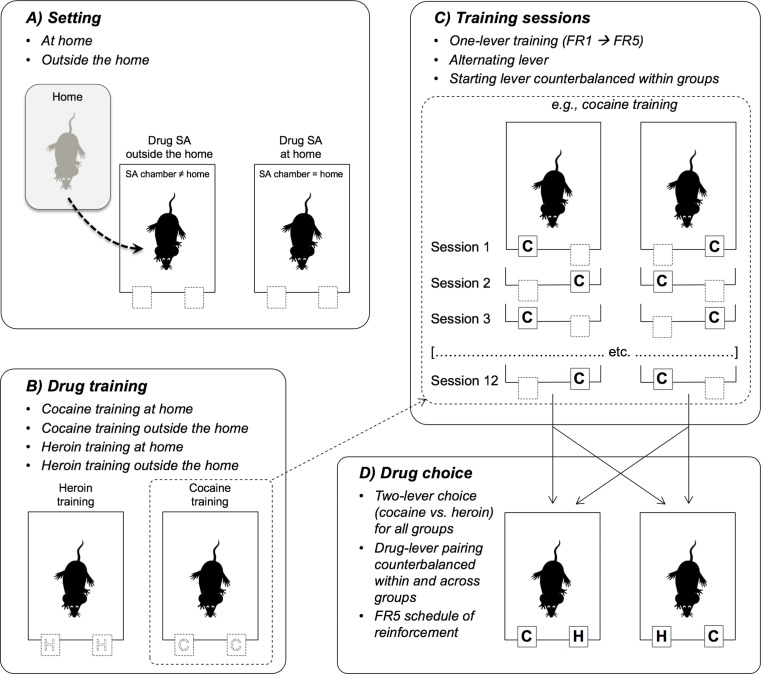
Rats with double-lumen catheters were first trained to self-administer either heroin (25 μg/kg) or cocaine (400 μg/kg) for 12 consecutive sessions. Twenty-six rats were housed in the self-administration chambers (thus, they were tested at home), whereas 30 rats lived in distinct home cages and were transferred to self-administration chambers only for the self-administration session (thus, they were tested outside the home). The rats were then allowed to choose repeatedly between heroin and cocaine within the same session for seven sessions.
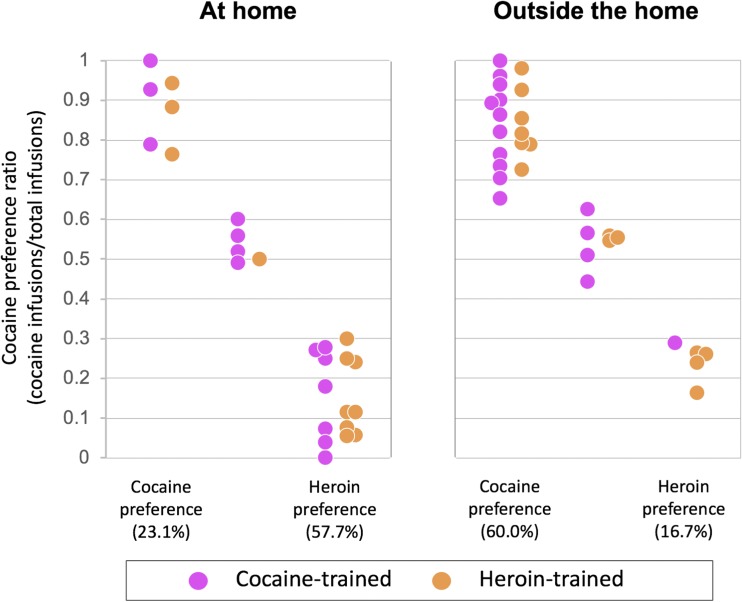
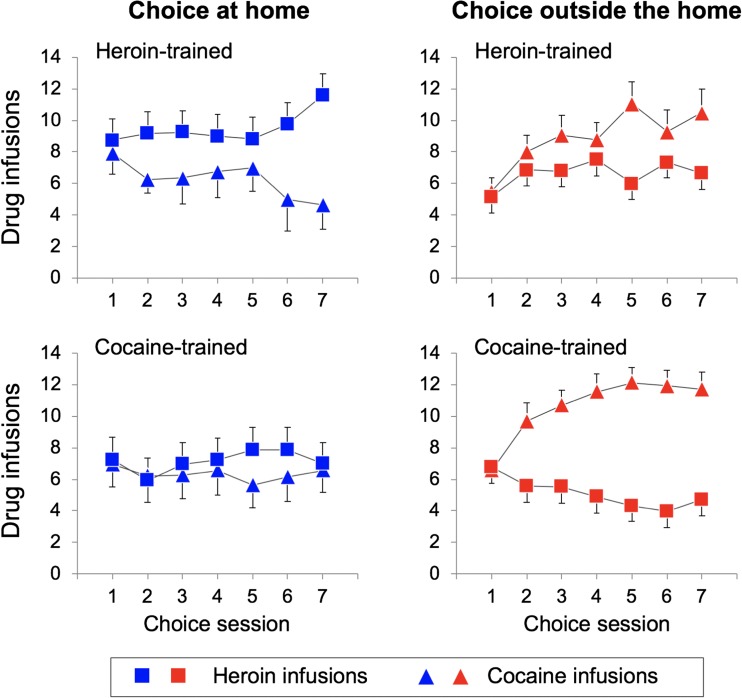
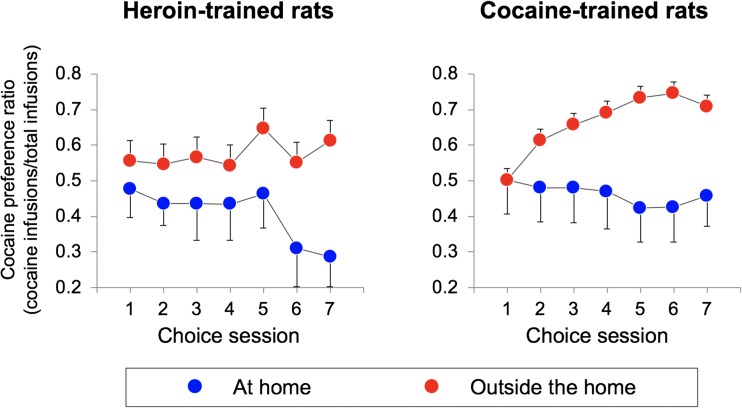
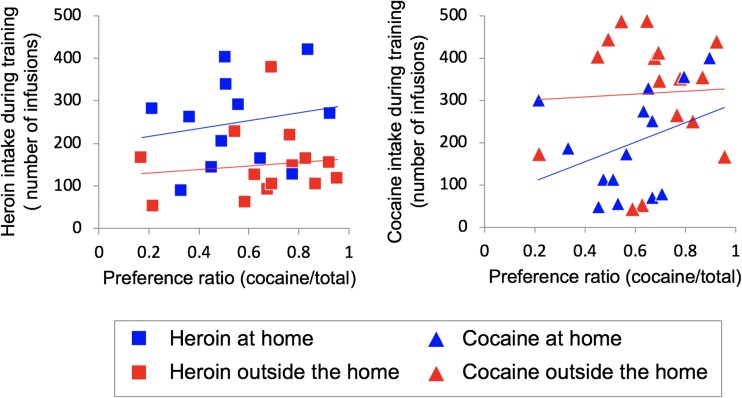
Regardless of the training drug, the rats tested outside the home preferred cocaine to heroin, whereas the rats tested at home preferred heroin to cocaine. There was no correlation between drug preference and drug intake during the training phase.
Drug preferences were powerfully influenced by the setting but, quite surprisingly, not by drug history. This suggests that, under certain conditions, associative learning processes and drug-induced neuroplastic adaptations play a minor role in shaping individual preferences for one drug or the other.
先前的研究表明,在选择范式中进行测试时,经过训练会自行摄取海洛因和可卡因的大鼠会根据环境表现出相反的偏好,这是环境作用的结果。在家中进行测试的大鼠更喜欢海洛因而不是可卡因,而在家庭以外的地方进行测试的大鼠则更喜欢可卡因而不是海洛因。在这里,我们研究了药物史是否会在不同的环境中影响随后的药物偏好。基于药物环境相互作用的理论模型,我们预测无论药物史如何,大鼠都会在家中更喜欢海洛因,而在家庭以外的地方更喜欢可卡因。
首先,具有双腔导管的大鼠经过 12 个连续疗程的训练,自行摄取海洛因(25μg/kg)或可卡因(400μg/kg)。26 只大鼠被安置在自我给药室中(因此,在家中进行测试),而 30 只大鼠则生活在不同的家庭笼子中,仅在自我给药疗程中被转移到自我给药室中(因此,在家庭以外的地方进行测试)。然后,在七个疗程中,大鼠在同一疗程中反复选择海洛因和可卡因。
无论训练药物如何,在家庭以外进行测试的大鼠更喜欢可卡因而不是海洛因,而在家庭中进行测试的大鼠则更喜欢海洛因而不是可卡因。在训练阶段,药物偏好与药物摄入量之间没有相关性。
药物偏好受到环境的强烈影响,但令人惊讶的是,不受药物史的影响。这表明,在某些条件下,联想学习过程和药物引起的神经可塑性适应在塑造对一种或另一种药物的个体偏好方面作用较小。