Department of Chemistry and Drug Technologies, University "La Sapienza" Rome, Italy.
Research Centre for Food and Nutrition, Council for Agricultural Research and Economics (CREA-AN), Rome, Italy.
Oxid Med Cell Longev. 2019 Jun 20;2019:7384193. doi: 10.1155/2019/7384193. eCollection 2019.
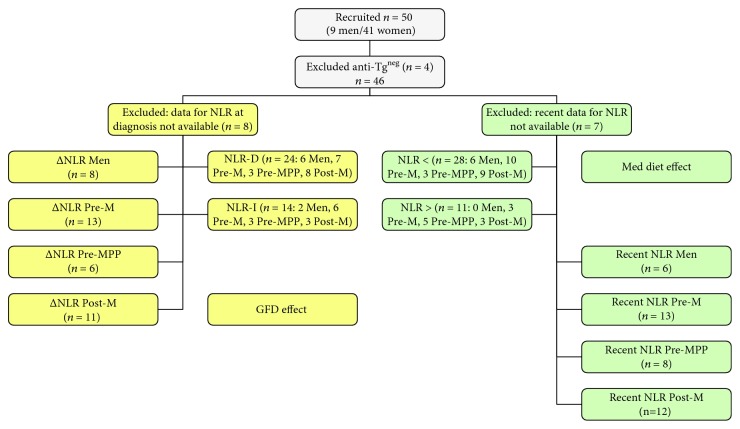
Neutrophil-to-lymphocyte ratio (NLR) has been proposed as a bone loss index in postmenopausal women and as a marker of inflammation in coeliac patients. The aims of this work were to evaluate the effect of gluten-free diet (GFD) on NLR retrospectively and study the relationship between NLR and Mediterranean diet adherence and selected food groups (fruits, vegetables, red meat, potatoes, and unrefined and refined cereals). Adult individuals ( = 50), who had been on a strict GFD by at least 6 months, were recruited. The degree of adherence to the Mediterranean diet was calculated with two different scores: the Mediterranean Diet Score (MDS-14), assessed through the validated 14-item questionnaire of the PREDIMED study, and the MEDScore (Score-55) proposed by Panagiotakos. The latter includes the consumption of unrefined cereals (UC). High percentages of osteopenia and osteoporosis were found within the recruited subjects, who furnished the reports of bone mineral density (BMD), in particular in postmenopausal (Post-M) women. Recent NLR was higher in subjects with osteoporosis compared to osteopenia and normal BMD. However, retrospective analysis showed both increase and decrease in NLR after GFD, with no significant differences between Marsh grade, anemia, and BMD status. Moreover, premenopausal previous pregnancy (Pre-MPP) and Post-M had higher NLR at diagnosis compared to Men and premenopausal (Pre-M), but higher differences were observed in recent NLR between Pre-MPP and Men only. Chocolate consumption was associated with lower recent NLR, whereas the latter was correlated with Score-55, but not with MDS-14. Moreover, refined cereal consumption was correlated with recent NLR. Although large prospective studies are needed in order to clarify the relationship between UC and NLR in coeliac patients, in this pilot study, we have investigated for the first time the relationship between NLR, dietary habit, and osteoporosis in coeliac disease.
中性粒细胞与淋巴细胞比值(NLR)已被提议作为绝经后妇女的骨质流失指标,以及作为乳糜泻患者炎症的标志物。本研究旨在回顾性评估无麸质饮食(GFD)对 NLR 的影响,并研究 NLR 与地中海饮食依从性和选定食物组(水果、蔬菜、红肉、土豆、未精制和精制谷物)之间的关系。招募了 50 名至少接受了 6 个月严格 GFD 的成年个体。通过验证的 PREDIMED 研究的 14 项问卷评估地中海饮食得分(MDS-14)和 Panagiotakos 提出的 MEDScore(Score-55)来评估地中海饮食的依从程度。后者包括未精制谷物(UC)的消耗。在招募的受试者中,发现了较高比例的骨质疏松症和骨质疏松症,他们提供了骨密度(BMD)报告,尤其是绝经后(Post-M)女性。与骨质疏松症和正常 BMD 相比,骨质疏松症患者的近期 NLR 较高。然而,回顾性分析显示,在 GFD 后 NLR 增加和减少,Marsh 分级、贫血和 BMD 状态之间没有显著差异。此外,与 Men 和绝经前(Pre-M)相比,绝经前有妊娠史(Pre-MPP)和绝经后诊断时的 NLR 更高,但仅在 Pre-MPP 和 Men 之间观察到近期 NLR 的差异更大。巧克力的消耗与较低的近期 NLR 相关,而后者与 Score-55 相关,但与 MDS-14 不相关。此外,精制谷物的消耗与近期 NLR 相关。尽管需要进行大规模的前瞻性研究以阐明乳糜泻患者 UC 与 NLR 之间的关系,但在这项初步研究中,我们首次研究了 NLR、饮食习惯与乳糜泻患者骨质疏松症之间的关系。