Lordan Ronan, Tsoupras Alexandros, Mitra Bhaskar, Zabetakis Ioannis
Department of Biological Sciences, University of Limerick, Limerick V94 T9PX, Ireland.
Extrx Oy, Salmelantie 43, Sotkamo 88600, Finland.
Foods. 2018 Mar 1;7(3):29. doi: 10.3390/foods7030029.
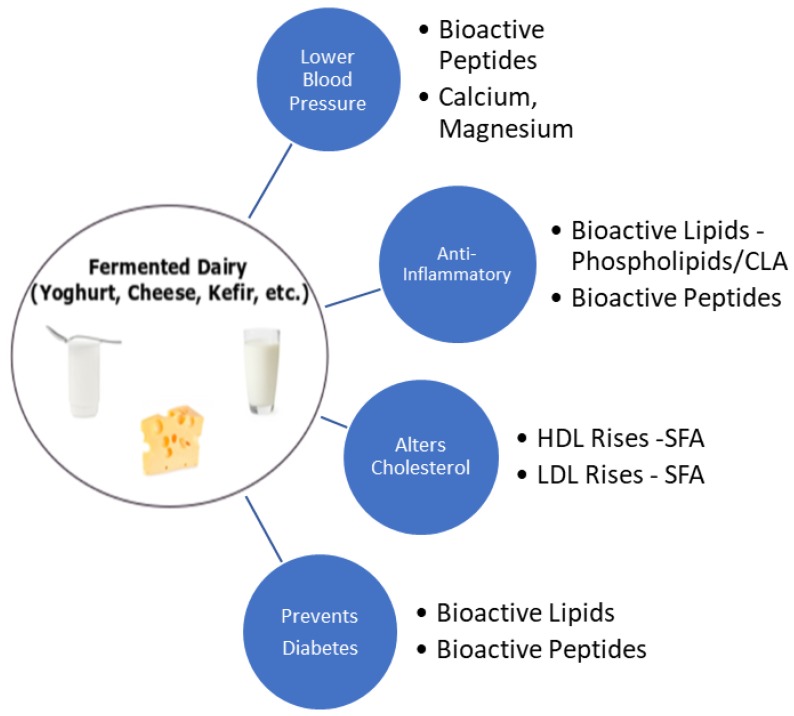
Cardiovascular diseases (CVD) remain a major cause of death and morbidity globally and diet plays a crucial role in the disease prevention and pathology. The negative perception of dairy fats stems from the effort to reduce dietary saturated fatty acid (SFA) intake due to their association with increased cholesterol levels upon consumption and the increased risk of CVD development. Institutions that set dietary guidelines have approached dairy products with negative bias and used poor scientific data in the past. As a result, the consumption of dairy products was considered detrimental to our cardiovascular health. In western societies, dietary trends indicate that generally there is a reduction of full-fat dairy product consumption and increased low-fat dairy consumption. However, recent research and meta-analyses have demonstrated the benefits of full-fat dairy consumption, based on higher bioavailability of high-value nutrients and anti-inflammatory properties. In this review, the relationship between dairy consumption, cardiometabolic risk factors and the incidence of cardiovascular diseases are discussed. Functional dairy foods and the health implications of dairy alternatives are also considered. In general, evidence suggests that milk has a neutral effect on cardiovascular outcomes but fermented dairy products, such as yoghurt, and cheese may have a positive or neutral effect. Particular focus is placed on the effects of the lipid content on cardiovascular health.
心血管疾病(CVD)仍然是全球范围内主要的死亡和发病原因,饮食在疾病预防和病理过程中起着至关重要的作用。对乳制品脂肪的负面看法源于人们努力减少膳食中饱和脂肪酸(SFA)的摄入量,因为食用后它们与胆固醇水平升高以及心血管疾病发生风险增加有关。过去,制定膳食指南的机构对乳制品存在负面偏见,并使用了缺乏科学性的数据。因此,食用乳制品被认为对我们的心血管健康有害。在西方社会,饮食趋势表明,全脂乳制品的消费量普遍减少,低脂乳制品的消费量增加。然而,最近的研究和荟萃分析表明,食用全脂乳制品有益,这基于高价值营养素的更高生物利用度和抗炎特性。在这篇综述中,我们讨论了乳制品消费、心脏代谢危险因素与心血管疾病发病率之间的关系。还考虑了功能性乳制品和替代乳制品对健康的影响。总体而言,证据表明牛奶对心血管疾病结局有中性影响,但发酵乳制品,如酸奶和奶酪,可能有积极或中性影响。特别关注脂质含量对心血管健康的影响。