Xiao Yu, Wang Yong, Wang Min, Liu Kai
Reproductive Medical Center, The International Peace Maternity and Child Health Hospital, School of Medicine, Shanghai Jiaotong University, 910 Hengshan Road, Shanghai, 200030, China.
BMC Womens Health. 2018 Nov 16;18(1):186. doi: 10.1186/s12905-018-0681-2.
To investigate the impact of follicular flushing on the number of oocytes retrieved and embryo quality and to determine the optimal number of flushings for poor ovarian responders (PORs) undergoing in vitro fertilization (IVF).
This retrospective study included 291 IVF cycles in 224 patients who were PORs and had no more than three dominant follicles on retrieval day. During oocyte retrieval, follicular fluid was aspirated and examined for an oocyte. If no oocyte was identified, follicular flushing was repeated until an oocyte was retrieved or up to a maximum of nine times.
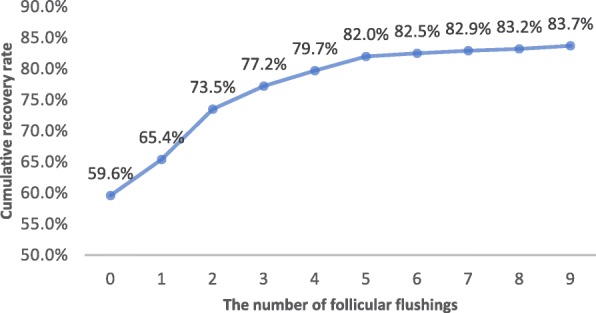
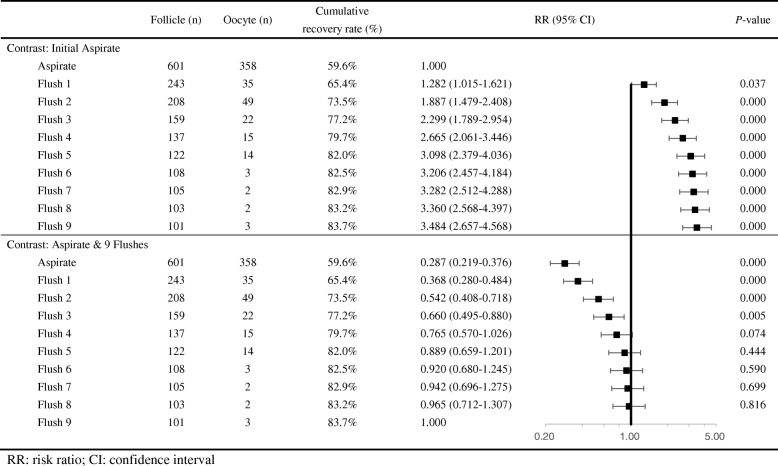
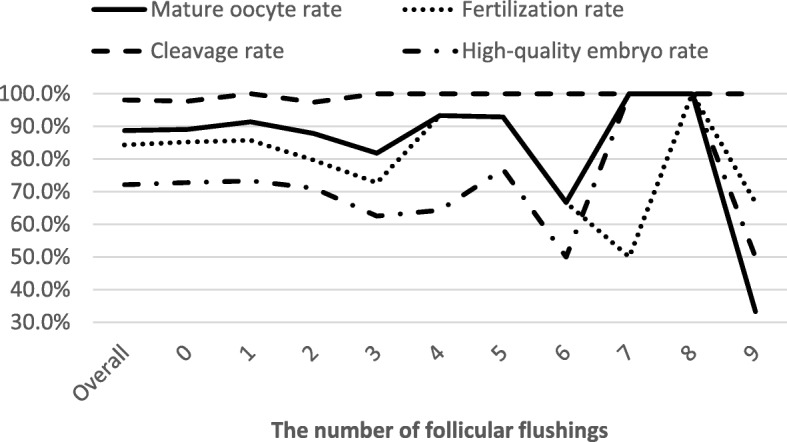
The mean number of oocytes retrieved by aspiration and subsequent flushes was significantly higher than the number retrieved from the initial aspirate (1.73 ± 0.96 VS. 1.23 ± 1.00, P = 0.000). The total recovery rate was 83.7% (503/601), which was significantly higher than the 59.6% recovery rate for direct aspiration (P = 0.000). Before the 4th follicular flushing, the cumulative recovery rate increased significantly as flushing was repeated, but after the 4th flushing, the ascending trend was mitigated; and the risk ratio of recovering fewer oocytes after 4 flushes compared with after 9 flushes was 0.765 (95%CI, 0.570-1.026, P = 0.074). Significant differences were not observed in maturation rate, fertilization rate, cleavage rate or high-quality embryo rate (P > 0.05).
Follicular flushing may increase the number of oocytes retrieved and does not have adverse effects on oocyte or embryo quality in PORs undergoing IVF. Four times may be an optimal number of follicular flushings.
探讨卵泡冲洗对获取的卵母细胞数量及胚胎质量的影响,并确定体外受精(IVF)中卵巢低反应者(PORs)的最佳冲洗次数。
这项回顾性研究纳入了224例PORs患者的291个IVF周期,这些患者在取卵日有不超过3个优势卵泡。在取卵过程中,抽吸卵泡液并检查是否有卵母细胞。如果未发现卵母细胞,则重复卵泡冲洗,直至获取到卵母细胞或最多冲洗9次。
通过抽吸及后续冲洗获取的卵母细胞平均数量显著高于初次抽吸获取的数量(1.73±0.96对1.23±1.00,P = 0.000)。总回收率为83.7%(503/601),显著高于直接抽吸的59.6%回收率(P = 0.000)。在第4次卵泡冲洗前,随着冲洗次数的增加,累积回收率显著上升,但在第4次冲洗后,上升趋势减缓;4次冲洗后获取较少卵母细胞的风险比与9次冲洗后相比为0.765(95%CI,0.570 - 1.026,P = 0.074)。在成熟率、受精率、分裂率或优质胚胎率方面未观察到显著差异(P>0.05)。
卵泡冲洗可能会增加PORs患者IVF中获取的卵母细胞数量,且对卵母细胞或胚胎质量没有不良影响。4次可能是卵泡冲洗的最佳次数。