Division of Cancer Epidemiology and Prevention, Department of Preventive Medicine, Aichi Cancer Center Research Institute.
Division of Cancer Information and Control, Department of Preventive Medicine, Aichi Cancer Center Research Institute.
J Epidemiol. 2019 Sep 5;29(9):347-353. doi: 10.2188/jea.JE20180112. Epub 2018 Nov 17.
Lung cancers are classified into small-cell lung cancer (SCLC) and non-small-cell lung cancer due to their different treatment and prognosis. Although many studies have reported the specific survival of SCLC patients treated at cancer hospitals, survival from population-based data has rarely been reported.
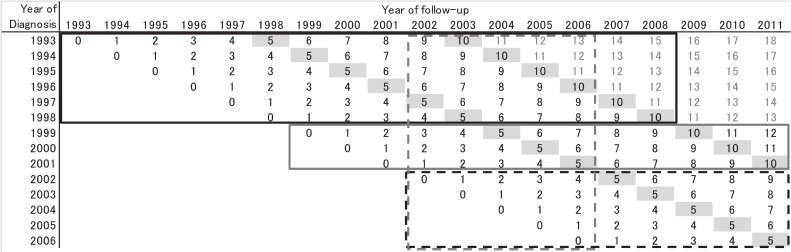
We analyzed survival of SCLC cases diagnosed from 1993 through 2006 from a population-based cancer registry of six prefectures. To assess trends in SCLC survival, we defined three periods that mirrored developments in SCLC treatment: period 1, 1993-1998; period 2, 1999-2001; and period 3, 2002-2006. Assessments were based on relative survival (RS), excess hazard, and conditional survival.
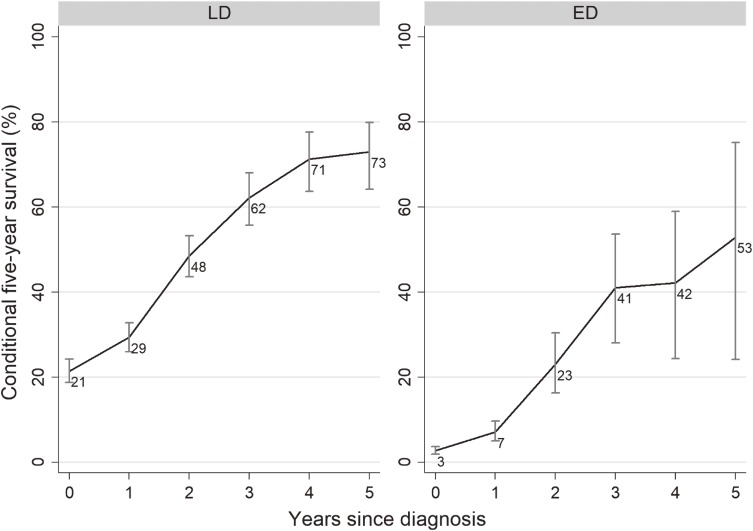
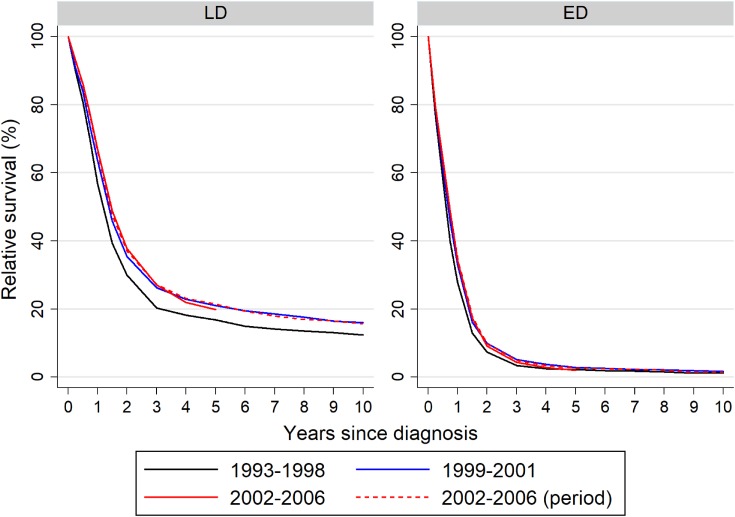
A total of 10,911 SCLC patients were analyzed. Five-year RS among limited disease SCLC (LD-SCLC) in periods 1 to 3 was 16.8%, 21.1%, and 21.4%, respectively. Five-year RS among extensive disease SCLC (ED-SCLC) in periods 1 to 3 was 2.3%, 2.8%, and 2.7%, respectively. Improvement in 5-year RS in periods 2 and 3 compared with period 1 was significant among both LD- and ED-SCLC patients (all P < 0.001). Conditional 5-year RS of LD-SCLC increased from 21% at year 0 to 73% at year 5, while that of ED-SCLC was 3% at year 0 and 53% at year 5.
The prognosis of SCLC patients improved from 1999-2001 but plateaued in 2002-2006, after which no further significant improvement was seen. Continuous survey based on population-based data is helpful in monitoring the impact of developments in treatment.
肺癌因其治疗和预后的不同,被分为小细胞肺癌(SCLC)和非小细胞肺癌。虽然许多研究报告了癌症专科医院治疗的 SCLC 患者的特定生存率,但基于人群的数据很少有报道。
我们分析了 1993 年至 2006 年期间,来自六个县的基于人群的癌症登记处诊断出的 SCLC 病例的生存情况。为了评估 SCLC 生存趋势,我们定义了三个反映 SCLC 治疗进展的时期:时期 1,1993-1998 年;时期 2,1999-2001 年;时期 3,2002-2006 年。评估基于相对生存率(RS)、超额风险和条件生存率。
共分析了 10911 例 SCLC 患者。局限期 SCLC(LD-SCLC)在时期 1 至 3 的 5 年 RS 分别为 16.8%、21.1%和 21.4%。广泛期 SCLC(ED-SCLC)在时期 1 至 3 的 5 年 RS 分别为 2.3%、2.8%和 2.7%。与时期 1 相比,时期 2 和 3 的 LD-SCLC 和 ED-SCLC 患者的 5 年 RS 改善均有统计学意义(均 P < 0.001)。LD-SCLC 的 5 年条件 RS 从 0 年的 21%增加到 5 年的 73%,而 ED-SCLC 的 RS 从 0 年的 3%增加到 5 年的 53%。
SCLC 患者的预后从 1999-2001 年开始改善,但在 2002-2006 年趋于稳定,此后未再出现显著改善。基于人群的连续监测有助于监测治疗进展的影响。