Hospital Universitario Puerta de Hierro-Majadahonda, Madrid, Spain.
Catalan Institute of Oncology, Hospital Universitari Germans Trias i Pujol, B-ARGO, IGTP, Badalona, Spain.
PLoS One. 2021 Jun 2;16(6):e0251761. doi: 10.1371/journal.pone.0251761. eCollection 2021.
Small-cell lung cancer (SCLC) is an aggressive disease with high metastatic potential and poor prognosis. Due to its low prevalence, epidemiological and clinical information of SCLC patients retrieved from lung cancer registries is scarce.
This was an observational multicenter study that enrolled patients with lung cancer and thoracic tumors, recruited from August 2016 to January 2020 at 50 Spanish hospitals. Demographic and clinical data, treatment patterns and survival of SCLC patients included in the Thoracic Tumor Registry (TTR) were analyzed.
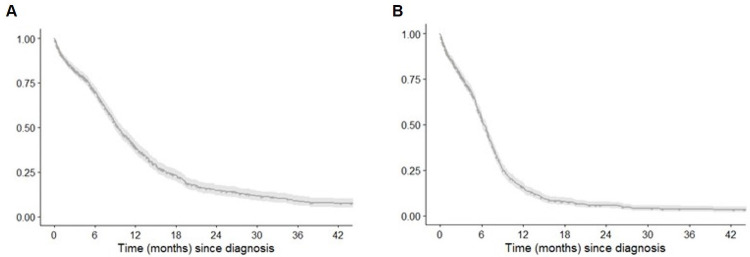
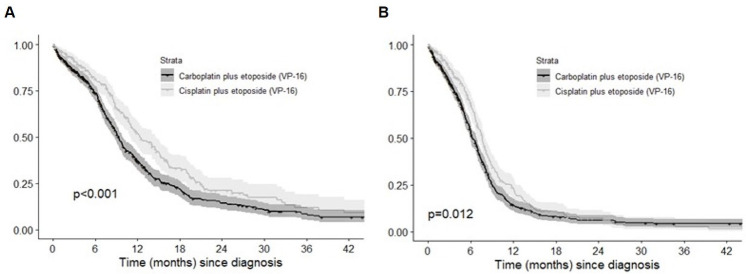
With a total of 956 cases, the age of 64.7 ± 9.1 years, 78.6% were men, 60.6% smokers, and ECOG PS 0, 1 or ≥ 2 in 23.1%, 53.0% and 23.8% of cases, respectively. Twenty percent of patients had brain metastases at the diagnosis. First-line chemotherapy (CT), mainly carboplatin or cisplatin plus etoposide was administered to >90% of patients. In total, 36.0% and 13.8% of patients received a second and third line of CT, respectively. Median overall survival was 9.5 months (95% CI 8.8-10.2 months), with an estimated rate of 70.3% (95% CI 67.2-73.4%), 38.9% (95% CI 35.4-42.4%), and 14.8% (95% CI 11.8-17.8%) at 6, 12 and 24 months respectively. Median progression-free survival was 6.3 months. Higher mortality and progression rates were significantly associated with male sex, older age, smoking habit, and ECOG PS 1-2. Long-term survival (> 2 years) was confirmed in 6.6% of patients, showing a positive correlation with better ECOG PS, poor smoking and absence of certain metastases at diagnosis.
This study provides an updated overview of the clinical situation and treatment landscape of ES-SCLC in Spain. Our results might assist oncologists to improve current clinical practice towards a better prognosis for these patients.
小细胞肺癌(SCLC)是一种侵袭性疾病,具有高转移潜能和不良预后。由于其发病率较低,从肺癌登记处获取的 SCLC 患者的流行病学和临床信息非常有限。
这是一项观察性多中心研究,纳入了 2016 年 8 月至 2020 年 1 月在西班牙 50 家医院就诊的肺癌和胸部肿瘤患者。分析了纳入胸部肿瘤登记处(TTR)的 SCLC 患者的人口统计学和临床数据、治疗模式和生存情况。
共纳入 956 例患者,年龄为 64.7±9.1 岁,78.6%为男性,60.6%为吸烟者,ECOG PS 0、1 或≥2 的患者分别占 23.1%、53.0%和 23.8%。20%的患者在诊断时已有脑转移。一线化疗(CT)主要为卡铂或顺铂联合依托泊苷,超过 90%的患者接受了该治疗。总共 36.0%和 13.8%的患者分别接受了二线和三线 CT 治疗。中位总生存期为 9.5 个月(95%CI 8.8-10.2 个月),预计 6、12 和 24 个月的生存率分别为 70.3%(95%CI 67.2-73.4%)、38.9%(95%CI 35.4-42.4%)和 14.8%(95%CI 11.8-17.8%)。中位无进展生存期为 6.3 个月。较高的死亡率和进展率与男性、年龄较大、吸烟习惯和 ECOG PS 1-2 显著相关。6.6%的患者长期生存(>2 年),与更好的 ECOG PS、较差的吸烟状况和无特定诊断时的转移呈正相关。
本研究提供了西班牙局限期小细胞肺癌(ES-SCLC)临床现状和治疗模式的最新概述。我们的结果可能有助于肿瘤学家改善目前的临床实践,为这些患者带来更好的预后。