Parratt Steven R, Laine Anna-Liisa
Research Centre for Ecological Change University of Helsinki Helsinki Finland.
J Appl Ecol. 2018 Nov;55(6):2976-2985. doi: 10.1111/1365-2664.13185. Epub 2018 Jun 19.
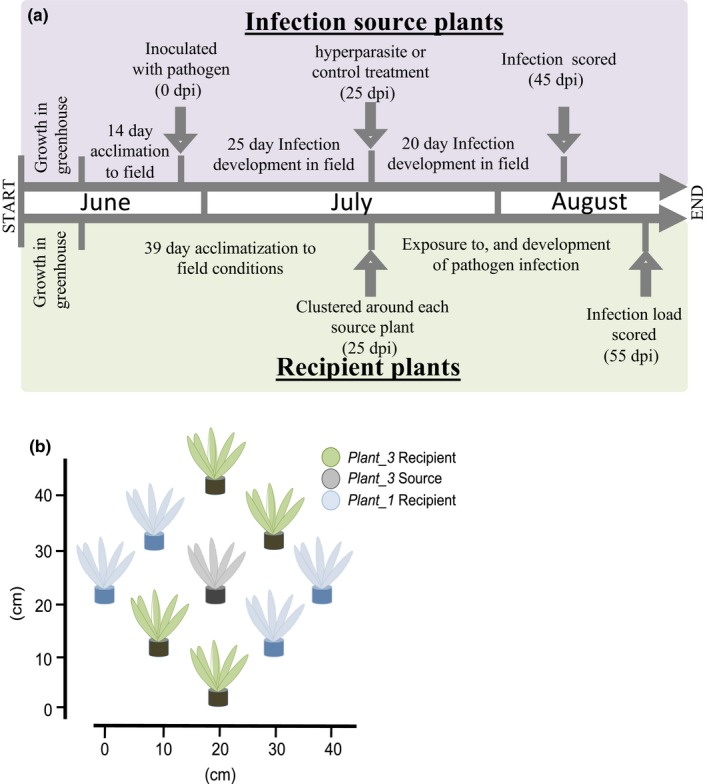
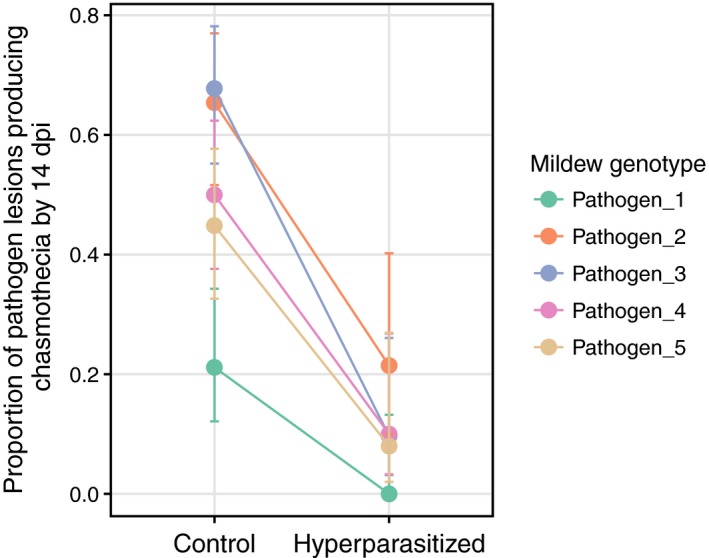
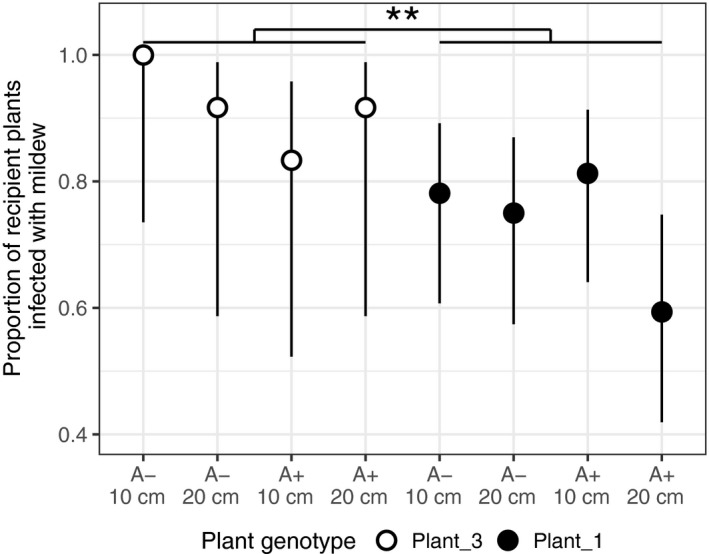
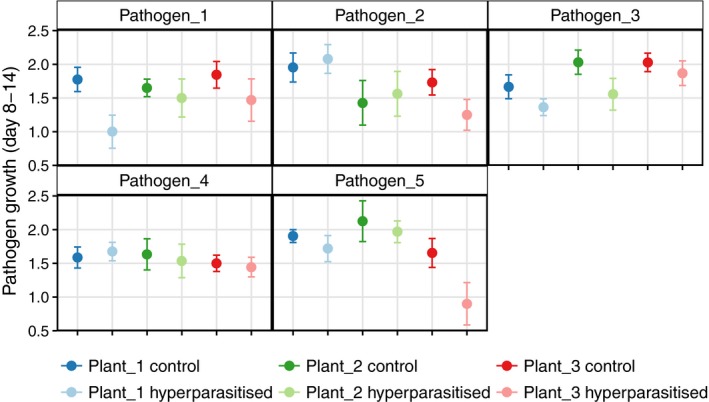
The relative importance of bottom-up versus top-down control of population dynamics has been the focus of much debate. In infectious disease biology, research is typically focused on the bottom-up process of host resistance, wherein the direction of control flows from the lower to the higher trophic level to impact on pathogen population size and epidemiology. However, the importance of top-down control by a pathogen's natural enemies has been mostly overlooked.Here, we explore the effects of, and interaction between, host genotype (i.e., genetic susceptibility to pathogen infection) and infection by a hyperparasitic fungus, spp., on the establishment and early epidemic growth and transmission of a powdery mildew plant pathogen (). We used a semi-natural field experiment to contrast the impacts of hyperparasite infection, host-plant resistance and spatial structure to reveal the key factors that determine pathogen spread. We then used a laboratory-based inoculation approach to test whether the field experiment results hold across multiple pathogen-host genetic combinations and to explore hyperparasite effects on the pathogen's later life-history stages.We found that hyperparasite infection had a negligible effect on within-host infection development and between-host spread of the pathogen during the onset of epidemics. In contrast, host-plant resistance was the major determinant of whether plants became infected, and host genotype and proximity to an infection source determined infection severity.Our laboratory study showed that, while the interaction between host and pathogen genotypes was the key determinant of infection outcome, hyperparasitism did, on average, reduce the severity of infection. Moreover, hyperparasite infection negatively influenced the production of the pathogen's overwintering structures. . Our results suggest that bottom-up host resistance affects pathogen spread, but top-down control of powdery mildew pathogens is likely more effective against later life-history stages. Further, while hyperparasitism in this system can reduce early pathogen growth under stable laboratory conditions, this effect is not detectable in a semi-natural environment. Considering the effects of hyperparasites at multiple points in pathogen's life history will be important when considering hyperparasite-derived biocontrol measures in other natural and agricultural systems.
自下而上与自上而下对种群动态的控制,其相对重要性一直是诸多争论的焦点。在传染病生物学中,研究通常聚焦于宿主抗性的自下而上过程,即控制方向从较低营养级流向较高营养级,以影响病原体种群规模和流行病学。然而,病原体天敌自上而下控制的重要性大多被忽视了。在此,我们探究宿主基因型(即对病原体感染的遗传易感性)与一种重寄生真菌对一种白粉病植物病原体的感染及其之间的相互作用,对白粉病植物病原体的定殖、早期流行增长和传播的影响。我们采用半自然田间试验,对比重寄生感染、宿主植物抗性和空间结构的影响,以揭示决定病原体传播的关键因素。然后,我们采用基于实验室的接种方法,测试田间试验结果是否适用于多种病原体 - 宿主遗传组合,并探究重寄生对病原体后期生活史阶段的影响。我们发现,在流行病暴发期间,重寄生感染对病原体在宿主体内的感染发展及在宿主间的传播影响可忽略不计。相比之下,宿主植物抗性是植物是否被感染的主要决定因素,宿主基因型和与感染源的距离决定感染严重程度。我们的实验室研究表明,虽然宿主和病原体基因型之间的相互作用是感染结果的关键决定因素,但平均而言,重寄生确实降低了感染的严重程度。此外,重寄生感染对病原体越冬结构的产生有负面影响。我们的结果表明,自下而上的宿主抗性影响病原体传播,但自上而下对白粉病病原体的控制可能对后期生活史阶段更有效。此外,虽然在稳定的实验室条件下,该系统中的重寄生可减少病原体早期生长,但在半自然环境中这种效果无法检测到。在考虑其他自然和农业系统中源自重寄生的生物防治措施时,考虑重寄生在病原体生活史多个阶段的影响将很重要。