Esfandiari Ebrahim, Ghanadian Mustafa, Rashidi Bahman, Mokhtarian Amir, Vatankhah Amir M
Department of Anatomical Sciences, Isfahan University of Medical Sciences, Isfahan, Iran.
Pharmaceutical Sciences Research Center, Faculty of Pharmacy and Pharmaceutical Sciences, Isfahan University of Medical Sciences, Isfahan, Iran.
Int J Prev Med. 2018 Oct 12;9:85. doi: 10.4103/ijpvm.IJPVM_75_18. eCollection 2018.
Several factors lead to memory loss, the most important of which is brain aging that is caused mostly by neuroinflammation and oxidative stress. The need of finding preventive treatments of memory impairment in elderly encouraged authors to assess the effect of on memory loss, anxiety, and antioxidant indices on neuroinflammation rat models.
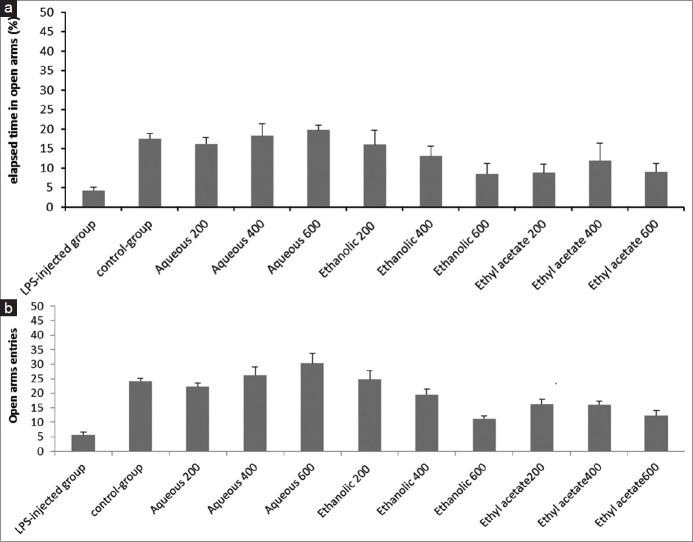
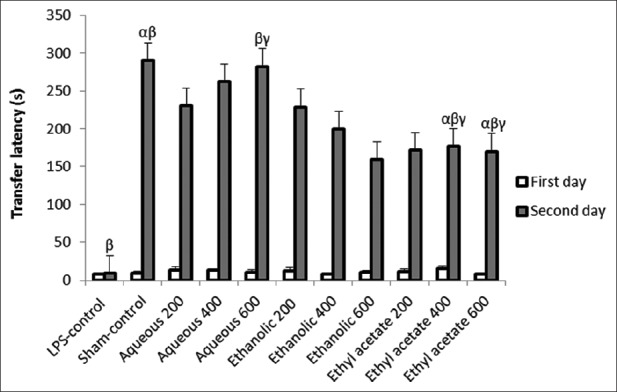
Different fractions of were prepared. The subject rats were grouped in 11 groups of 10 each. In the nine treated groups, the extract gavage began 1 week before intraperitoneal (i.p.) injection of lipopolysaccharide (LPS) and continued for 2 weeks after the last injection of LPS. Behavioral tests, including passive avoidance and elevated plus-maze (EPM) tests, were run on days 24, 25, and 26 and the subjects were sacrificed on the day after the last behavioral test, and their hippocampus was isolated to measure the oxidative stress markers.
Assessment of oxidative stress markers in hippocampus samples revealed that the amounts of endogenous antioxidant enzymes (superoxide dismutase, glutathione peroxidase, and total antioxidant activity) in the groups that received different fractions were less than their equivalent figures in LPS-control group, and levels of malondialdehyde (MDA) in treatment groups were less than MDA level in LPS-control group. Moreover, the treatment groups with different fractions of revealed better performance compared to LPS-control group in shuttle-box test. In EPM test, the groups with different fractions revealed lower stress level in comparison with LPS-control group. The best performance in memory test and the lowest level of stress in EPM was observed in the group with aqueous fraction at 600 mg/kg dose, and the least figures of oxidative stress markers were of the group with aqueous fraction at 600 mg/kg dose.
The oral administration of different fractions of , especially aqueous fraction, prevented from memory deficits and stress through controlling oxidative stress and inflammation processes.
多种因素导致记忆丧失,其中最重要的是大脑衰老,其主要由神经炎症和氧化应激引起。寻找老年记忆障碍预防治疗方法的需求促使作者评估[具体物质]对神经炎症大鼠模型记忆丧失、焦虑和抗氧化指标的影响。
制备了[具体物质]的不同组分。将受试大鼠分为11组,每组10只。在9个治疗组中,提取物灌胃在腹腔注射脂多糖(LPS)前1周开始,并在最后一次注射LPS后持续2周。在第24、25和26天进行行为测试,包括被动回避和高架十字迷宫(EPM)测试,在最后一次行为测试后的第二天处死受试动物,并分离其海马体以测量氧化应激标志物。
海马体样本中氧化应激标志物的评估显示,接受不同组分的组中内源性抗氧化酶(超氧化物歧化酶、谷胱甘肽过氧化物酶和总抗氧化活性)的量低于LPS对照组中的相应数值,且治疗组中丙二醛(MDA)水平低于LPS对照组中的MDA水平。此外,与LPS对照组相比,接受[具体物质]不同组分的治疗组在穿梭箱测试中表现更好。在EPM测试中,与LPS对照组相比,不同组分的组应激水平更低。在600mg/kg剂量水相组分的组中观察到记忆测试中的最佳表现和EPM中最低的应激水平,且氧化应激标志物数值最低的是600mg/kg剂量水相组分的组。
口服[具体物质]的不同组分,尤其是水相组分,通过控制氧化应激和炎症过程预防记忆缺陷和应激。