Eli and Edythe Broad Center of Regeneration Medicine and Stem Cell Research, University of California, San Francisco, San Francisco, CA, USA.
Department of Psychiatry, University of California, San Francisco, San Francisco, CA, USA.
Nat Neurosci. 2018 Dec;21(12):1784-1792. doi: 10.1038/s41593-018-0265-3. Epub 2018 Nov 19.
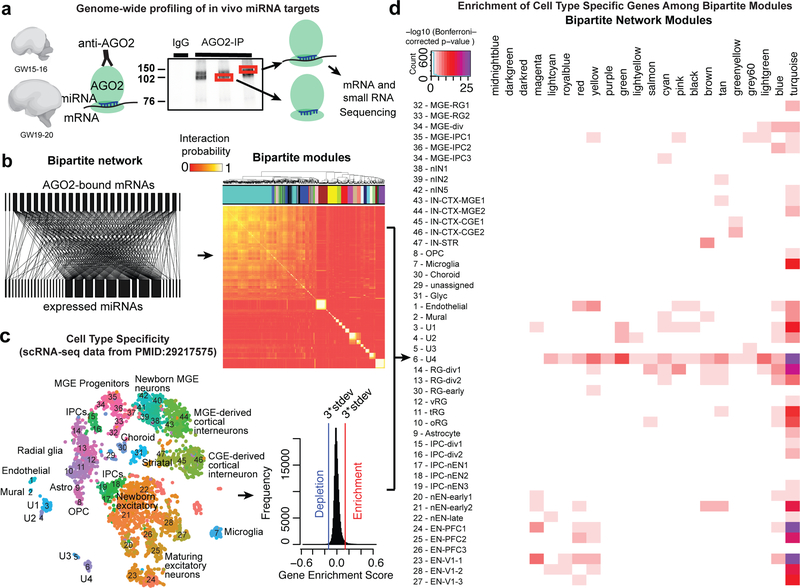
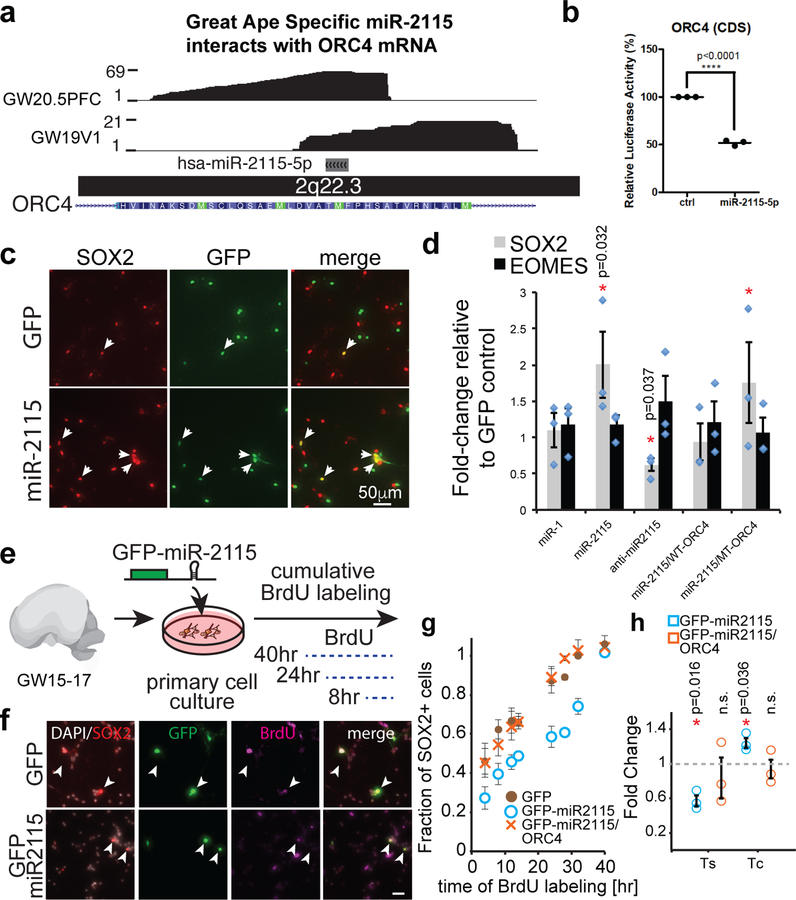
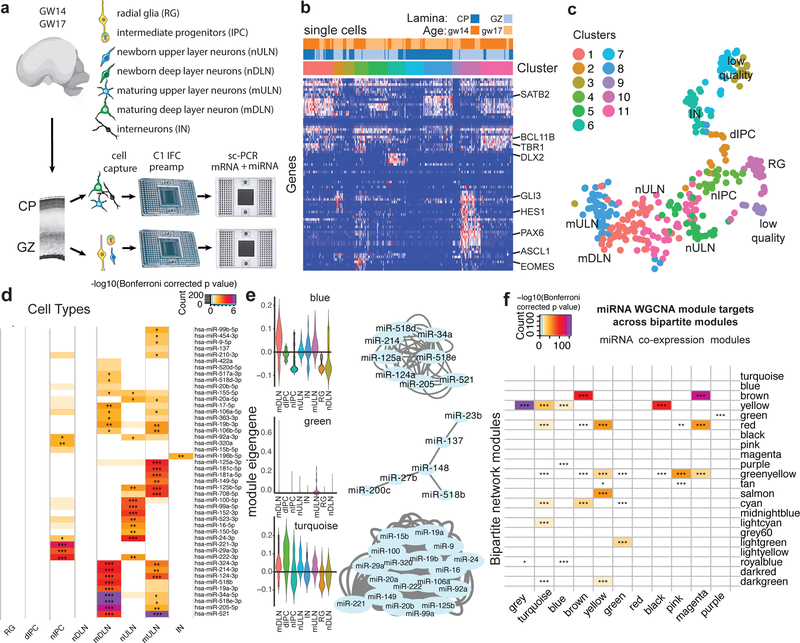
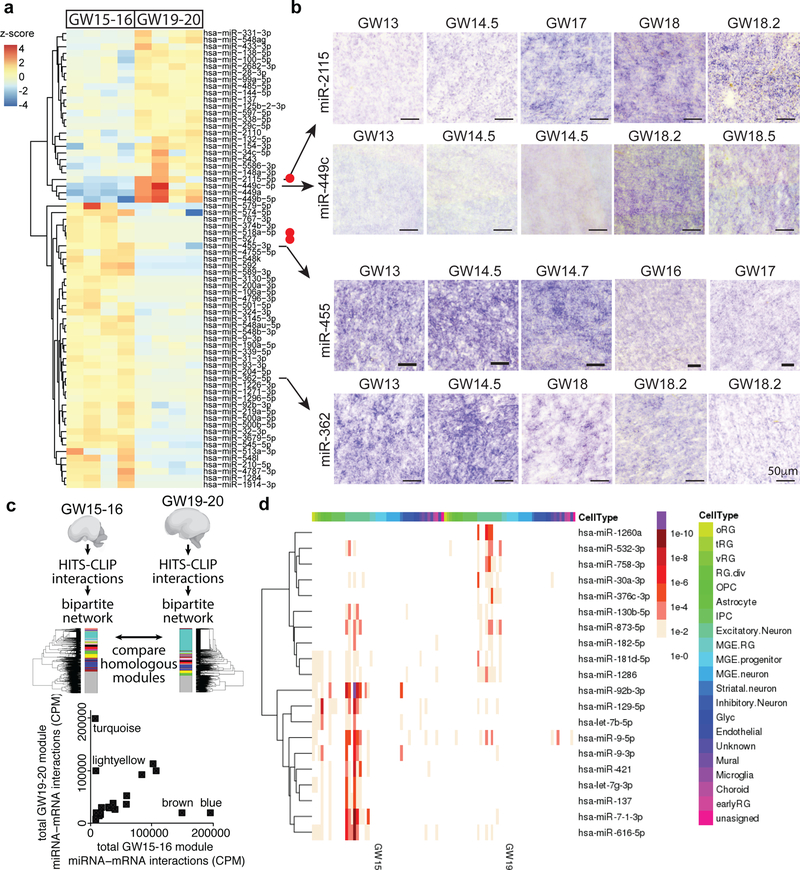
MicroRNAs (miRNAs) regulate many cellular events during brain development by interacting with hundreds of mRNA transcripts. However, miRNAs operate nonuniformly upon the transcriptional profile with an as yet unknown logic. Shortcomings in defining miRNA-mRNA networks include limited knowledge of in vivo miRNA targets and their abundance in single cells. By combining multiple complementary approaches, high-throughput sequencing of RNA isolated by cross-linking immunoprecipitation with an antibody to AGO2 (AGO2-HITS-CLIP), single-cell profiling and computational analyses using bipartite and coexpression networks, we show that miRNA-mRNA interactions operate as functional modules that often correspond to cell-type identities and undergo dynamic transitions during brain development. These networks are highly dynamic during development and over the course of evolution. One such interaction is between radial-glia-enriched ORC4 and miR-2115, a great-ape-specific miRNA, which appears to control radial glia proliferation rates during human brain development.
微小 RNA(miRNA)通过与数百个 mRNA 转录本相互作用来调节脑发育过程中的许多细胞事件。然而,miRNA 的转录谱的作用并不均匀,其作用逻辑尚不清楚。定义 miRNA-mRNA 网络的不足之处包括对体内 miRNA 靶标的了解有限,以及它们在单细胞中的丰度有限。通过结合多种互补方法,对与 AGO2 抗体交联免疫沉淀分离的 RNA 进行高通量测序(AGO2-HITS-CLIP)、单细胞分析和使用二部图和共表达网络的计算分析,我们表明 miRNA-mRNA 相互作用作为功能模块起作用,这些模块通常对应于细胞类型的身份,并在大脑发育过程中经历动态转变。这些网络在发育过程中和进化过程中都具有高度动态性。这样的相互作用之一是富含放射状胶质细胞的 ORC4 和 miR-2115 之间的相互作用,miR-2115 是一种大猿特异性 miRNA,它似乎控制了人类大脑发育过程中放射状胶质细胞的增殖速度。