Division of Structural Biology, Wellcome Centre for Human Genetics, University of Oxford, Oxford, UK.
Interdisciplinary Institute for Neuroscience, University of Bordeaux, Bordeaux, France.
Nat Protoc. 2018 Dec;13(12):2991-3017. doi: 10.1038/s41596-018-0075-9.
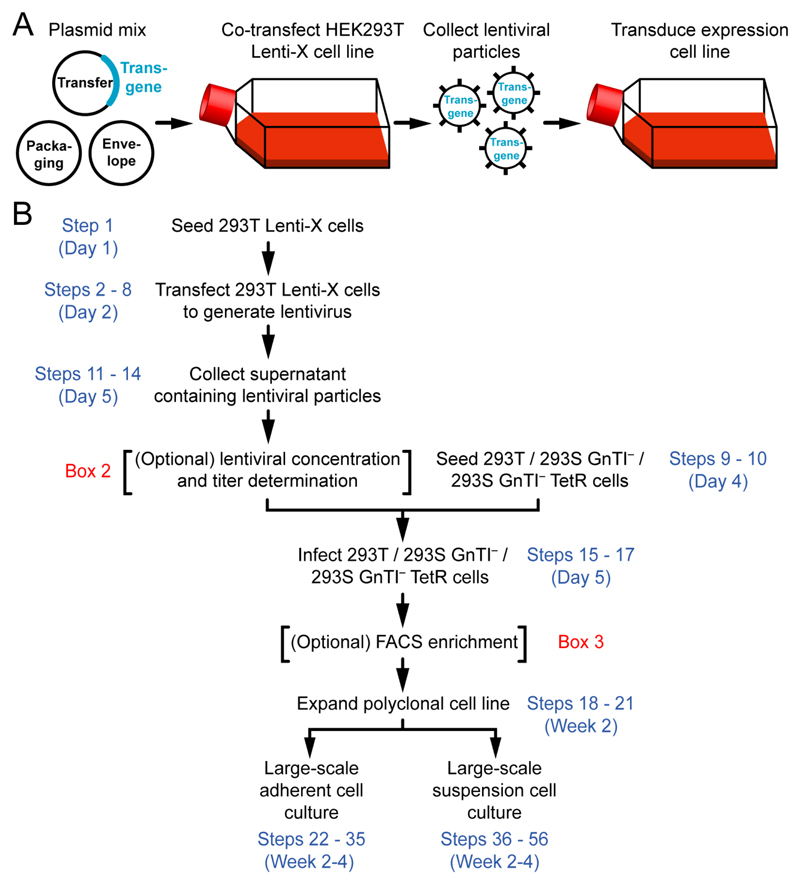
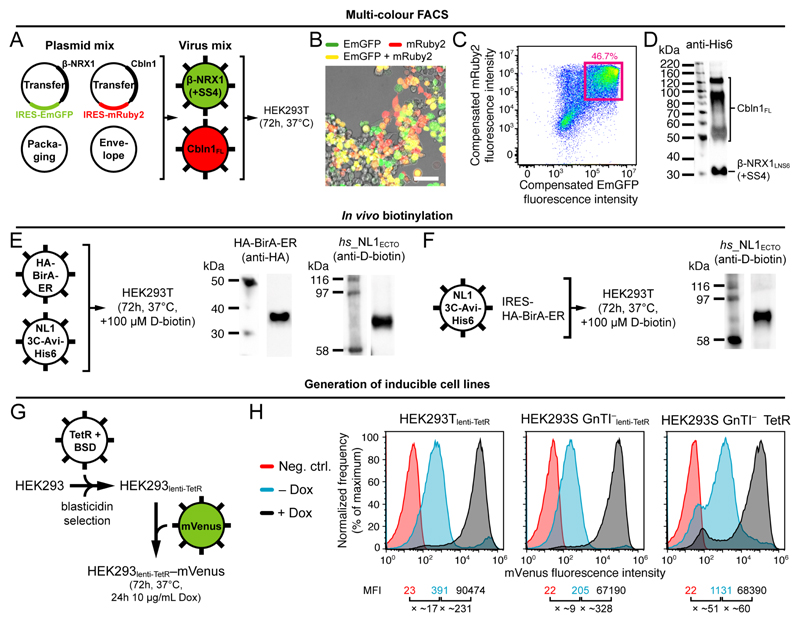
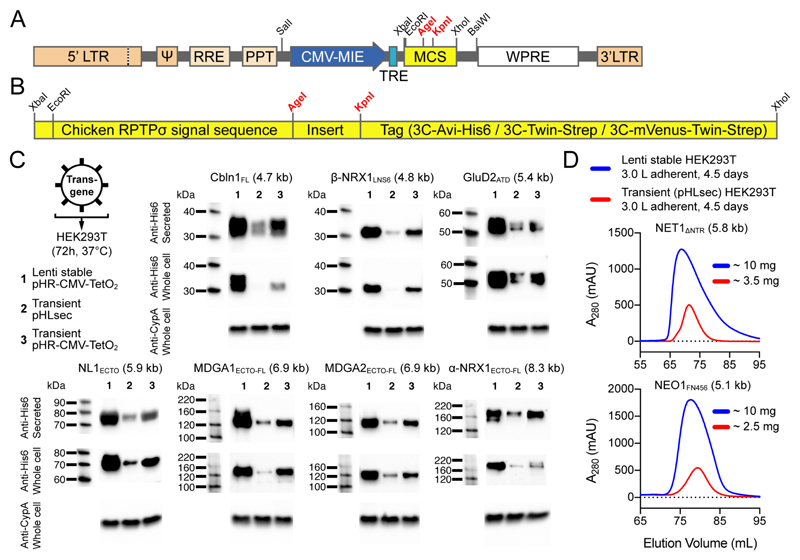
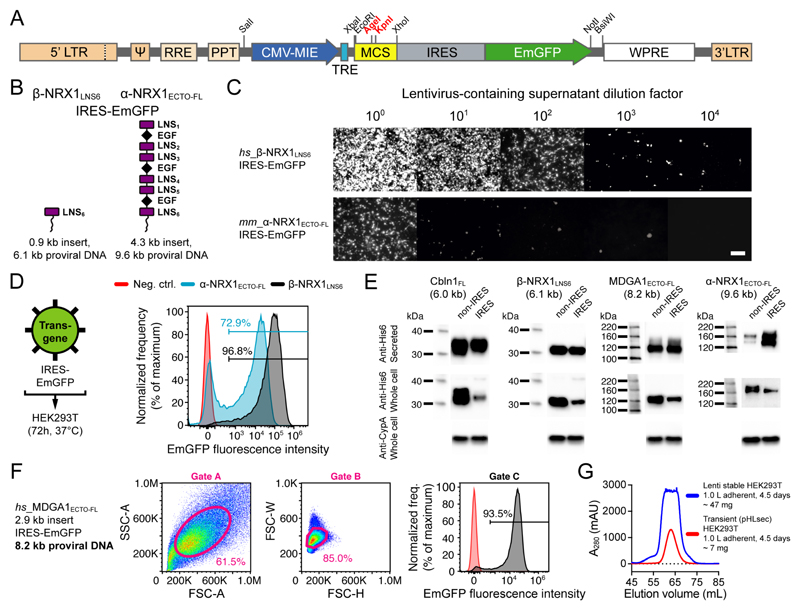
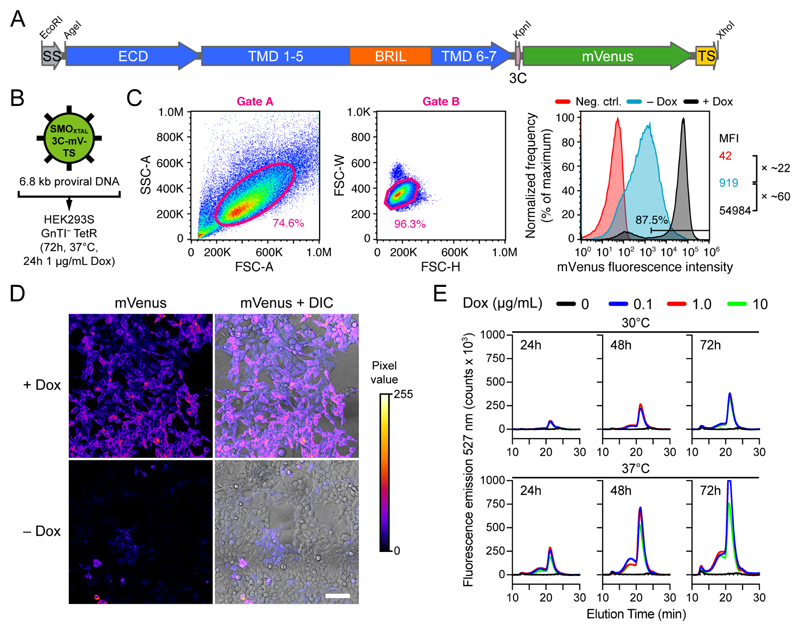
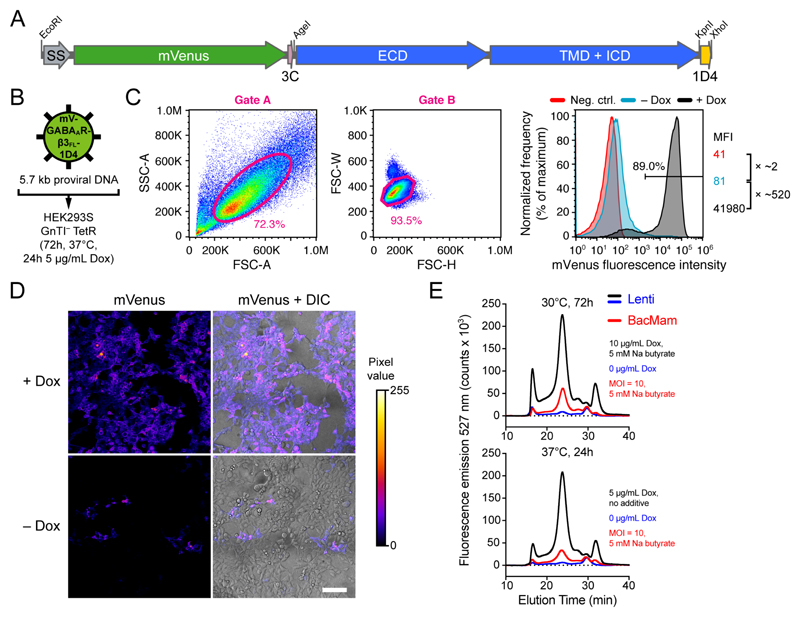
Structural, biochemical and biophysical studies of eukaryotic soluble and membrane proteins require their production in milligram quantities. Although large-scale protein expression strategies based on transient or stable transfection of mammalian cells are well established, they are associated with high consumable costs, limited transfection efficiency or long and tedious selection of clonal cell lines. Lentiviral transduction is an efficient method for the delivery of transgenes to mammalian cells and unifies the ease of use and speed of transient transfection with the robust expression of stable cell lines. In this protocol, we describe the design and step-by-step application of a lentiviral plasmid suite, termed pHR-CMV-TetO, for the constitutive or inducible large-scale production of soluble and membrane proteins in HEK293 cell lines. Optional features include bicistronic co-expression of fluorescent marker proteins for enrichment of co-transduced cells using cell sorting and of biotin ligase for in vivo biotinylation. We demonstrate the efficacy of the method for a set of soluble proteins and for the G-protein-coupled receptor (GPCR) Smoothened (SMO). We further compare this method with baculovirus transduction of mammalian cells (BacMam), using the type-A γ-aminobutyric acid receptor (GABAR) β3 homopentamer as a test case. The protocols described here are optimized for simplicity, speed and affordability; lead to a stable polyclonal cell line and milligram-scale amounts of protein in 3-4 weeks; and routinely achieve an approximately three- to tenfold improvement in protein production yield per cell as compared to transient transduction or transfection.
真核可溶性和膜蛋白的结构、生化和生物物理研究需要以毫克级的量生产它们。尽管基于哺乳动物细胞瞬时或稳定转染的大规模蛋白质表达策略已经成熟,但它们与高耗材成本、有限的转染效率或克隆细胞系的冗长和繁琐选择有关。慢病毒转导是将转基因递送到哺乳动物细胞的有效方法,它将瞬时转染的易用性和速度与稳定细胞系的稳健表达统一起来。在本方案中,我们描述了一种慢病毒质粒套件(称为 pHR-CMV-TetO)的设计和逐步应用,用于在 HEK293 细胞系中组成型或诱导性大规模生产可溶性和膜蛋白。可选功能包括双顺反子共表达荧光标记蛋白,用于使用细胞分选富集共转导的细胞,以及生物素连接酶用于体内生物素化。我们证明了该方法对一组可溶性蛋白和 G 蛋白偶联受体 (GPCR) Smoothened (SMO) 的有效性。我们进一步将该方法与哺乳动物细胞的杆状病毒转导 (BacMam) 进行了比较,使用 A 型 γ-氨基丁酸受体 (GABAR) β3 同源五聚体作为测试案例。此处描述的方案经过优化,以实现简单性、速度和可负担性;在 3-4 周内导致稳定的多克隆细胞系和毫克级的蛋白质量;并且通常与瞬时转导或转染相比,每细胞的蛋白质产量提高约 3-10 倍。