Roschel Hamilton, Ugrinowistch Carlos, Santos Audrei Reis, Barbosa Wesley Pereira, Miyabara Elen Haruka, Tricoli Valmor, Aoki Marcelo Saldanha
School of Physical Education and Sport, University of São Paulo, São Paulo, SP, Brazil.
School of Arts, Sciences and Humanities, University of São Paulo, São Paulo, SP, Brazil.
Biol Sport. 2018 Jun;35(2):111-119. doi: 10.5114/biolsport.2018.71600. Epub 2017 Nov 23.
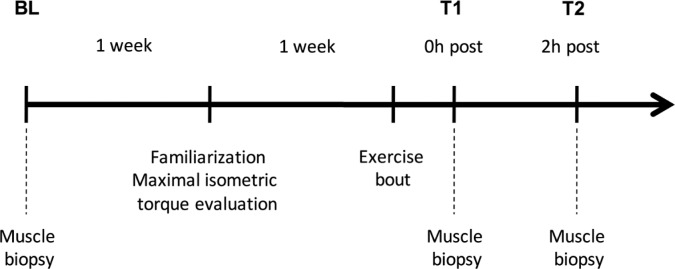
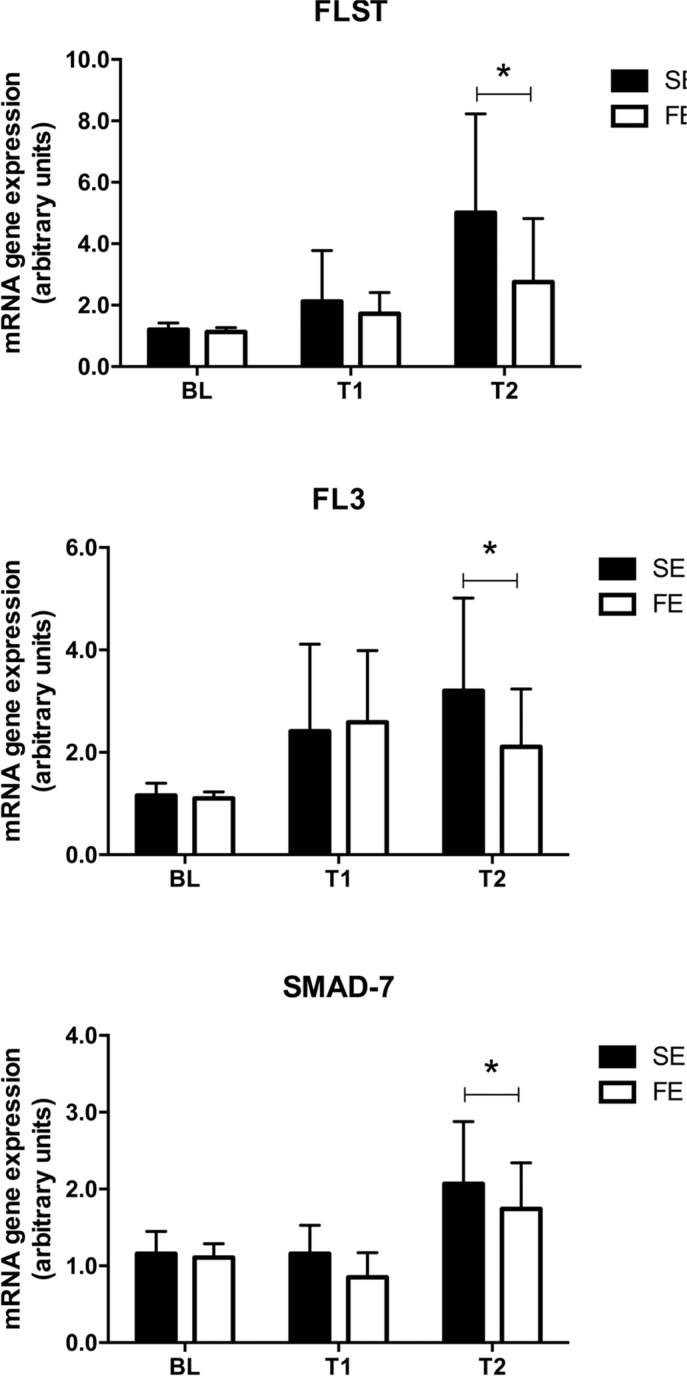
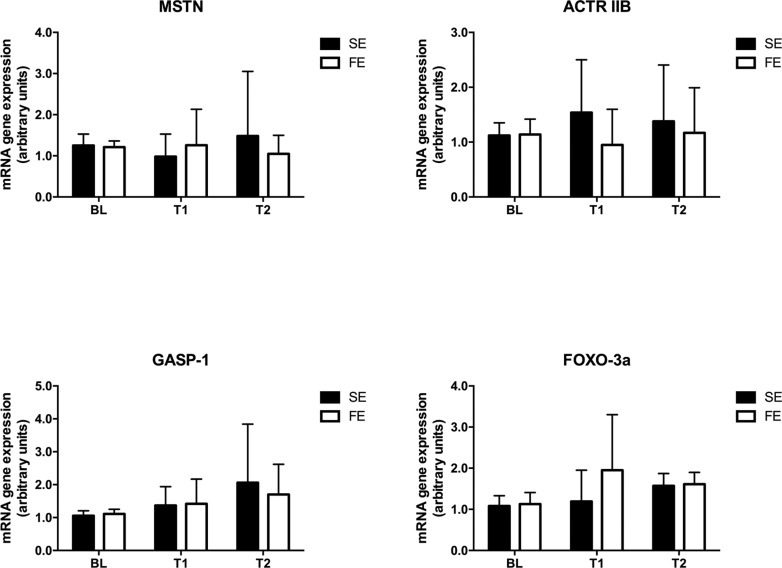
The aim of this study was to investigate the effects of an acute bout of eccentric actions, performed at fast velocity (210ºs) and at slow velocity (20ºs), on the gene expression of regulatory components of the myostatin (MSTN) signalling pathway. Participants performed an acute bout of eccentric actions at either a slow or a fast velocity. Muscle biopsy samples were taken before, immediately after, and 2 h after the exercise bout. The gene expression of the components of the MSTN pathway was assessed by real-time PCR. No change was observed in MSTN, ACTRIIB, GASP-1 or FOXO-3a gene expression after either slow or fast eccentric actions (p > 0.05). However, the MSTN inhibitors follistatin (FST), FST-like-3 (FSTL3) and SMAD-7 were significantly increased 2 h after both eccentric actions (p < 0.05). No significant difference between bouts was found before, immediately after, or 2 h after the eccentric actions (slow and fast velocities, p > 0.05). The current findings indicate that a bout of eccentric actions activates the expression of MSTN inhibitors. However, no difference was observed in MSTN inhibitors' gene expression when comparing slow and fast eccentric actions. It is possible that the greater time under tension induced by slow eccentric (SE) actions might compensate the effect of the greater velocity of fast eccentric (FE) actions. Additional studies are required to address the effect of eccentric action (EA) velocities on the pathways related to muscle hypertrophy.
本研究的目的是调查以快速(210°/秒)和慢速(20°/秒)进行的一次急性离心运动对肌肉生长抑制素(MSTN)信号通路调节成分基因表达的影响。参与者以慢速或快速进行了一次急性离心运动。在运动前、运动后立即以及运动后2小时采集肌肉活检样本。通过实时PCR评估MSTN通路各成分的基因表达。慢速或快速离心运动后,MSTN、ACTRIIB、GASP-1或FOXO-3a基因表达均未观察到变化(p>0.05)。然而,两种离心运动后2小时,MSTN抑制剂卵泡抑素(FST)、类卵泡抑素-3(FSTL3)和SMAD-7均显著增加(p<0.05)。在离心运动前、运动后立即或运动后2小时(慢速和快速,p>0.05),各运动组之间未发现显著差异。目前的研究结果表明,一次离心运动可激活MSTN抑制剂的表达。然而,比较慢速和快速离心运动时,MSTN抑制剂的基因表达未观察到差异。慢速离心(SE)运动诱导的更大张力时间可能会补偿快速离心(FE)运动更大速度的影响。需要进一步的研究来探讨离心运动(EA)速度对与肌肉肥大相关通路的影响。