N'Diaye Amidou, Haile Jemanesh K, Nilsen Kirby T, Walkowiak Sean, Ruan Yuefeng, Singh Asheesh K, Clarke Fran R, Clarke John M, Pozniak Curtis J
Department of Plant Sciences, Crop Development Centre, University of Saskatchewan, Saskatoon, SK, Canada.
Agriculture and Agri-Food Canada, Swift Current Research and Development Centre, Swift Current, SK, Canada.
Front Plant Sci. 2018 Nov 5;9:1589. doi: 10.3389/fpls.2018.01589. eCollection 2018.
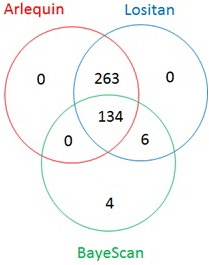
Durum wheat was introduced in the southern prairies of western Canada in the late nineteenth century. Breeding efforts have mainly focused on improving quality traits to meet the pasta industry demands. For this study, 192 durum wheat lines were genotyped using the Illumina 90K Infinium iSelect assay, and resulted in a total of 14,324 polymorphic SNPs. Genetic diversity changed over time, declining during the first 20 years of breeding in Canada, then increased in the late 1980s and early 1990s. We scanned the genome for signatures of selection, using the total variance Fst-based outlier detection method (Lositan), the hierarchical island model (Arlequin) and the Bayesian genome scan method (BayeScan). A total of 407 outliers were identified and clustered into 84 LD-based haplotype loci, spanning all 14 chromosomes of the durum wheat genome. The association analysis detected 54 haplotype loci, of which 39% contained markers with a complete reversal of allelic state. This tendency to fixation of favorable alleles corroborates the success of the Canadian durum wheat breeding programs over time. Twenty-one haplotype loci were associated with multiple traits. In particular, explained 20.6, 17.9 and 16.6% of the phenotypic variance of pigment loss, pasta b and dough extensibility, respectively. The locus explained 15.9 and 17.8% of the variation of protein content and protein loss, respectively. All these pleiotropic haplotype loci offer breeders the unique opportunity for further improving multiple traits, facilitating marker-assisted selection in durum wheat, and could help in identifying genes as functional annotations of the wheat genome become available.
硬粒小麦于19世纪末被引入加拿大西部的大草原南部。育种工作主要集中在改善品质性状以满足面食行业的需求。在本研究中,使用Illumina 90K Infinium iSelect分析法对192个硬粒小麦品系进行了基因分型,共获得14324个多态性单核苷酸多态性(SNP)。遗传多样性随时间变化,在加拿大育种的前20年中下降,然后在20世纪80年代末和90年代初增加。我们使用基于总方差Fst的离群值检测方法(Lositan)、分层岛屿模型(Arlequin)和贝叶斯基因组扫描方法(BayeScan)在基因组中扫描选择信号。共鉴定出407个离群值,并将其聚类为84个基于连锁不平衡(LD)的单倍型位点,跨越硬粒小麦基因组的所有14条染色体。关联分析检测到54个单倍型位点,其中39%包含等位基因状态完全反转的标记。有利等位基因的固定趋势证实了加拿大硬粒小麦育种计划长期以来的成功。21个单倍型位点与多个性状相关。特别是,分别解释了色素损失、面食b和面团延展性表型变异的20.6%、17.9%和16.6%。该位点分别解释了蛋白质含量和蛋白质损失变异的15.9%和17.8%。所有这些多效性单倍型位点为育种者提供了进一步改善多个性状的独特机会,便于在硬粒小麦中进行标记辅助选择,并且随着小麦基因组功能注释的可得,有助于鉴定基因。