Roncallo Pablo Federico, Larsen Adelina Olga, Achilli Ana Laura, Pierre Carolina Saint, Gallo Cristian Andrés, Dreisigacker Susanne, Echenique Viviana
Centro de Recursos Naturales Renovables de la Zona Semiárida (CERZOS), Departamento de Agronomía, Universidad Nacional del Sur (UNS)-CONICET, Bahía Blanca, Argentina.
CEI Barrow, Instituto Nacional de Tecnología Agropecuaria (INTA), Tres Arroyos, Buenos Aires, Argentina.
BMC Genomics. 2021 Apr 5;22(1):233. doi: 10.1186/s12864-021-07519-z.
Durum wheat (Triticum turgidum L. ssp. durum Desf. Husn) is the main staple crop used to make pasta products worldwide. Under the current climate change scenarios, genetic variability within a crop plays a crucial role in the successful release of new varieties with high yields and wide crop adaptation. In this study we evaluated a durum wheat collection consisting of 197 genotypes that mainly comprised a historical set of Argentinian germplasm but also included worldwide accessions.
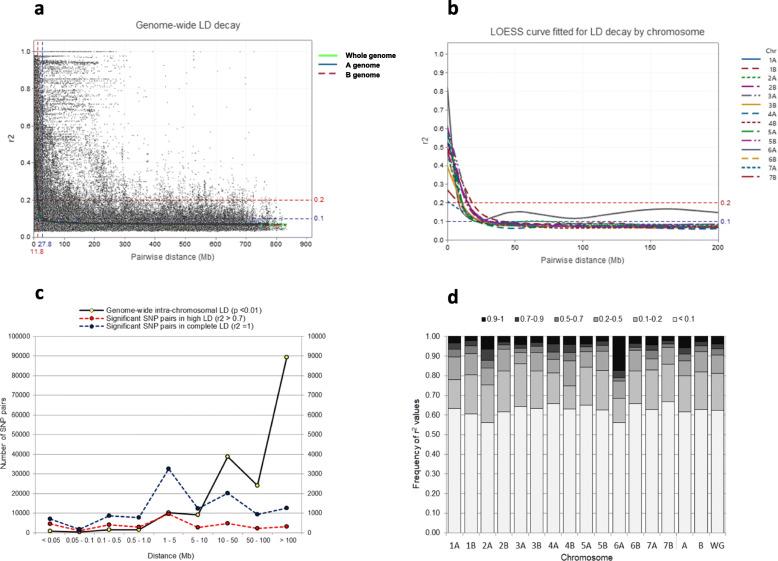
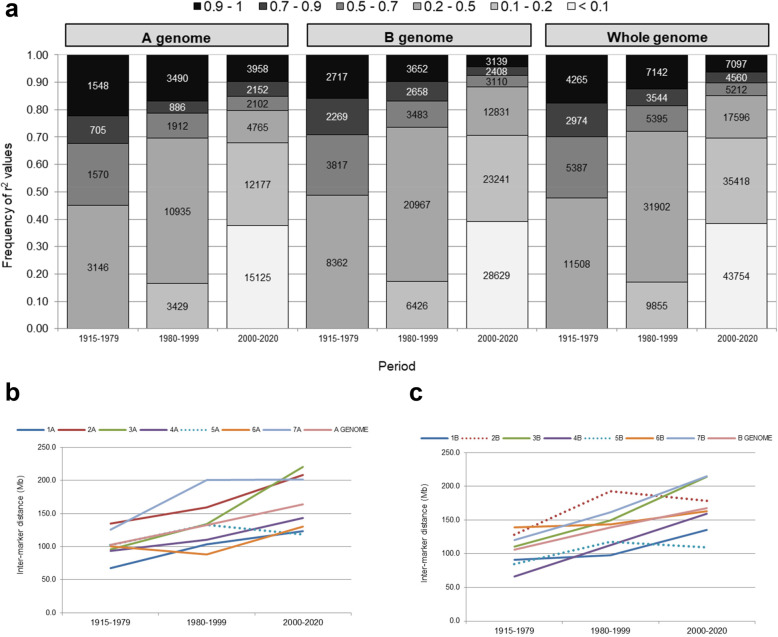
We assessed the genetic diversity, population structure and linkage disequilibrium (LD) patterns in this collection using a 35 K SNP array. The level of polymorphism was considered, taking account of the frequent and rare allelic variants. A total of 1547 polymorphic SNPs was located within annotated genes. Genetic diversity in the germplasm collection increased slightly from 1915 to 2010. However, a reduction in genetic diversity using SNPs with rare allelic variants was observed after 1979. However, larger numbers of rare private alleles were observed in the 2000-2009 period, indicating that a high reservoir of rare alleles is still present among the recent germplasm in a very low frequency. The percentage of pairwise loci in LD in the durum genome was low (13.4%) in our collection. Overall LD and the high (r > 0.7) or complete (r = 1) LD presented different patterns in the chromosomes. The LD increased over three main breeding periods (1915-1979, 1980-1999 and 2000-2020).
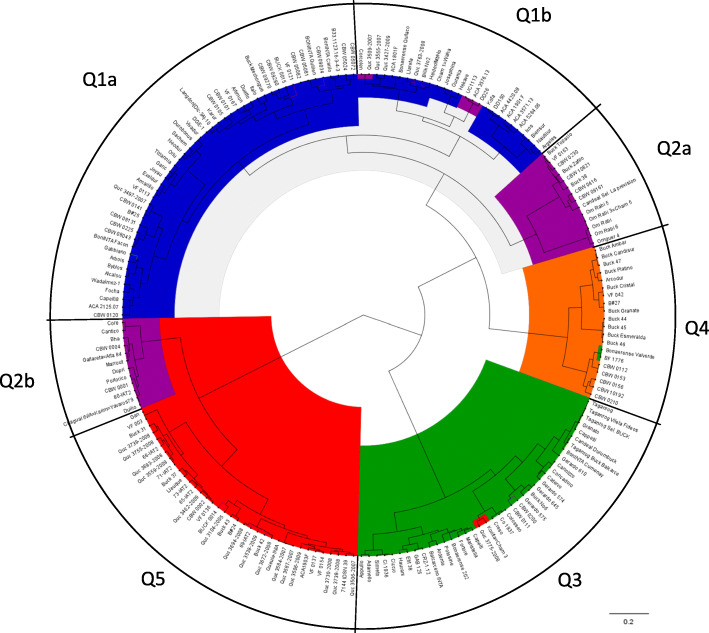
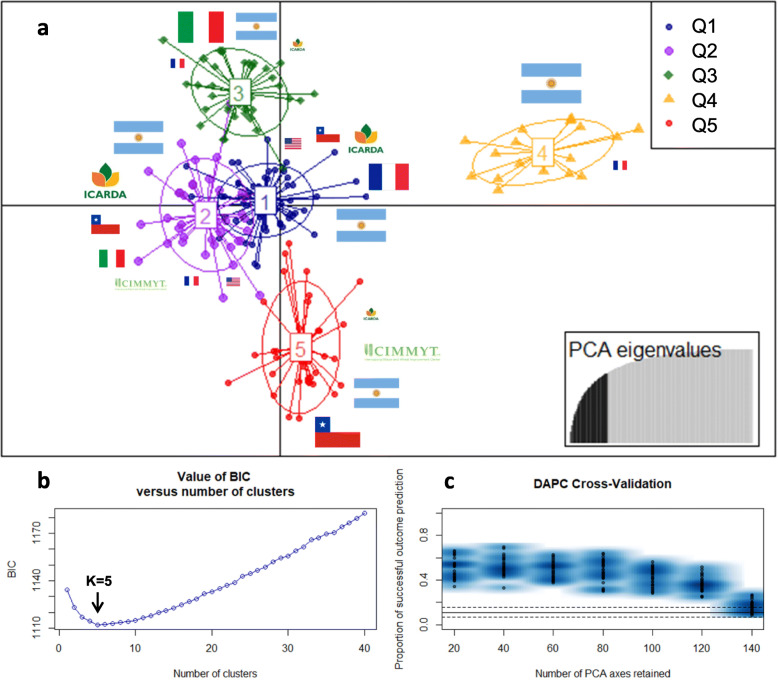
Our results suggest that breeding and selection have impacted differently on the A and B genomes, particularly on chromosome 6A and 2A. The collection was structured in five sub-populations and modern Argentinian accessions (cluster Q4) which were clearly differentiated. Our study contributes to the understanding of the complexity of Argentinian durum wheat germplasm and to derive future breeding strategies enhancing the use of genetic diversity in a more efficient and targeted way.
硬粒小麦(Triticum turgidum L. ssp. durum Desf. Husn)是全球用于制作意大利面制品的主要主食作物。在当前气候变化情景下,作物内部的遗传变异性对于成功培育出高产且适应性广泛的新品种起着关键作用。在本研究中,我们评估了一个由197个基因型组成的硬粒小麦群体,该群体主要包括一组阿根廷历史种质,但也包含了来自世界各地的种质。
我们使用一个35K SNP阵列评估了该群体的遗传多样性、群体结构和连锁不平衡(LD)模式。考虑到常见和罕见等位基因变体,评估了多态性水平。共有1547个多态性SNP位于注释基因内。种质群体的遗传多样性在1915年至2010年间略有增加。然而,在1979年之后,观察到使用具有罕见等位基因变体的SNP时遗传多样性有所降低。不过,在2000 - 2009年期间观察到大量罕见的私有等位基因,这表明在近期种质中仍存在频率极低的大量罕见等位基因库。在我们的群体中,硬粒小麦基因组中处于LD状态的成对位点百分比很低(13.4%)。总体LD以及高(r > 0.7)或完全(r = 1)LD在染色体上呈现出不同模式。LD在三个主要育种时期(1915 - 1979年、1980 - 1999年和2000 - 2020年)有所增加。
我们的结果表明,育种和选择对A和B基因组的影响不同,特别是对6A和2A染色体。该群体被划分为五个亚群,现代阿根廷种质(聚类Q4)明显不同。我们的研究有助于理解阿根廷硬粒小麦种质的复杂性,并推导未来育种策略,以更有效和有针对性的方式加强遗传多样性的利用。