Horvat Filip, Fulka Helena, Jankele Radek, Malik Radek, Jun Ma, Solcova Katerina, Sedlacek Radislav, Vlahovicek Kristian, Schultz Richard M, Svoboda Petr
Institute of Molecular Genetics of the Czech Academy of Sciences, Prague, Czech Republic.
Bioinformatics Group, Division of Molecular Biology, Department of Biology, Faculty of Science, University of Zagreb, Zagreb, Croatia.
Life Sci Alliance. 2018 Jul 16;1(4):e201800084. doi: 10.26508/lsa.201800084. eCollection 2018 Aug.
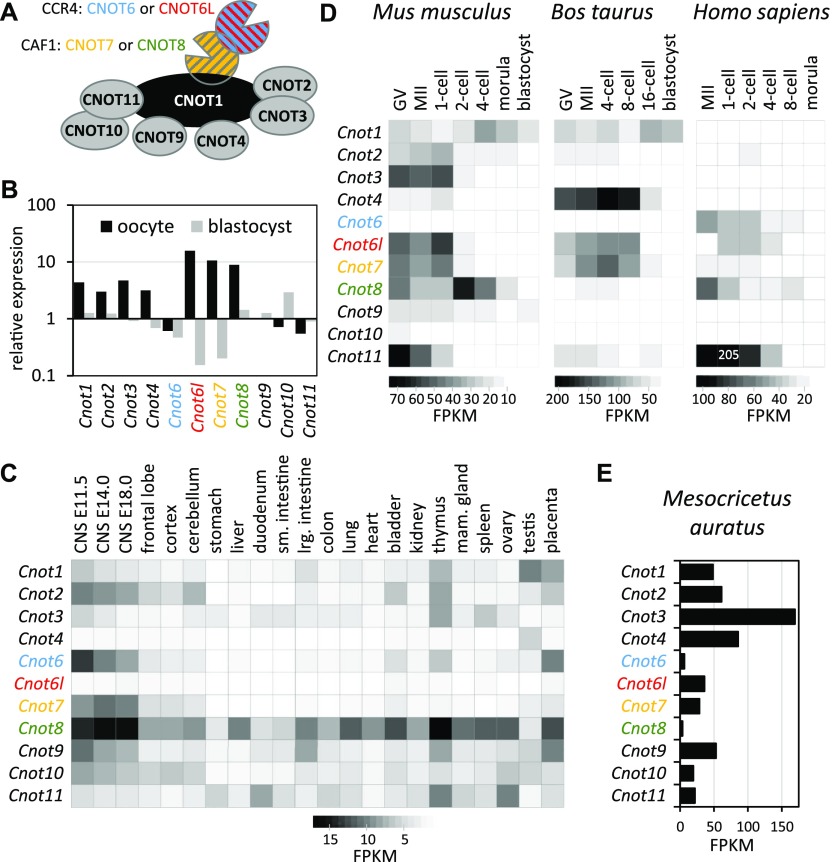
Removal of poly(A) tail is an important mechanism controlling eukaryotic mRNA turnover. The major eukaryotic deadenylase complex CCR4-NOT contains two deadenylase components, CCR4 and CAF1, for which mammalian CCR4 is encoded by or paralogs. We show that apparently supplies the majority of CCR4 in the maternal CCR4-NOT in mouse, hamster, and bovine oocytes. Deletion of yielded viable mice, but females exhibited ∼40% smaller litter size. The main onset of the phenotype was post-zygotic: fertilized eggs developed slower and arrested more frequently than eggs, suggesting that maternal CNOT6L is necessary for accurate oocyte-to-embryo transition. Transcriptome analysis revealed major transcriptome changes in ovulated eggs and one-cell zygotes. In contrast, minimal transcriptome changes in preovulatory oocytes were consistent with reported mRNA dormancy. A minimal overlap between transcripts sensitive to decapping inhibition and loss suggests that decapping and CNOT6L-mediated deadenylation selectively target distinct subsets of mRNAs during oocyte-to-embryo transition in mouse.
去除多聚腺苷酸尾是控制真核生物mRNA周转的重要机制。主要的真核生物去腺苷酸化酶复合物CCR4-NOT包含两种去腺苷酸化酶成分,即CCR4和CAF1,哺乳动物的CCR4由 或 旁系同源物编码。我们发现,在小鼠、仓鼠和牛的卵母细胞中, 显然为母源CCR4-NOT中的大部分CCR4提供了来源。敲除 可产生存活的小鼠,但 雌性小鼠的产仔数减少了约40%。该表型的主要发病期是在合子后:受精的 卵比 卵发育得更慢,且更频繁地停滞,这表明母源CNOT6L对于从卵母细胞到胚胎的准确转变是必需的。转录组分析揭示了排卵卵和单细胞合子中的主要转录组变化。相比之下,排卵前 卵母细胞中最小的转录组变化与报道的 mRNA休眠一致。对脱帽抑制敏感的转录本与 缺失之间的最小重叠表明,在小鼠从卵母细胞到胚胎的转变过程中,脱帽和CNOT6L介导的去腺苷酸化选择性地靶向不同的mRNA亚群。