Emerg Infect Dis. 2018 Dec;24(12):2303-2308. doi: 10.3201/eid2412.180409.
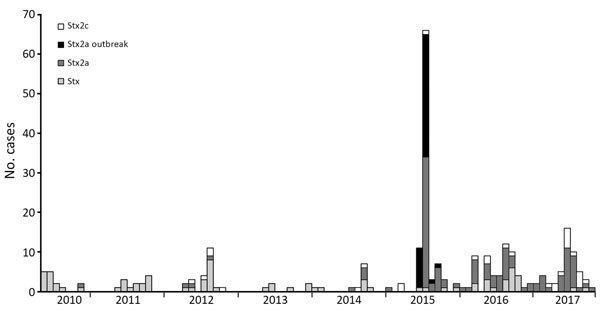
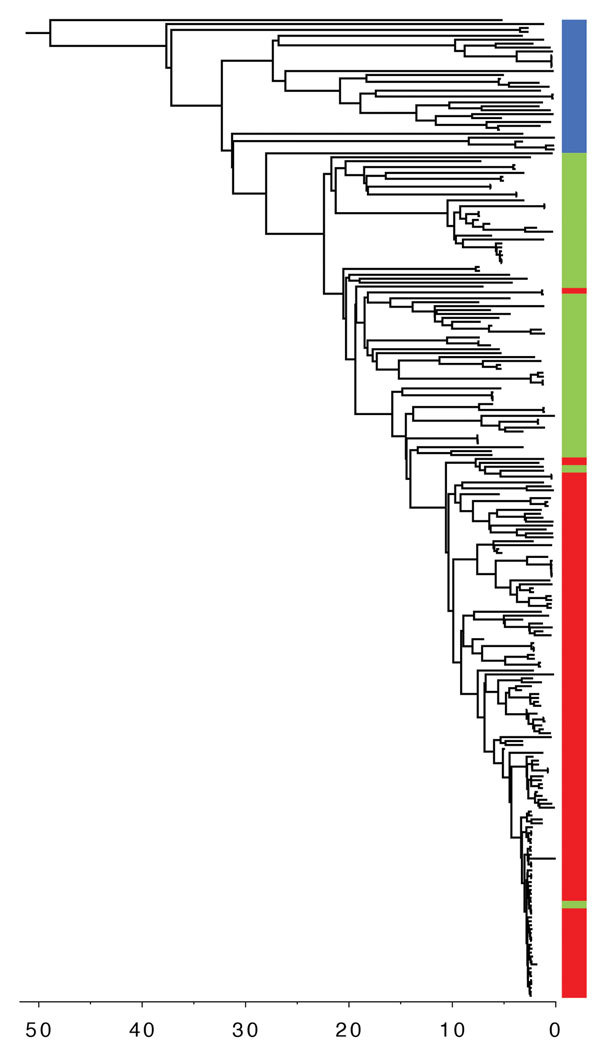
We used whole-genome sequencing to investigate the evolutionary context of an emerging highly pathogenic strain of Shiga toxin-producing Escherichia coli (STEC) O157:H7 in England and Wales. A timed phylogeny of sublineage IIb revealed that the emerging clone evolved from a STEC O157:H7 stx-negative ancestor ≈10 years ago after acquisition of a bacteriophage encoding Shiga toxin (stx) 2a, which in turn had evolved from a stx2c progenitor ≈20 years ago. Infection with the stx2a clone was a significant risk factor for bloody diarrhea (OR 4.61, 95% CI 2.24-9.48; p<0.001), compared with infection with other strains within sublineage IIb. Clinical symptoms of cases infected with sublineage IIb stx2c and stx-negative clones were comparable, despite the loss of stx2c. Our analysis highlighted the highly dynamic nature of STEC O157:H7 Stx-encoding bacteriophages and revealed the evolutionary history of a highly pathogenic clone emerging within sublineage IIb, a sublineage not previously associated with severe clinical symptoms.
我们使用全基因组测序来研究英国和威尔士出现的高致病性产志贺毒素大肠杆菌(STEC)O157:H7 的进化背景。子谱系 IIb 的时间进化树表明,该新兴克隆是大约 10 年前从一个 STEC O157:H7 stx 阴性祖先进化而来的,在此之前,它获得了编码志贺毒素(stx)2a 的噬菌体,而 stx2a 又大约 20 年前从 stx2c 前体进化而来。与感染子谱系 IIb 中的其他菌株相比,感染 stx2a 克隆是血性腹泻的一个重要危险因素(OR 4.61,95%CI 2.24-9.48;p<0.001)。尽管 stx2c 丢失了,但感染子谱系 IIb stx2c 和 stx 阴性克隆的临床症状是可比的。我们的分析突出了 STEC O157:H7 编码志贺毒素的噬菌体的高度动态性质,并揭示了在子谱系 IIb 内出现的高致病性克隆的进化历史,该子谱系以前与严重的临床症状无关。