Cancer Prevention and Control, Lombardi Comprehensive Cancer Center, Georgetown University, Washington, District of Columbia, USA.
Department of Health Management and Policy, School of Public Health, University of Michigan, Ann Arbor, Michigan, USA.
Tob Control. 2019 Nov;28(6):629-635. doi: 10.1136/tobaccocontrol-2018-054446. Epub 2018 Nov 20.
The 2018 National Academies of Sciences, Engineering, and Medicine Report found substantial evidence that electronic cigarette use (vaping) by youth is strongly associated with an increased risk of ever using cigarettes (smoking) and moderately associated with progressing to more established smoking. However, the Report also noted that recent increases in vaping have been associated with declining rates of youth smoking. This paper examines the temporal relationship between vaping and youth smoking using multiple data sets to explore the question of whether vaping promotes smoking initiation in the USA.
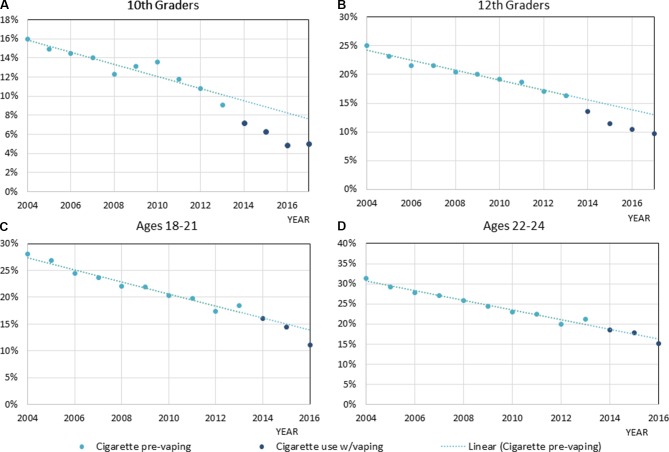
Using publicly available, nationally representative data on smoking and vaping among youth and young adults, we conducted a trend line analysis of deviations from long-term trends in smoking starting from when vaping became more prevalent.
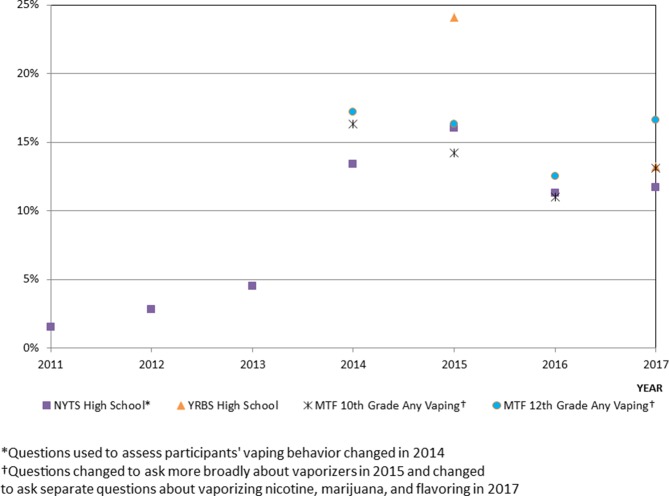
There was a substantial increase in youth vaping prevalence beginning in about 2014. Time trend analyses showed that the decline in past 30-day smoking prevalence accelerated by two to four times after 2014. Indicators of more established smoking rates, including the proportion of daily smokers among past 30-day smokers, also decreased more rapidly as vaping became more prevalent.
The inverse relationship between vaping and smoking was robust across different data sets for both youth and young adults and for current and more established smoking. While trying electronic cigarettes may causally increase smoking among some youth, the aggregate effect at the population level appears to be negligible given the reduction in smoking initiation during the period of vaping's ascendance.
2018 年美国国家科学院、工程院和医学院的报告发现,大量证据表明,青少年使用电子烟(蒸气烟)与增加吸烟(吸烟)的风险密切相关,与更成熟的吸烟行为进展中度相关。然而,该报告还指出,最近蒸气烟使用的增加与青少年吸烟率的下降有关。本文使用多个数据集研究蒸气烟和青少年吸烟之间的时间关系,以探讨蒸气烟是否在美国促进了吸烟的开始。
使用关于青少年和年轻人吸烟和蒸气烟的公开、全国代表性数据,我们从蒸气烟变得更普遍时开始,对吸烟开始的长期趋势进行偏离的趋势线分析。
从大约 2014 年开始,青少年蒸气烟的流行率大幅上升。时间趋势分析显示,2014 年后,过去 30 天吸烟率的下降速度加快了两到四倍。更成熟的吸烟率指标,包括过去 30 天吸烟者中每日吸烟者的比例,也随着蒸气烟的普及而更快地下降。
蒸气烟和吸烟之间的反比关系在青少年和年轻人的不同数据集以及当前和更成熟的吸烟方面都是稳健的。虽然尝试电子烟可能会导致一些青少年吸烟,但鉴于蒸气烟兴起期间吸烟率的下降,在人群水平上的总体影响似乎可以忽略不计。