Center for Tobacco Research, The Ohio State University Comprehensive Cancer Center, Columbus.
Division of Health Behavior & Health Promotion, College of Public Health, The Ohio State University, Columbus.
JAMA Netw Open. 2024 Aug 1;7(8):e2426702. doi: 10.1001/jamanetworkopen.2024.26702.
Concerns have been raised about the abuse liability of modern e-cigarettes that use acidic additives to form nicotine salts, making the inhalation of nicotine smoother than freebase nicotine.
To examine the effects of nicotine form and concentration and e-liquid flavor on subjective effects ratings, vaping behavior, and nicotine uptake among young adults who use e-cigarettes.
DESIGN, SETTING, AND PARTICIPANTS: In this single-blind, within-participant, crossover randomized clinical trial, a convenience sample of young adults aged 21 to 25 years who currently used e-cigarettes was recruited from December 2021 to August 2023, for in-person research laboratory visits in Columbus, Ohio.
Participants completed up to 9 vaping sessions, starting with their usual e-cigarette brand in the first session followed by 1 of 8 laboratory-prepared e-liquids in a randomly assigned order in each subsequent session. Prepared e-liquids varied by nicotine form (salt-based vs freebase), nicotine concentration (5% vs 1% weight per weight), and flavor (menthol vs tobacco). Each session included a 5-minute, 10-puff standardized vaping period followed by 30 minutes of ad libitum vaping.
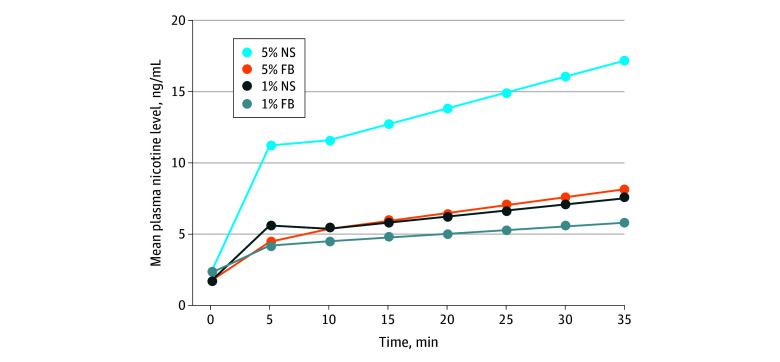
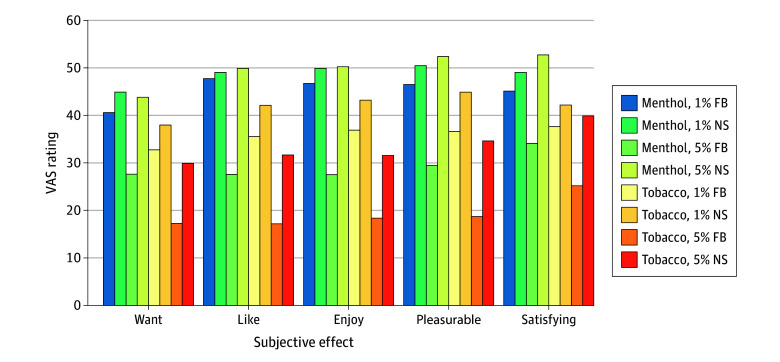
At 4 time points (0, 5, 10, and 35 minutes) during each vaping session, plasma samples were collected for assessing nicotine uptake, and self-reports of urges, craving, and withdrawal were collected via questionnaires. Positive subjective effects were self-reported after 35 minutes of vaping using a visual analog scale; urges and cravings were reported using the Questionnaire of Smoking Urges (QSU). Puff topography data were collected throughout each vaping session.
Seventy-two participants (mean [SD] age, 22.4 [1.4] years; 42 [58.3%] female) who sampled at least 1 laboratory-prepared e-liquid composed the analytic sample. Salt-based (vs freebase) nicotine e-liquids increased nicotine intake, with 5% salt-based e-liquids delivering the highest mean plasma levels of nicotine (11.2 ng/mL [95% CI, 9.3-13.2 ng/mL] at 5 minutes; 17.2 ng/mL [95% CI, 14.3-20.1 ng/mL] at 35 minutes) irrespective of flavors. Higher positive subjective effect ratings (eg, for liking) were received by salt-based (42.8; 95% CI, 39.4-46.1) vs freebase (32.0; 95% CI, 28.6-35.3) nicotine, 1% (43.4; 95% CI, 40.2-46.6) vs 5% (31.2; 95% CI, 27.7-34.6) nicotine, and menthol-flavored (43.2; 95% CI, 39.7-46.7) vs tobacco-flavored (31.5; 95% CI, 28.4-34.7) e-liquids. Salt-based and 1% but not menthol-flavored nicotine elicited more intense puffing (eg, 25% [95% CI, 12%-40%] more total puffs for nicotine salts vs freebase). All study e-liquids reduced urges and cravings, with 5% vs 1% nicotine being more effective (mean [SE] QSU-Desire score at 35 minutes, 15.4 [0.5] vs 16.7 [0.5]).
In this crossover randomized clinical trial among young adult e-cigarette users, salt-based (vs freebase) nicotine e-liquids increased nicotine intake and yielded more positive subjective effects ratings and intense puffing behaviors, suggesting higher abuse potential. Restricting the level of acidic additives and menthol flavoring may reduce the addictiveness of e-cigarettes.
ClinicalTrials.gov Identifier: NCT05458895.
人们对使用酸性添加剂形成尼古丁盐的现代电子烟的滥用倾向表示担忧,这使得尼古丁的吸入比游离碱尼古丁更顺畅。
研究尼古丁形式和浓度以及电子烟液口味对年轻成年电子烟使用者的主观效果评分、吸烟行为和尼古丁摄入的影响。
设计、地点和参与者:在这项单盲、参与者内、交叉随机临床试验中,从 2021 年 12 月至 2023 年 8 月,在俄亥俄州哥伦布市的现场研究实验室中,招募了目前使用电子烟的 21 至 25 岁的年轻成年人作为便利样本。
参与者完成了多达 9 次吸烟会议,首先是在第一次会议中使用他们通常使用的电子烟品牌,然后在随后的每次会议中按照随机顺序使用 8 种实验室制备的电子烟液中的 1 种。准备好的电子烟液在尼古丁形式(盐基与游离碱)、尼古丁浓度(5%与 1%重量比)和口味(薄荷醇与烟草)方面有所不同。每次会议包括 5 分钟、10 口标准化吸烟期,随后是 30 分钟的自由吸烟期。
在每次吸烟会议的 4 个时间点(0、5、10 和 35 分钟)收集血浆样本以评估尼古丁摄入情况,并通过问卷收集吸烟欲望、渴望和戒断的自我报告。吸烟 35 分钟后,使用视觉模拟量表自我报告积极的主观效果;使用吸烟欲望问卷(QSU)报告吸烟欲望和渴望。在每次吸烟会议期间收集吸烟量数据。
在至少采样了 1 种实验室制备的电子烟液的 72 名参与者(平均[标准差]年龄,22.4[1.4]岁;42[58.3%]名女性)组成了分析样本。盐基(与游离碱)尼古丁电子烟液增加了尼古丁的摄入,5%盐基电子烟液在 5 分钟时提供了最高的尼古丁血浆水平(11.2ng/mL[95%置信区间,9.3-13.2ng/mL];35 分钟时为 17.2ng/mL[95%置信区间,14.3-20.1ng/mL]),无论口味如何。盐基(42.8;95%置信区间,39.4-46.1)与游离碱(32.0;95%置信区间,28.6-35.3)尼古丁、1%(43.4;95%置信区间,40.2-46.6)与 5%(31.2;95%置信区间,27.7-34.6)尼古丁以及薄荷醇味(43.2;95%置信区间,39.7-46.7)与烟草味(31.5;95%置信区间,28.4-34.7)电子烟液的积极主观效果评分(例如,喜欢程度)更高。盐基和 1%,但不是薄荷醇味,会引起更强烈的吸烟行为(例如,尼古丁盐比游离碱多吸 25%[95%置信区间,12%-40%]的总口数)。所有研究电子烟液都减少了吸烟欲望和渴望,5%尼古丁比 1%尼古丁更有效(35 分钟时 QSU-欲望评分的平均[SE],15.4[0.5]比 16.7[0.5])。
在这项针对年轻成年电子烟使用者的交叉随机临床试验中,盐基(与游离碱)尼古丁电子烟液增加了尼古丁的摄入,并产生了更高的积极主观效果评分和更强烈的吸烟行为,表明潜在的滥用风险更高。限制酸性添加剂和薄荷醇调味剂的水平可能会降低电子烟的成瘾性。
ClinicalTrials.gov 标识符:NCT05458895。