Department of Hepatobiliary and Pancreatic Surgery, the Second Affiliated Hospital, Zhejiang University School of Medicine.
Department of Radiology, the Second Affiliated Hospital, Zhejiang University School of Medicine.
Oncologist. 2019 Mar;24(3):301-e93. doi: 10.1634/theoncologist.2018-0696. Epub 2018 Nov 20.
Modification of FOLFIRINOX significantly improves safety and tolerability in Chinese patients with locally advanced pancreatic cancer.Patients with locally advanced pancreatic cancer benefit from neoadjuvant therapy and experience a much better survival than patients with upfront surgery.
The objective of this study was to evaluate the efficacy of modified-FOLFIRINOX (mFOLFIRINOX) regimens in Chinese patients with locally advanced pancreatic cancer (LAPC) and to compare outcomes between patients with LAPC treated with mFOLFIRINOX-based neoadjuvant therapy (LAPC-N) and patients with LAPC who underwent upfront surgery (LAPC-S).
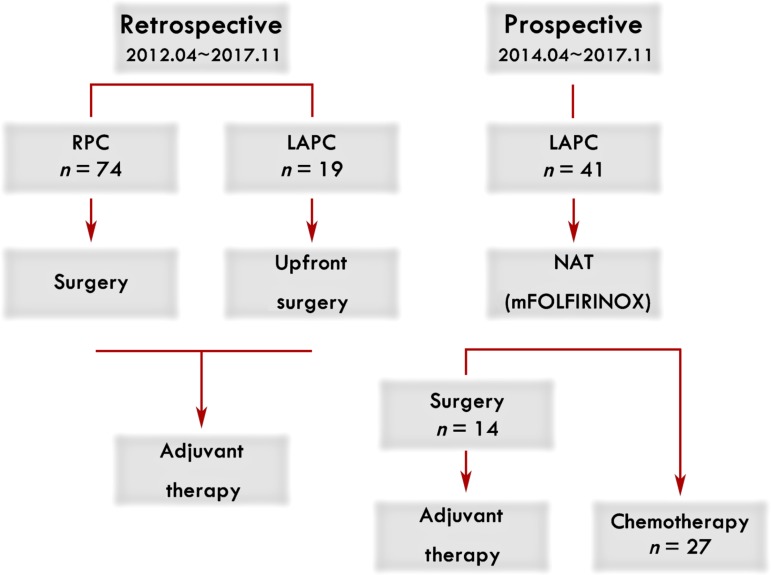
Forty-one patients with LAPC-N were enrolled prospectively. Imaging features, chemotherapy response, adverse events, perioperative complications, histology, and survival were analyzed. Seventy-four patients with resectable pancreatic cancer (RPC) (from April 2012 to November 2017) and 19 patients with LAPC-S (from April 2012 to March 2014) were set as observational cohorts, and data were collected retrospectively. LAPC-N patients with adequate response underwent surgical treatment, whereas continuous chemotherapy was given to LAPC-N patients who were not deemed resectable after treatment, and the response was re-evaluated every 2 months.
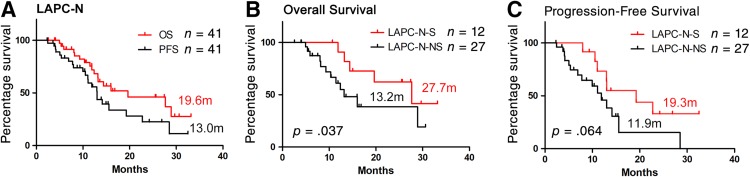
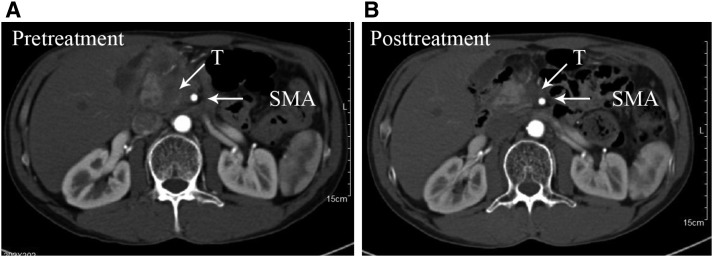
Forty-one patients with LAPC received mFOLFIRINOX with a response rate of 37.1%. The most common severe adverse events were neutropenia and anemia. mFOLFIRINOX-based neoadjuvant therapy contributed to a remarkable decrease in CA19-9 level and tumor diameter. Fourteen LAPC-N patients underwent surgery (LAPC-N-S) after downstaging. Compared with LAPC-N-S cases, LAPC-S patients had longer operative time, more blood loss, and a higher risk of grade 5 complications. The median overall survival (OS) and progression-free survival (PFS) of LAPC-N-S patients were 27.7 months and 19.3 months, respectively, which were similar to those of patients with RPC (30.0 months and 23.0 months) and much longer than those of patients with LAPC-S (8.9 months and 7.6 months), respectively.
Neoadjuvant chemotherapy such as the mFOLFIRINOX regimen can be recommended for Chinese patients with LAPC after dose modification. Patients with LAPC-N who underwent surgery obtained significantly improved survival compared with patients in the observational LAPC-S cohort, who did not undergo neoadjuvant therapy.
改良 FOLFIRINOX 方案显著提高了局部晚期胰腺癌中国患者的安全性和耐受性。局部晚期胰腺癌患者受益于新辅助治疗,生存状况明显优于直接手术患者。
本研究旨在评估改良 FOLFIRINOX(mFOLFIRINOX)方案在中国局部晚期胰腺癌(LAPC)患者中的疗效,并比较接受 mFOLFIRINOX 新辅助治疗(LAPC-N)的 LAPC 患者和直接手术(LAPC-S)的 LAPC 患者的结局。
前瞻性纳入 41 例 LAPC-N 患者。分析影像学特征、化疗反应、不良反应、围手术期并发症、组织学和生存情况。以 2012 年 4 月至 2017 年 11 月间的 74 例可切除胰腺癌(RPC)患者和 2012 年 4 月至 2014 年 3 月间的 19 例 LAPC-S 患者为观察队列,收集回顾性数据。对治疗后反应充分的 LAPC-N 患者进行手术治疗,对认为不可切除的患者继续给予 mFOLFIRINOX 化疗,每 2 个月评估一次反应。
41 例 LAPC 患者接受 mFOLFIRINOX 治疗,反应率为 37.1%。最常见的严重不良反应是中性粒细胞减少和贫血。mFOLFIRINOX 新辅助治疗可显著降低 CA19-9 水平和肿瘤直径。14 例 LAPC-N 患者经降期后行手术治疗(LAPC-N-S)。与 LAPC-N-S 患者相比,LAPC-S 患者的手术时间更长、出血量更多、5 级并发症风险更高。LAPC-N-S 患者的中位总生存期(OS)和无进展生存期(PFS)分别为 27.7 个月和 19.3 个月,与 RPC 患者(30.0 个月和 23.0 个月)相似,长于 LAPC-S 患者(8.9 个月和 7.6 个月)。
中国局部晚期胰腺癌患者接受改良 FOLFIRINOX 方案新辅助化疗是安全可行的。接受手术治疗的 LAPC-N 患者的生存状况显著优于未接受新辅助治疗的观察性 LAPC-S 队列患者。