Department of Pediatrics, Division of Medical Genetics, Stanford University, Palo Alto, CA, USA.
Department of Pathology, Cytogenetics and Genomics Laboratory, University of Washington, Seattle, WA, USA.
J Perinatol. 2019 Jan;39(1):28-33. doi: 10.1038/s41372-018-0278-5. Epub 2018 Nov 21.
Non-invasive prenatal screening (NIPS) utilizes circulating cell-free DNA (cfDNA) to screen for fetal genetic abnormalities. NIPS is the first widely-available prenatal screen to assess genotypic sex. Most pediatricians have limited familiarity with NIPS technology and potential etiologies of discordant results. Increased familiarity may provide diagnostic insight and improve clinical care.
We reviewed all patients with discordant genotypic fetal sex assessed by cfDNA and neonatal phenotypic sex referred to our medical center.
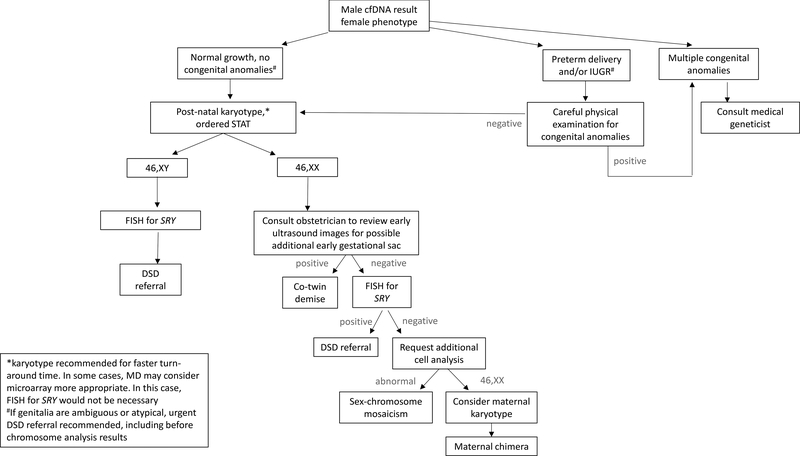
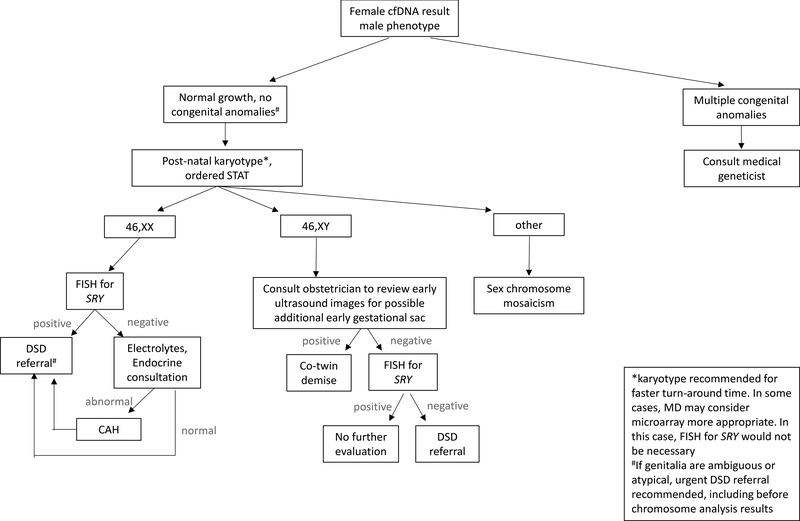
Four infants with discordant cfDNA result and phenotypic sex were identified. Etiologies include vanishing twin syndrome, difference of sexual development, sex chromosome aneuploidy and maternal chimerism.
We present four cases illustrating potential etiologies of discordant cfDNA result and postnatal phenotypic sex. Unanticipated cfDNA results offer the perinatologist a unique opportunity for early diagnosis and targeted treatment of various conditions, many of which may not have otherwise been detected in the perinatal period.
无创产前筛查(NIPS)利用循环游离 DNA(cfDNA)筛查胎儿遗传异常。NIPS 是首个广泛可用的产前筛查方法,用于评估基因型性别。大多数儿科医生对 NIPS 技术和结果不一致的潜在病因了解有限。增加熟悉程度可能提供诊断见解并改善临床护理。
我们回顾了所有因 cfDNA 评估的基因型胎儿性别不一致并转诊至我们医疗中心的新生儿表型性别的患者。
确定了 4 例 cfDNA 结果和表型性别不一致的婴儿。病因包括双胎消失综合征、性发育差异、性染色体非整倍体和母体嵌合体。
我们提出了 4 个病例,说明了 cfDNA 结果和产后表型性别不一致的潜在病因。意外的 cfDNA 结果为围生期医生提供了一个独特的机会,可早期诊断和靶向治疗各种病症,其中许多病症在围产期可能无法检测到。