Lambert Matthias, Bastide Bruno, Cieniewski-Bernard Caroline
Equipe Activité Physique, Muscle, Santé, Unité de Recherche Pluridisciplinaire Sport, Santé, Société (EA7369-URePSSS), Faculté des Sciences et Technologies, Université de Lille, Lille, France.
Front Endocrinol (Lausanne). 2018 Oct 16;9:578. doi: 10.3389/fendo.2018.00578. eCollection 2018.
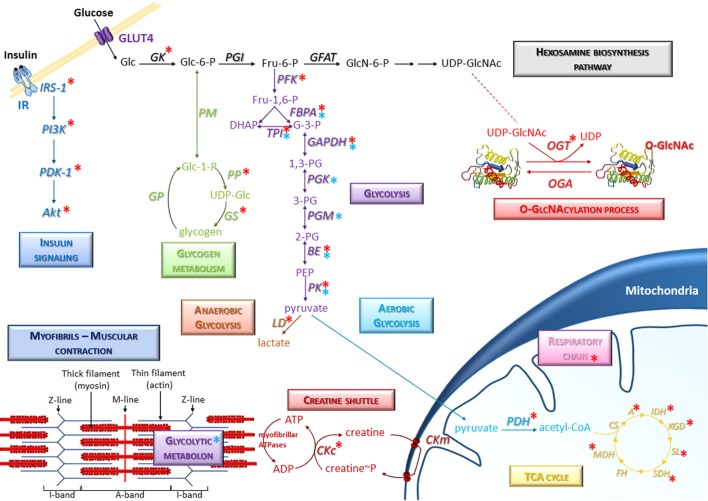
Skeletal muscle represents around 40% of whole body mass. The principal function of skeletal muscle is the conversion of chemical energy toward mechanic energy to ensure the development of force, provide movement and locomotion, and maintain posture. This crucial energy dependence is maintained by the faculty of the skeletal muscle for being a central place as a "reservoir" of amino acids and carbohydrates in the whole body. A fundamental post-translational modification, named O-GlcNAcylation, depends, , on these nutrients; it consists to the transfer or the removal of a unique monosaccharide (N-acetyl-D-glucosamine) to a serine or threonine hydroxyl group of nucleocytoplasmic and mitochondrial proteins in a dynamic process by the O-GlcNAc Transferase (OGT) and the O-GlcNAcase (OGA), respectively. O-GlcNAcylation has been shown to be strongly involved in crucial intracellular mechanisms through the modulation of signaling pathways, gene expression, or cytoskeletal functions in various organs and tissues, such as the brain, liver, kidney or pancreas, and linked to the etiology of associated diseases. In recent years, several studies were also focused on the role of O-GlcNAcylation in the physiology and the physiopathology of skeletal muscle. These studies were mostly interested in O-GlcNAcylation during muscle exercise or muscle-wasting conditions. Major findings pointed out a different "O-GlcNAc signature" depending on muscle type metabolism at resting, wasting and exercise conditions, as well as depending on acute or long-term exhausting exercise protocol. First insights showed some differential OGT/OGA expression and/or activity associated with some differential stress cellular responses through Reactive Oxygen Species and/or Heat-Shock Proteins. Robust data displayed that these O-GlcNAc changes could lead to (i) a differential modulation of the carbohydrates metabolism, since the majority of enzymes are known to be O-GlcNAcylated, and to (ii) a differential modulation of the protein synthesis/degradation balance since O-GlcNAcylation regulates some key signaling pathways such as Akt/GSK3β, Akt/mTOR, Myogenin/Atrogin-1, Myogenin/Mef2D, Mrf4 and PGC-1α in the skeletal muscle. Finally, such involvement of O-GlcNAcylation in some metabolic processes of the skeletal muscle might be linked to some associated diseases such as type 2 diabetes or neuromuscular diseases showing a critical increase of the global O-GlcNAcylation level.
骨骼肌约占全身质量的40%。骨骼肌的主要功能是将化学能转化为机械能,以确保力量的产生、提供运动和移动,并维持姿势。骨骼肌作为全身氨基酸和碳水化合物的“储存库”这一核心地位,维持了这种关键的能量依赖性。一种名为O-连接N-乙酰葡糖胺化的重要翻译后修饰依赖于这些营养物质;它包括在一个动态过程中,由O-连接N-乙酰葡糖胺转移酶(OGT)和O-连接N-乙酰葡糖胺酶(OGA)分别将一种独特的单糖(N-乙酰-D-葡糖胺)转移或去除到核质和线粒体蛋白的丝氨酸或苏氨酸羟基上。已表明O-连接N-乙酰葡糖胺化通过调节信号通路、基因表达或细胞骨架功能,在大脑、肝脏、肾脏或胰腺等各种器官和组织的关键细胞内机制中发挥重要作用,并与相关疾病的病因有关。近年来,多项研究也聚焦于O-连接N-乙酰葡糖胺化在骨骼肌生理和病理生理中的作用。这些研究主要关注肌肉运动或肌肉萎缩状态下的O-连接N-乙酰葡糖胺化。主要研究结果指出,根据静息、萎缩和运动状态下的肌肉类型代谢,以及急性或长期疲劳运动方案,存在不同的“O-连接N-乙酰葡糖胺特征”。初步见解显示,通过活性氧和/或热休克蛋白,一些OGT/OGA表达和/或活性差异与一些不同的应激细胞反应相关。有力的数据表明,这些O-连接N-乙酰葡糖胺变化可能导致:(i)碳水化合物代谢的差异调节,因为已知大多数酶都被O-连接N-乙酰葡糖胺化;(ii)蛋白质合成/降解平衡的差异调节,因为O-连接N-乙酰葡糖胺化调节骨骼肌中的一些关键信号通路,如Akt/GSK3β、Akt/mTOR、肌细胞生成素/萎缩基因1、肌细胞生成素/Mef2D、Mrf4和PGC-1α。最后,O-连接N-乙酰葡糖胺化在骨骼肌某些代谢过程中的这种参与可能与一些相关疾病有关,如2型糖尿病或神经肌肉疾病,这些疾病显示出整体O-连接N-乙酰葡糖胺化水平显著升高。