School of Medicine, Trinity Biomedical Sciences Institute, Trinity College Dublin, Dublin, Ireland.
National Children's Research Centre, Our Lady's Children's Hospital, Dublin, Ireland.
Front Immunol. 2018 Oct 29;9:2492. doi: 10.3389/fimmu.2018.02492. eCollection 2018.
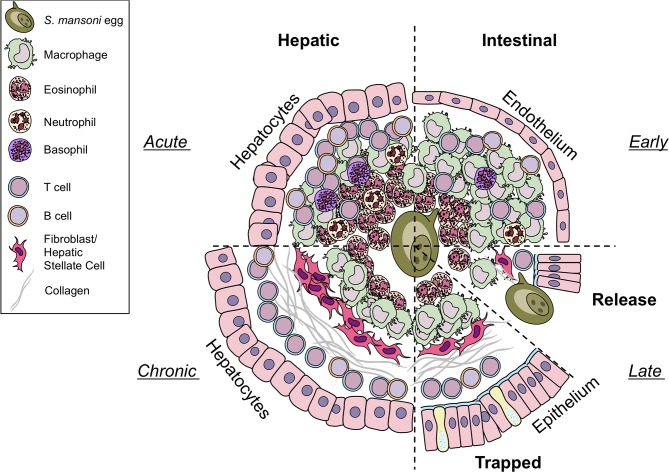
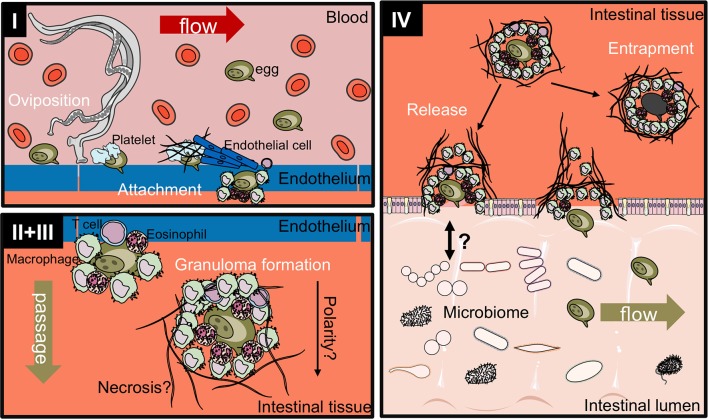
Schistosomiasis is a major cause of morbidity in humans invoked by chronic infection with parasitic trematodes of the genus Schistosoma. Schistosomes have a complex life-cycle involving infections of an aquatic snail intermediate host and a definitive mammalian host. In humans, adult male and female worms lie within the vasculature. Here, they propagate and eggs are laid. These eggs must then be released from the host to continue the life cycle. and reside in the mesenteric circulation of the intestines with egg excreted in the feces. In contrast, are present in the venus plexus of the bladder, expelling eggs in the urine. In an impressive case of exploitation of the host immune system, this process of Schistosome "eggs-iting" the host is immune dependent. In this article, we review the formation of the egg granuloma and explore how eggs laid in vasculature must usurp immunity to induce regulated inflammation, to facilitate extravasation through the intestinal wall and to be expelled in the feces. We highlight the roles of immune cell populations, stromal factors, and egg secretions in the process of egg excretion to provide a comprehensive overview of the current state of knowledge regarding a vastly unexplored mechanism.
血吸虫病是由寄生性吸虫属血吸虫引起的慢性感染导致的主要人类疾病原因。血吸虫具有复杂的生命周期,涉及到水生蜗牛中间宿主和最终哺乳动物宿主的感染。在人类中,成年雌雄虫位于脉管系统内。在这里,它们繁殖并产卵。这些卵必须从宿主中释放出来才能继续生命周期。 和 位于肠道的肠系膜循环中,卵在粪便中排出。相比之下, 位于膀胱的静脉丛中,卵在尿液中排出。在宿主免疫系统被利用的惊人案例中,这种血吸虫“产卵”宿主的过程依赖于免疫。在本文中,我们回顾了卵肉芽肿的形成,并探讨了在血管中产卵的卵如何篡夺免疫来诱导调节性炎症,从而促进穿过肠壁的渗出,并在粪便中排出。我们强调了免疫细胞群、基质因子和卵分泌物在卵排泄过程中的作用,提供了对这一广泛未探索机制的当前知识状态的全面概述。