Department of Diagnostic and Interventional Radiology and Nuclear medicine, University Medical Center, Hamburg-Eppendorf, Germany.
Institute of Immunology, University Medical Center, Hamburg-Eppendorf, Germany.
Theranostics. 2020 Feb 3;10(6):2645-2658. doi: 10.7150/thno.38533. eCollection 2020.
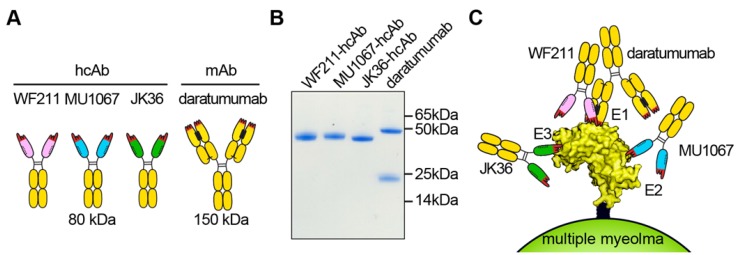
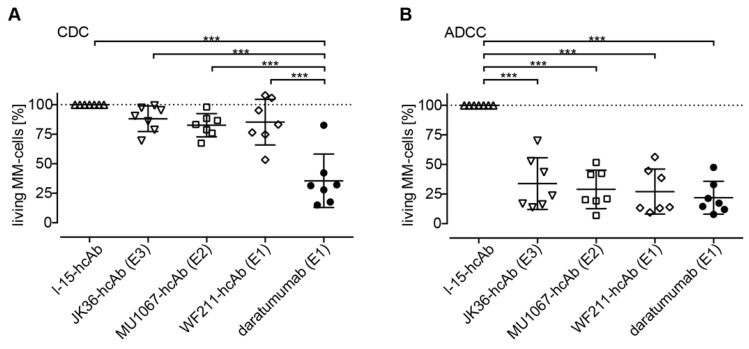
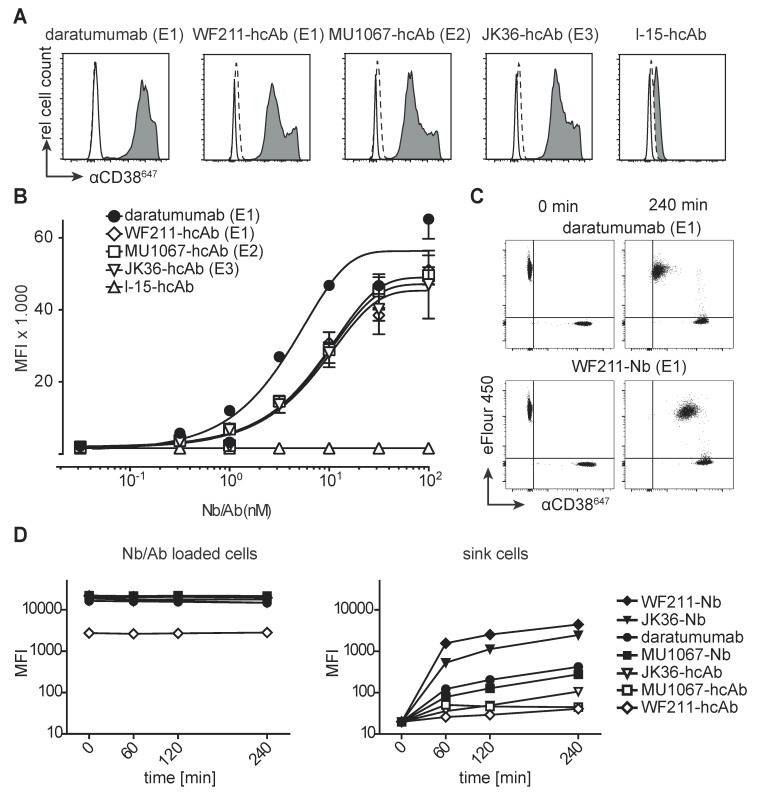
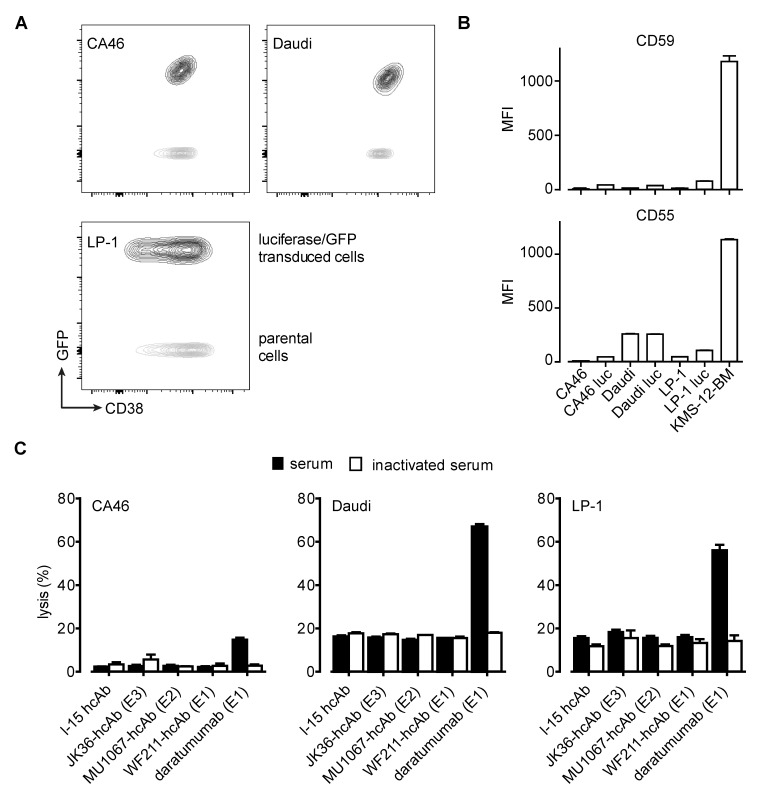
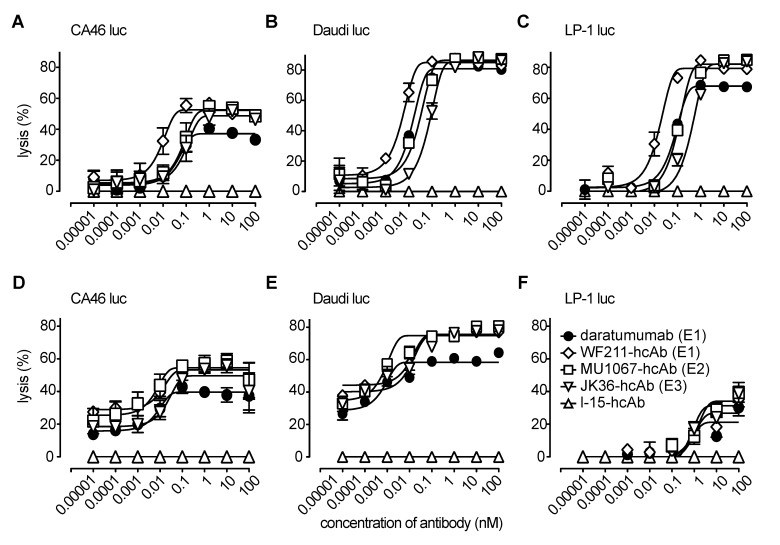
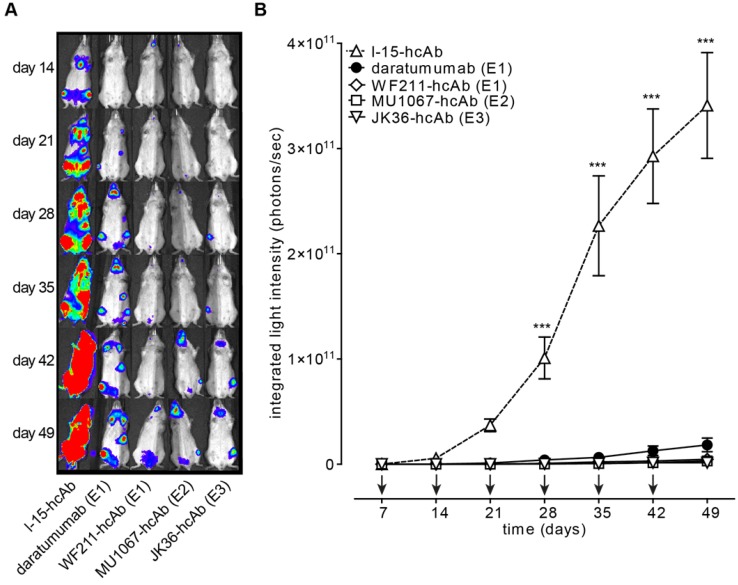
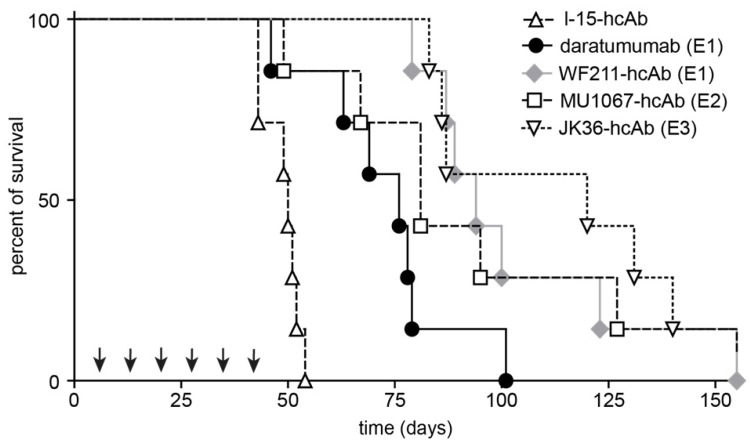
: CD38 is a target for the therapy of multiple myeloma (MM) with monoclonal antibodies such as daratumumab and isatuximab. Since MM patients exhibit a high rate of relapse, the development of new biologics targeting alternative CD38 epitopes is desirable. The discovery of single-domain antibodies (nanobodies) has opened the way for a new generation of antitumor therapeutics. We report the generation of nanobody-based humanized IgG1 heavy chain antibodies (hcAbs) with a high specificity and affinity that recognize three different and non-overlapping epitopes of CD38 and compare their cytotoxicity against CD38-expressing hematological cancer cells , . : We generated three humanized hcAbs (WF211-hcAb, MU1067-hcAb, JK36-hcAb) that recognize three different non-overlapping epitopes (E1, E2, E3) of CD38 by fusion of llama-derived nanobodies to the hinge- and Fc-domains of human IgG1. WF211-hcAb shares the binding epitope E1 with daratumumab. We compared the capacity of these CD38-specific hcAbs and daratumumab to induce CDC and ADCC in CD38-expressing tumor cell lines and in patient MM cells as well as effects on xenograft tumor growth and survival . : CD38-specific heavy chain antibodies (WF211-hcAb, MU1067-hcAb, JK36-hcAb) potently induced antibody-dependent cellular cytotoxicity (ADCC) in CD38-expressing tumor cell lines and in primary patient MM cells, but only little if any complement-dependent cytotoxicity (CDC). CD38-specific heavy chain antibodies significantly reduced the growth of systemic lymphomas and prolonged survival of tumor bearing SCID mice. : CD38-specific nanobody-based humanized IgG1 heavy chain antibodies mediate cytotoxicity against CD38-expressing hematological cancer cells , . These promising results of our study indicate that CD38-specific hcAbs warrant further clinical development as therapeutics for multiple myeloma and other hematological malignancies.
CD38 是多发性骨髓瘤 (MM) 治疗的靶点,可使用单克隆抗体,如达雷妥尤单抗和伊沙妥昔单抗。由于 MM 患者复发率较高,因此需要开发针对替代 CD38 表位的新型生物制剂。单域抗体 (纳米抗体) 的发现为新一代抗肿瘤治疗药物开辟了道路。我们报告了生成具有高特异性和亲和力的基于纳米抗体的人源化 IgG1 重链抗体 (hcAb),这些抗体识别 CD38 的三个不同且不重叠的表位,并比较它们对表达 CD38 的血液癌症细胞的细胞毒性,。我们通过将骆驼科动物衍生的纳米抗体融合到人 IgG1 的铰链和 Fc 结构域,生成了三种识别 CD38 三个不同不重叠表位 (E1、E2、E3) 的人源化 hcAb (WF211-hcAb、MU1067-hcAb、JK36-hcAb)。WF211-hcAb 与达雷妥尤单抗共享结合表位 E1。我们比较了这些 CD38 特异性 hcAb 和达雷妥尤单抗在表达 CD38 的肿瘤细胞系和患者 MM 细胞中诱导 CDC 和 ADCC 的能力,以及对异种移植肿瘤生长和存活的影响。CD38 特异性重链抗体 (WF211-hcAb、MU1067-hcAb、JK36-hcAb) 可有效诱导表达 CD38 的肿瘤细胞系和原代患者 MM 细胞中的抗体依赖性细胞毒性 (ADCC),但只有少量补体依赖性细胞毒性 (CDC)。CD38 特异性重链抗体显著抑制系统性淋巴瘤的生长并延长荷瘤 SCID 小鼠的存活。CD38 特异性纳米抗体基于人源化 IgG1 重链抗体介导对表达 CD38 的血液癌症细胞的细胞毒性。我们的研究结果表明,CD38 特异性 hcAb 作为多发性骨髓瘤和其他血液恶性肿瘤的治疗药物具有很大的临床开发潜力。