Hughes Maria F, Lenighan Yvonne M, Godson Catherine, Roche Helen M
UCD Diabetes Complications Research Centre, Conway Institute of Biomolecular and Biomedical Research, University College Dublin, Dublin, Ireland.
Nutrigenomics Research Group, UCD Institute of Food and Health, School of Public Health Physiotherapy and Sports Science, University College Dublin, Dublin, Ireland.
Front Cardiovasc Med. 2018 Nov 6;5:148. doi: 10.3389/fcvm.2018.00148. eCollection 2018.
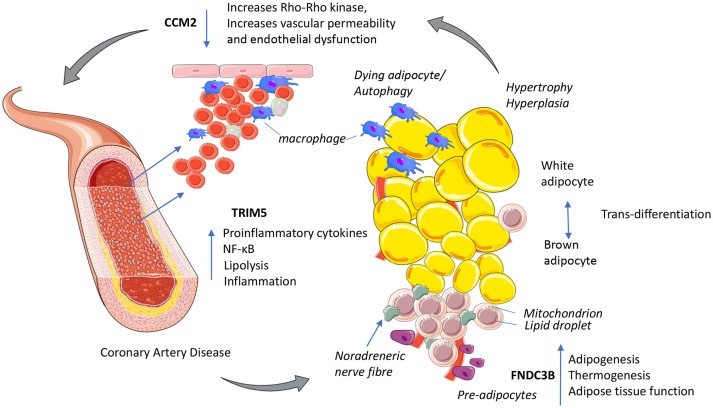
Finding genetic variants that cause functional disruption or regulatory change among the many implicated GWAs variants remains a key challenge to translating the findings from GWAs to therapeutic treatments. Defining the causal mechanisms behind the variants require functional screening experiments that can be complex and costly. Prioritizing variants for functional characterization using techniques that capture important functional and regulatory elements can assist this. The genetic architecture of complex traits such as cardiovascular disease and type II diabetes comprise an enormously large number of variants of small effect contributing to heritability and spread throughout the genome. This makes it difficult to distinguish which variants or core genes are most relevant for prioritization and how they contribute to the regulatory networks that become dysregulated leading to disease. Despite these challenges, recent GWAs for CAD prioritized genes associated with lipid metabolism, coagulation and adhesion along with novel signals related to innate immunity, adipose tissue and, vascular function as important core drivers of risk. We focus on three examples of novel signals associated with CAD which affect risk through missense or UTR mutations indicating their potential for therapeutic modification. These variants play roles in adipose tissue function vascular function and innate immunity which form the cornerstones of immuno-metabolism. In addition we have explored the putative, but potentially important interactions between the environment, specifically food and nutrition, with respect to key processes.
在众多与全基因组关联研究(GWAS)相关的变异中,找出导致功能破坏或调控变化的基因变异,仍然是将GWAS研究结果转化为治疗方法的关键挑战。确定这些变异背后的因果机制需要进行功能筛选实验,而这些实验可能复杂且成本高昂。使用能够捕捉重要功能和调控元件的技术对变异进行功能特征优先级排序,有助于解决这一问题。心血管疾病和II型糖尿病等复杂性状的遗传结构包含大量效应较小的变异,这些变异对遗传力有贡献,并分布在整个基因组中。这使得难以区分哪些变异或核心基因对于优先级排序最为相关,以及它们如何对导致疾病的失调调控网络产生影响。尽管存在这些挑战,但最近针对冠心病的GWAS将与脂质代谢、凝血和黏附相关的基因以及与先天免疫、脂肪组织和血管功能相关的新信号作为重要的核心风险驱动因素进行了优先级排序。我们重点关注与冠心病相关的三个新信号实例,这些信号通过错义突变或非翻译区(UTR)突变影响风险,表明它们具有治疗修饰的潜力。这些变异在脂肪组织功能、血管功能和先天免疫中发挥作用,而这些构成了免疫代谢的基石。此外,我们还探讨了环境,特别是食物和营养,在关键过程方面可能存在的但潜在重要的相互作用。