Department of Behavioural Science and Health, University College London, UCL, Gower Street, London, WC1E 6BT, UK.
Curr Cardiol Rep. 2019 Aug 30;21(10):116. doi: 10.1007/s11886-019-1208-7.
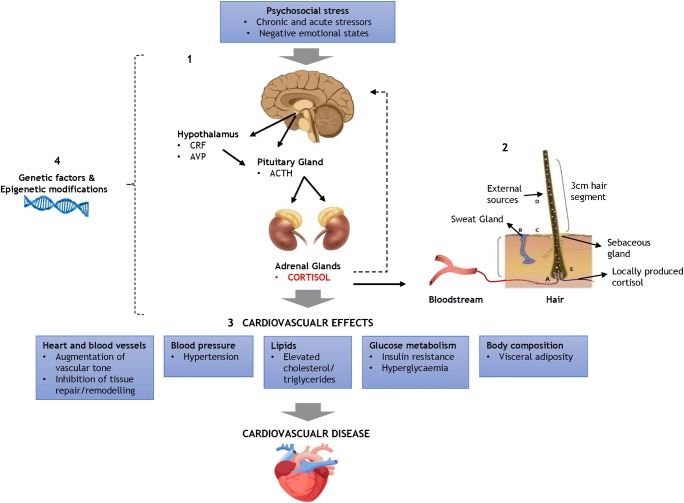
This review focuses on the concentration of cortisol in human hair as a biomarker of chronic stress in cardiovascular disease (CVD). We outline the cardiovascular consequences of cortisol excess and provide a comprehensive overview of recent studies investigating the relationship of hair cortisol with CVD. In addition, clinical implications and limitations of the evidence are discussed, together with directions for future research.
Hair cortisol may be a reliable biomarker of chronic stress since it provides quantification of total cortisol secreted into hair over several weeks. A growing body of evidence suggests that elevated hair cortisol levels are associated with both the incidence of CVD and poorer recovery and treatment outcomes. Moreover, increased hair cortisol concentration has been linked with established cardiometabolic risk factors for CVD including high blood pressure, diabetes, and adiposity. Hair cortisol is a promising biomarker of chronic cortisol excess which may contribute to both the pathogenesis and prognosis of CVD. However, the current evidence relies on small-scale cross-sectional studies. Further research adopting longitudinal designs across larger samples of CVD patients and healthy participants is required to inform the development of novel evidence-based interventions.
本综述重点关注人发中皮质醇浓度作为心血管疾病(CVD)慢性应激的生物标志物。我们概述了皮质醇过量的心血管后果,并全面回顾了最近研究头发皮质醇与 CVD 之间关系的研究。此外,还讨论了证据的临床意义和局限性,并提出了未来研究的方向。
由于头发皮质醇可量化数周内分泌到头发中的总皮质醇,因此它可能是慢性应激的可靠生物标志物。越来越多的证据表明,升高的头发皮质醇水平与 CVD 的发生率以及恢复和治疗效果较差有关。此外,头发皮质醇浓度的增加与 CVD 的既定心血管代谢危险因素有关,包括高血压、糖尿病和肥胖症。头发皮质醇是慢性皮质醇过多的有前途的生物标志物,可能与 CVD 的发病机制和预后有关。然而,目前的证据依赖于小规模的横断面研究。需要在更大的 CVD 患者和健康参与者样本中采用纵向设计进行进一步研究,为新的循证干预措施的制定提供信息。