Sheffield Institute for Translational Neuroscience, University of Sheffield, Sheffield, UK.
Academic Department of Neurosciences, Sheffield Teaching Hospitals, NHS Foundation Trust, Sheffield, UK.
J Neurol. 2019 Dec;266(12):2897-2906. doi: 10.1007/s00415-018-9119-x. Epub 2018 Nov 20.
Dystonia is characterised by sustained muscular contractions frequently producing repetitive, twisting and patterned movements. The primary aim of this systematic review was to establish how quality of life (QoL) is affected in idiopathic focal, multifocal and segmental dystonia. This review aimed to evaluate variations in QoL between different subtypes of dystonia, identify the determinants of QoL and assess the effects of different treatments on QoL.
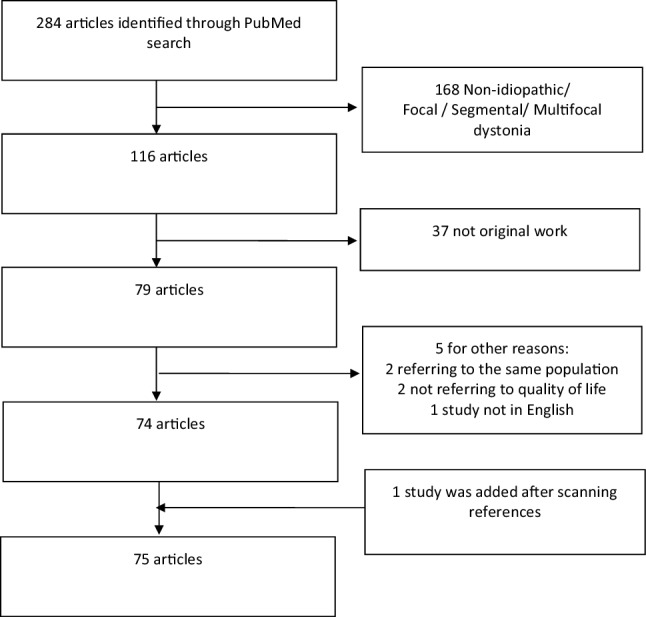
A systematic computer-based literature search was conducted using the PubMed database to search for papers on QoL in idiopathic focal, segmental, multifocal and generalized dystonia. We identified 75 studies meeting our inclusion criteria. Information was extracted regarding prevalence, demographics and response to treatment where indicated.
This review revealed QoL to be a significant yet often overlooked issue in idiopathic dystonia. Data consistently showed that dystonia has a negative effect on QoL in patients compared to healthy controls, when measured using disease-specific and generic QoL measures. The majority of studies (n = 25) involved patients with cervical dystonia, followed by benign-essential blepharospasm (n = 10). Along with the beneficial effect to the dystonia symptoms, treatment using Botulinum Toxin and Deep Brain Stimulation is also effective in improving overall QoL across the majority of subtypes.
The findings demonstrate that patients' QoL should routinely be assessed and monitored, as this may affect subsequent management. Further research will allow for more robust management of factors contributing to impaired QoL, aside from the physical defects found in dystonia.
肌张力障碍的特征是持续性肌肉收缩,经常导致重复、扭曲和模式化的运动。本系统评价的主要目的是确定特发性局灶性、多灶性和节段性肌张力障碍如何影响生活质量(QoL)。本综述旨在评估不同亚型肌张力障碍之间的 QoL 差异,确定 QoL 的决定因素,并评估不同治疗方法对 QoL 的影响。
使用 PubMed 数据库进行了系统的计算机文献检索,以搜索特发性局灶性、节段性、多灶性和全身性肌张力障碍的 QoL 论文。我们确定了 75 篇符合纳入标准的研究。提取了有关患病率、人口统计学和治疗反应的信息(如有)。
本综述揭示了 QoL 是特发性肌张力障碍中一个重要但经常被忽视的问题。数据一致表明,与健康对照组相比,使用疾病特异性和通用 QoL 测量方法,肌张力障碍对患者的 QoL 有负面影响。大多数研究(n=25)涉及颈肌张力障碍患者,其次是良性特发性眼睑痉挛(n=10)。除了对肌张力障碍症状有有益作用外,肉毒杆菌毒素和深部脑刺激治疗也能有效改善大多数亚型的整体 QoL。
研究结果表明,应定期评估和监测患者的 QoL,因为这可能会影响后续的治疗管理。进一步的研究将有助于更好地控制影响 QoL 的因素,除了肌张力障碍中发现的身体缺陷。