Department of Orthodontics, Nihon University School of Dentistry, Chiyoda-ku, Tokyo 101-8310, Japan.
Department of Oral Biological and Medical Sciences, Faculty of Dentistry, University of British Columbia, Vancouver, BC V6T 1Z3, Canada.
Int J Mol Sci. 2018 Nov 19;19(11):3638. doi: 10.3390/ijms19113638.
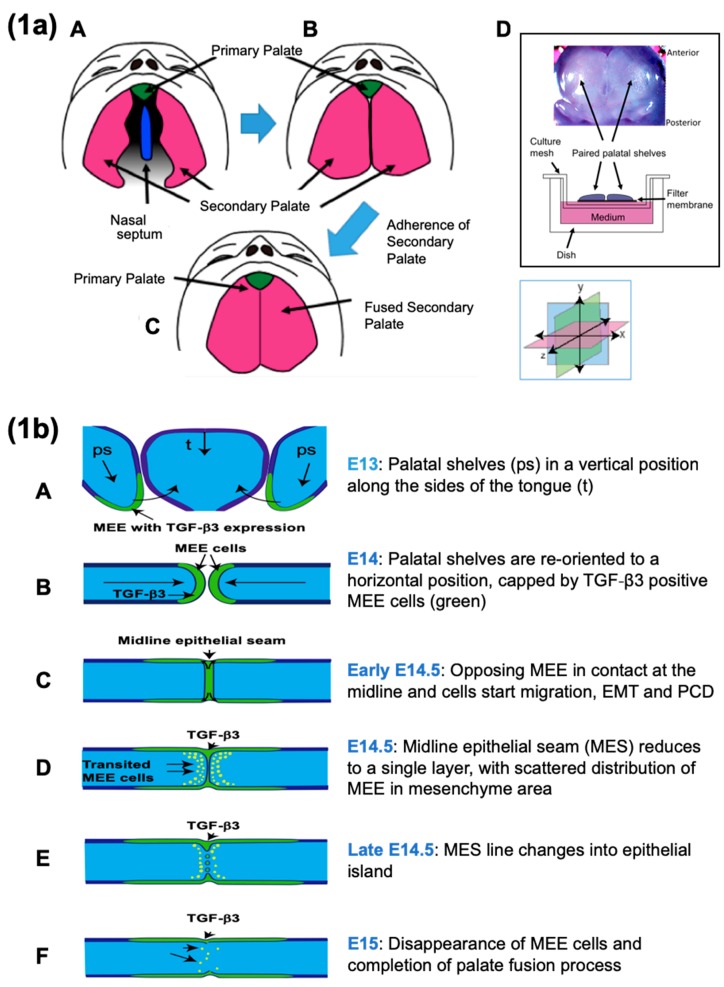
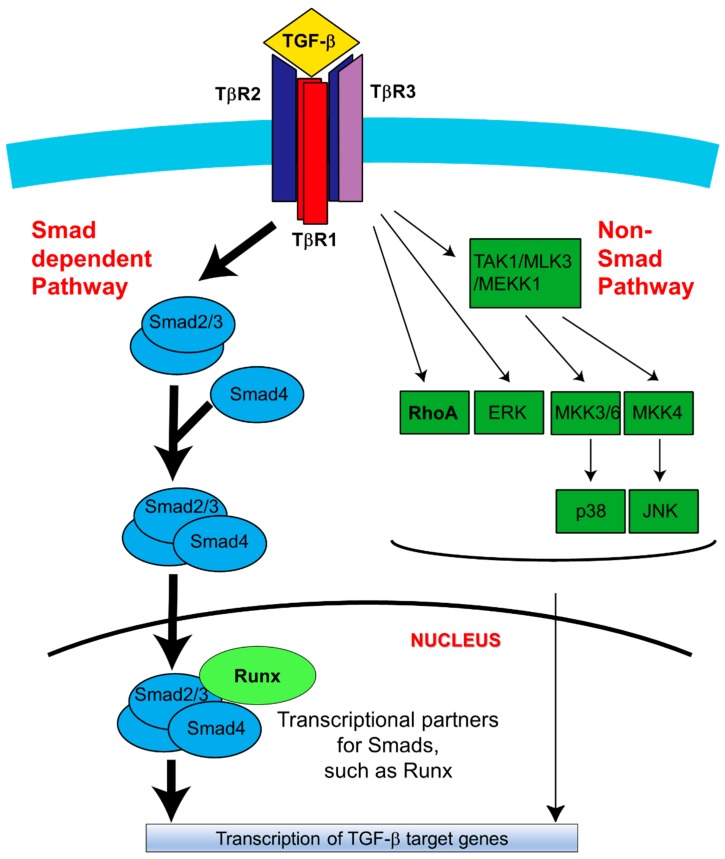
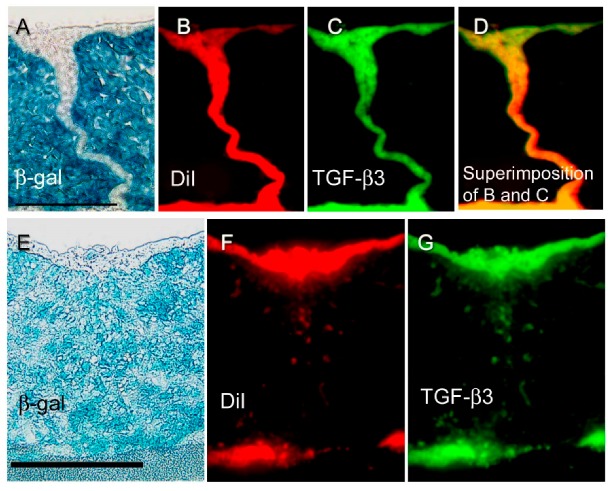
Signaling by transforming growth factor (TGF)-β plays an important role in development, including in palatogenesis. The dynamic morphological process of palatal fusion occurs to achieve separation of the nasal and oral cavities. Critically and specifically important in palatal fusion are the medial edge epithelial (MEE) cells, which are initially present at the palatal midline seam and over the course of the palate fusion process are lost from the seam, due to cell migration, epithelial-mesenchymal transition (EMT), and/or programed cell death. In order to define the role of TGF-β signaling during this process, several approaches have been utilized, including a small interfering RNA (siRNA) strategy targeting TGF-β receptors in an organ culture context, the use of genetically engineered mice, such as Wnt1-cre/R26R double transgenic mice, and a cell fate tracing through utilization of cell lineage markers. These approaches have permitted investigators to distinguish some specific traits of well-defined cell populations throughout the palatogenic events. In this paper, we summarize the current understanding on the role of TGF-β signaling, and specifically its association with MEE cell fate during palatal fusion. TGF-β is highly regulated both temporally and spatially, with TGF-β3 and Smad2 being the preferentially expressed signaling molecules in the critical cells of the fusion processes. Interestingly, the accessory receptor, TGF-β type 3 receptor, is also critical for palatal fusion, with evidence for its significance provided by Cre-lox systems and siRNA approaches. This suggests the high demand of ligand for this fine-tuned signaling process. We discuss the new insights in the fate of MEE cells in the midline epithelial seam (MES) during the palate fusion process, with a particular focus on the role of TGF-β signaling.
转化生长因子-β(TGF-β)信号在发育过程中发挥着重要作用,包括腭发生。腭融合的动态形态发生过程发生以实现鼻腔和口腔的分离。在腭融合中,重要的是中线上皮(MEE)细胞,它们最初存在于腭中线缝处,并且在腭融合过程中由于细胞迁移、上皮-间充质转化(EMT)和/或程序性细胞死亡而从中线缝中丢失。为了定义 TGF-β信号在这个过程中的作用,已经采用了几种方法,包括在器官培养环境中靶向 TGF-β受体的小干扰 RNA(siRNA)策略、使用基因工程小鼠,如 Wnt1-cre/R26R 双转基因小鼠,以及通过利用细胞谱系标记进行细胞命运追踪。这些方法使研究人员能够区分腭发生事件中某些特定特征的明确细胞群体。在本文中,我们总结了 TGF-β信号作用的最新认识,特别是它与 MEE 细胞命运在腭融合中的关联。TGF-β在时间和空间上受到高度调节,TGF-β3 和 Smad2 是融合过程中关键细胞中优先表达的信号分子。有趣的是,辅助受体 TGF-β类型 3 受体对于腭融合也很重要,Cre-lox 系统和 siRNA 方法提供了其重要性的证据。这表明精细调节信号过程对配体的高需求。我们讨论了在腭融合过程中线间上皮缝(MES)中 MEE 细胞命运的新见解,特别关注 TGF-β信号的作用。