State Key Laboratory of Natural Medicines and School of Traditional Chinese Pharmacy, China Pharmaceutical University, Nanjing 210009, China.
Int J Mol Sci. 2018 Nov 20;19(11):3658. doi: 10.3390/ijms19113658.
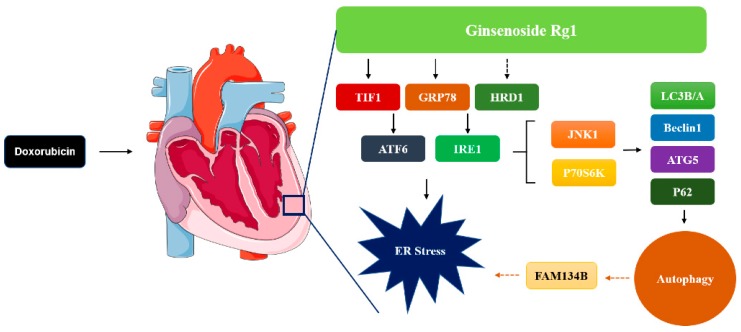
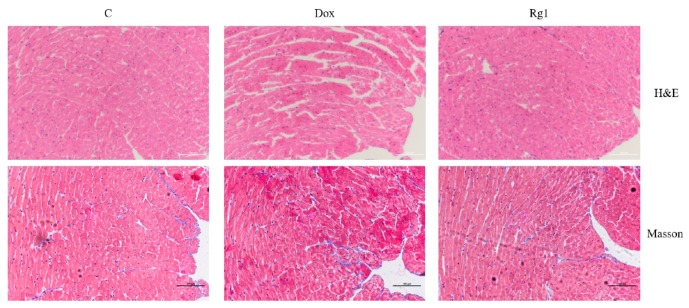
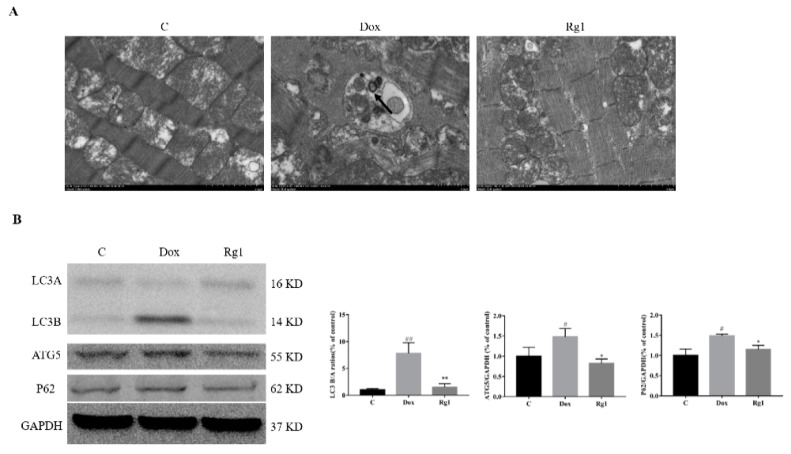
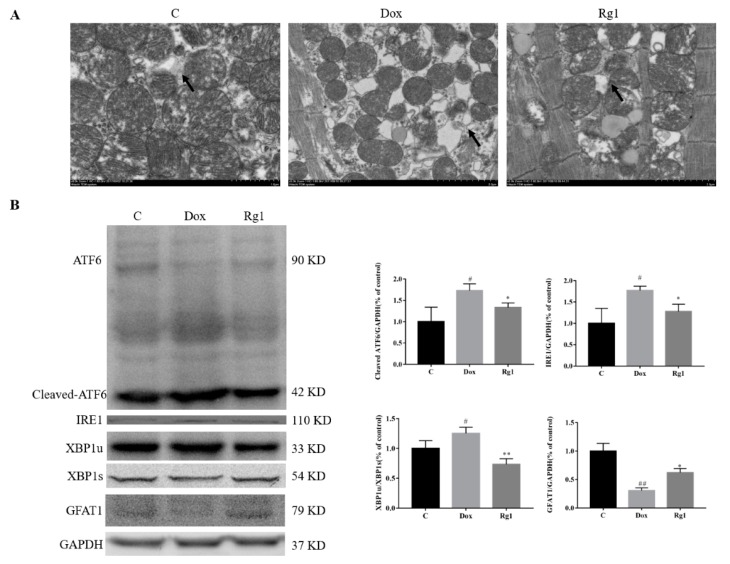
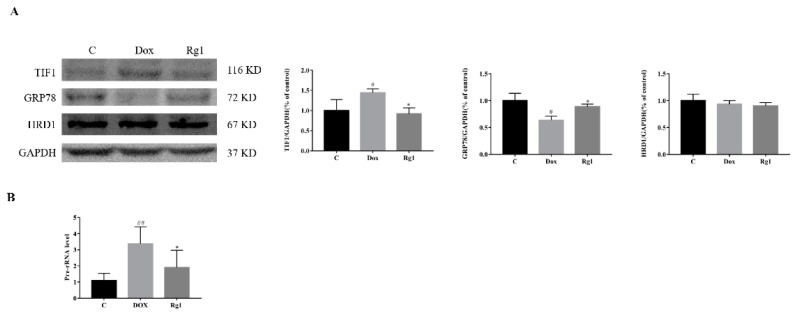
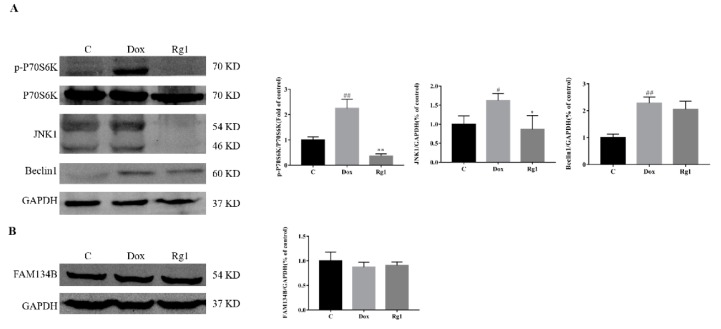
Ginsenoside Rg1, a saponin that is a primary component of ginseng, has been demonstrated to protect hearts from diverse cardiovascular diseases with regulating multiple cellular signal pathways. In the present study, we investigated the protective role of ginsenoside Rg1 on doxorubicin-induced cardiotoxicity and its effects on endoplasmic reticulum stress and autophagy. After pre-treatment with ginsenoside Rg1 (50 mg/kg i.g.) for 7 days, male C57BL/6J mice were intraperitoneally injected with a single dose of doxorubicin (6 mg/kg) every 3 days for four injections. Echocardiographic and pathological findings showed that ginsenoside Rg1 could significantly reduce the cardiotoxicity induced by doxorubicin. Ginsenoside Rg1 significantly inhibited doxorubicin-induced formation of autophagosome. At the same time, ginsenoside Rg1 decreased the doxorubicin-induced cardiac microtubule-associated protein-light chain 3 and autophagy related 5 expression. Ginsenoside Rg1 can reduce endoplasmic reticulum dilation caused by doxorubicin. Compared with the doxorubicin group, the expression of cleaved activating transcription factor 6 and inositol-requiring enzyme 1 decreased in group ginsenoside Rg1. Treatment with ginsenoside Rg1 reduces the expression of TIF1 and increases the expression of glucose-regulated protein 78. In the ginsenoside Rg1 group, the expression of p-P70S6K, c-Jun N-terminal kinases 1 and Beclin1 declined. These results indicate that ginsenoside Rg1 may improve doxorubicin-induced cardiac dysfunction by inhibiting endoplasmic reticulum stress and autophagy.
人参皂苷 Rg1 是人参的主要成分之一,已被证明通过调节多种细胞信号通路来保护心脏免受多种心血管疾病的侵害。在本研究中,我们研究了人参皂苷 Rg1 对阿霉素诱导的心脏毒性的保护作用及其对内质网应激和自噬的影响。用人参皂苷 Rg1(50mg/kg 灌胃)预处理 7 天后,雄性 C57BL/6J 小鼠每 3 天腹腔注射一次阿霉素(6mg/kg),共 4 次。超声心动图和病理结果表明,人参皂苷 Rg1 可显著减轻阿霉素引起的心脏毒性。人参皂苷 Rg1 显著抑制阿霉素诱导的自噬体形成。同时,人参皂苷 Rg1 降低了阿霉素诱导的心肌微管相关蛋白轻链 3 和自噬相关蛋白 5 的表达。人参皂苷 Rg1 可减少阿霉素引起的内质网扩张。与阿霉素组相比,人参皂苷 Rg1 组的活化转录因子 6 切割和肌醇需求酶 1 的表达减少。人参皂苷 Rg1 治疗可降低 TIF1 的表达,增加葡萄糖调节蛋白 78 的表达。在人参皂苷 Rg1 组中,p-P70S6K、c-Jun N-末端激酶 1 和 Beclin1 的表达下降。这些结果表明,人参皂苷 Rg1 可能通过抑制内质网应激和自噬来改善阿霉素引起的心脏功能障碍。