Faculty of Health, School of Nursing and Midwifery, Deakin University, Geelong, Victoria, 3220, Australia.
Cancer Council SA, 202 Greenhill Road, Eastwood, South Australia, 5063, Australia.
BMC Med Res Methodol. 2018 Nov 21;18(1):146. doi: 10.1186/s12874-018-0614-7.
Family members are increasingly involved in the care of cancer patients, however many are not prepared for this challenging role. Intervention-based studies are valuable to inform the most appropriate and effective support for caregivers. Barriers in the recruitment of patient/caregiver dyads exist but the reasons for non-participation are less well understood. This analysis determined the factors associated with participation in a randomized controlled trial involving patient/caregiver dyads, reasons for non-participation and factors associated with these reasons.
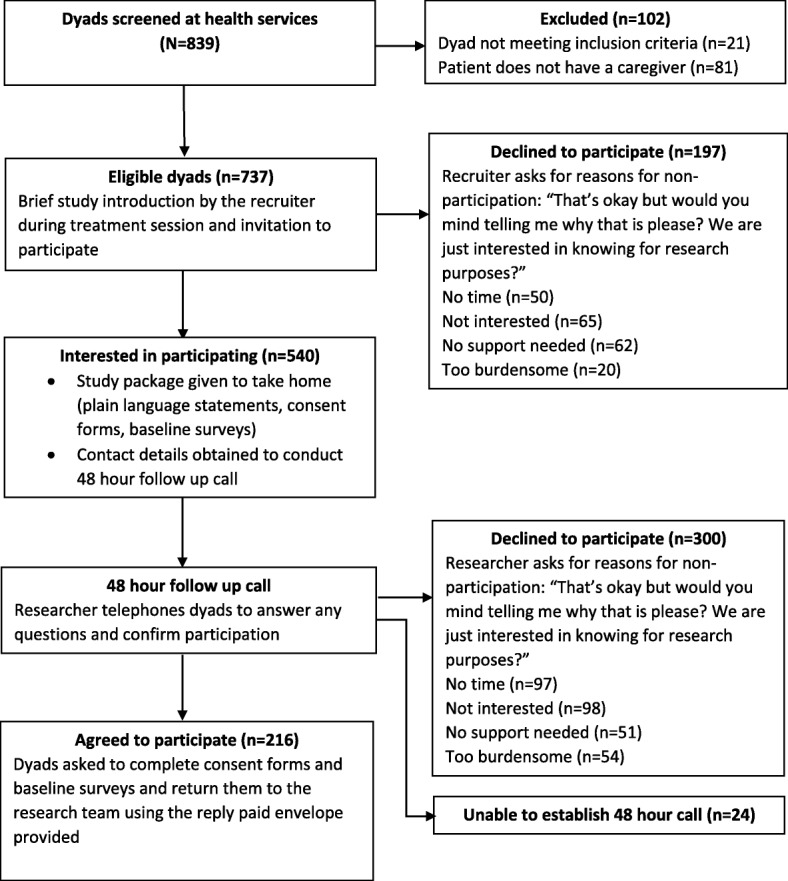
Patients with any type of cancer (other than non-melanoma skin cancer), and their caregiver were recruited at four Australian health services. Eligible patients were invited to participate together with their caregiver (N = 737). Non-participation data were collected from non-participants. Bivariate and binary logistic regression analyses were conducted to examine factors associated with participation.
Of the 737 eligible dyads, 521 (71%) declined participation. Dyad characteristics associated with participation were caregiver gender, patient treatment modality and hospital type. The odds for participating were almost two times greater for female than male caregivers (p = 0.005); 13 times greater for patients receiving chemoradiotherapy compared to radiotherapy alone (p < 0.001); and three times greater for dyads attending a private versus public hospital (p < 0.001). Reasons for non-participation were lack of interest (33%), lack of time (29%), not requiring support (23%), too burdensome (15%); factors significantly associated with these reasons were treatment modality, patient age, cancer type, and hospital type. Patients diagnosed with prostate cancer and receiving chemotherapy alone were less likely to decline due to a lack of interest. Patients more likely to decline due to lack of time were those aged 40-59 years and receiving chemotherapy alone. Patients who were more likely to decline because they felt participation was too burdensome were those attending a private hospital for treatment.
To optimize recruitment, it is recommended that special attention is given to different cancer types and treatment modalities, gender and age. Approaching dyads at varied time points when their need for support is high is recommended. This analysis provides important information for researchers undertaking randomized controlled trials involving people diagnosed with cancer and their caregivers.
家庭成员越来越多地参与癌症患者的护理,但许多人并未为此项具有挑战性的角色做好准备。基于干预的研究对于为护理人员提供最合适和最有效的支持具有重要价值。尽管患者/照护者配对参与研究存在障碍,但人们对其不参与的原因了解甚少。本分析旨在确定与参与一项涉及患者/照护者配对的随机对照试验相关的因素、不参与的原因以及与这些原因相关的因素。
在澳大利亚的 4 家医疗服务机构招募了各种类型的癌症(非黑色素瘤皮肤癌除外)患者及其照护者。符合条件的患者被邀请与他们的照护者一起参与(N=737)。非参与者的数据是从非参与者那里收集的。进行了单变量和二元逻辑回归分析,以检查与参与相关的因素。
在 737 对符合条件的配对中,有 521 对(71%)拒绝参与。与参与相关的配对特征是照护者的性别、患者的治疗方式和医院类型。与男性照护者相比,女性照护者参与的可能性几乎高出两倍(p=0.005);与仅接受放疗的患者相比,接受放化疗的患者的可能性高出 13 倍(p<0.001);与在私立医院就诊的患者相比,在公立医院就诊的患者的可能性高出 3 倍(p<0.001)。不参与的原因是缺乏兴趣(33%)、缺乏时间(29%)、不需要支持(23%)、负担过重(15%);与这些原因显著相关的因素是治疗方式、患者年龄、癌症类型和医院类型。仅诊断为前列腺癌和接受化疗的患者因缺乏兴趣而不太可能拒绝。由于缺乏时间而更有可能拒绝的患者是年龄在 40-59 岁之间且仅接受化疗的患者。那些因认为参与负担过重而更有可能拒绝的患者是在私立医院接受治疗的患者。
为了优化招募,建议特别注意不同的癌症类型和治疗方式、性别和年龄。建议在患者需要支持的高峰期,分阶段接触配对患者。本分析为从事涉及癌症患者及其照护者的随机对照试验的研究人员提供了重要信息。