School of Public Health, College of Health and Medical Sciences, Haramaya University, P.O. BOX 138, 3020, Dire Dawa, Ethiopia.
Child and Adolescent Health Service, Health Department, Government of Western Australia, 189 Royal Street, East Perth, WA, 6004, Australia.
Hum Resour Health. 2018 Nov 21;16(1):63. doi: 10.1186/s12960-018-0331-7.
Community-based health workers and volunteers are not just low-level health workforce; their effectiveness is also due to their unique relationship with the community and is often attributed to social capital, an area not well studied or acknowledged in the literature.
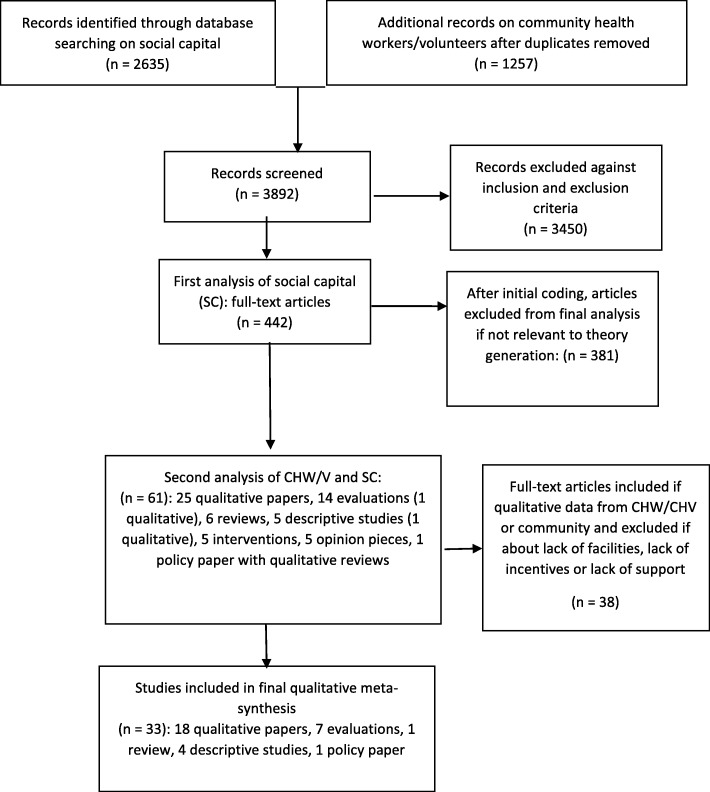
A qualitative meta-synthesis was conducted using the SPIDER framework and based on critical interpretive synthesis. The protocol was registered with PROSPERO, ID = CRD42018084130. This article reports on the qualitative data extracted from the final 33 articles selected from 147 full-text articles on social capital and community-based health systems.
Three constructs were identified that enable community health workers to bring about changes in behaviour in the community: seeing their role as a service or a calling motivated by altruistic values, accompanying community members on their journey and the aim of the journey being empowerment rather than health. Community health workers feel under-resourced to provide for expectations from the community, to fulfil their non-health needs, to meet the expectations of their employers and to be able to deliver health services.
The dichotomy of needs between the community and health services can be resolved if policy makers and programme designers examine the possibility of two cadres of community-based health workforce: full-time workers and part-time volunteers, with clear scopes of practice and supervision. Community health workers would primarily be concerned with task shifting roles demanded by programmes, and volunteers can focus on the wider empowerment-based needs of communities.
社区卫生工作者和志愿者不仅是低层次的卫生工作者;他们的有效性也是由于他们与社区的独特关系,这通常归因于社会资本,这是文献中研究和承认不足的一个领域。
使用 SPIDER 框架和基于关键解释性综合的定性元综合进行。该方案在 PROSPERO 上进行了注册,ID = CRD42018084130。本文报告了从最终 33 篇关于社会资本和基于社区的卫生系统的全文文章中提取的定性数据。
确定了三个构建模块,使社区卫生工作者能够在社区中引起行为变化:将他们的角色视为出于利他主义价值观的服务或召唤,陪伴社区成员踏上旅程,旅程的目的是赋权而不是健康。社区卫生工作者感到资源不足,无法满足社区的期望、满足非健康需求、满足雇主的期望以及提供卫生服务。
如果政策制定者和方案设计者研究建立两个社区卫生工作者队伍的可能性,即全职工作者和兼职志愿者,明确实践和监督范围,那么社区和卫生服务之间的需求二分法是可以解决的。社区卫生工作者将主要关注方案要求的任务转移角色,志愿者可以专注于社区更广泛的赋权需求。