Xiao Weikai, Zheng Shaoquan, Yang Anli, Zhang Xingcai, Zou Yutian, Tang Hailin, Xie Xiaoming
Department of Breast Oncology, Sun Yat-sen University Cancer Center, State Key Laboratory of Oncology in South China, Collaborative Innovation Center for Cancer Medicine, Guangzhou 510060, People's Republic of China,
Department of Medicine; Massachusetts General Hospital and Harvard Medical School, Boston, MA 02114, USA.
Cancer Manag Res. 2018 Nov 5;10:5329-5338. doi: 10.2147/CMAR.S176763. eCollection 2018.
It was unclear whether breast cancer subtypes are associated with the risk of site-specific metastases. This study aimed to evaluate the relationship between molecular subtypes and distant metastatic sites and their prognostic significance.
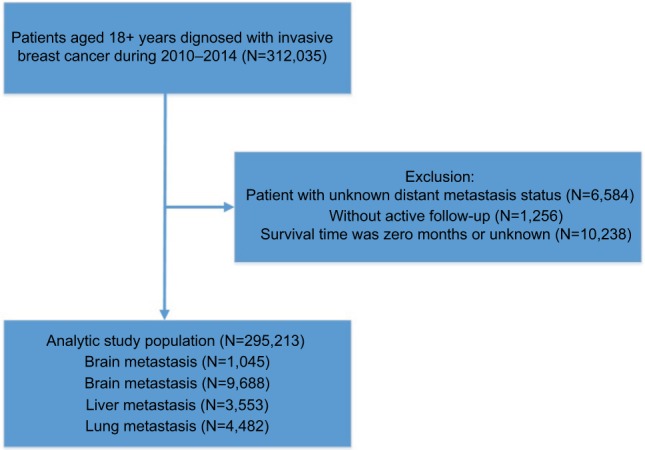
We identified 295,213 patients with invasive breast cancer from 2010 to 2014 using the Surveillance, Epidemiology and End Results database. Subtypes were classified into four categories: hormone receptor (HR)/human epidermal growth factor receptor 2 (HER2), HR/HER2, HR/HER2, and triple-negative (HR/HER2). Logistic regression was used to assess the association between metastasis location and subtypes. Multivariate Cox models were used to estimate the overall survival (OS) of related factors.
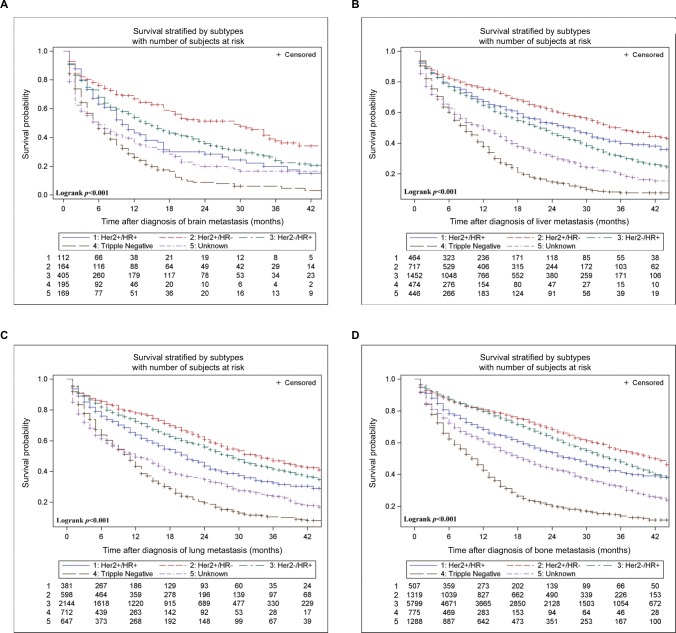
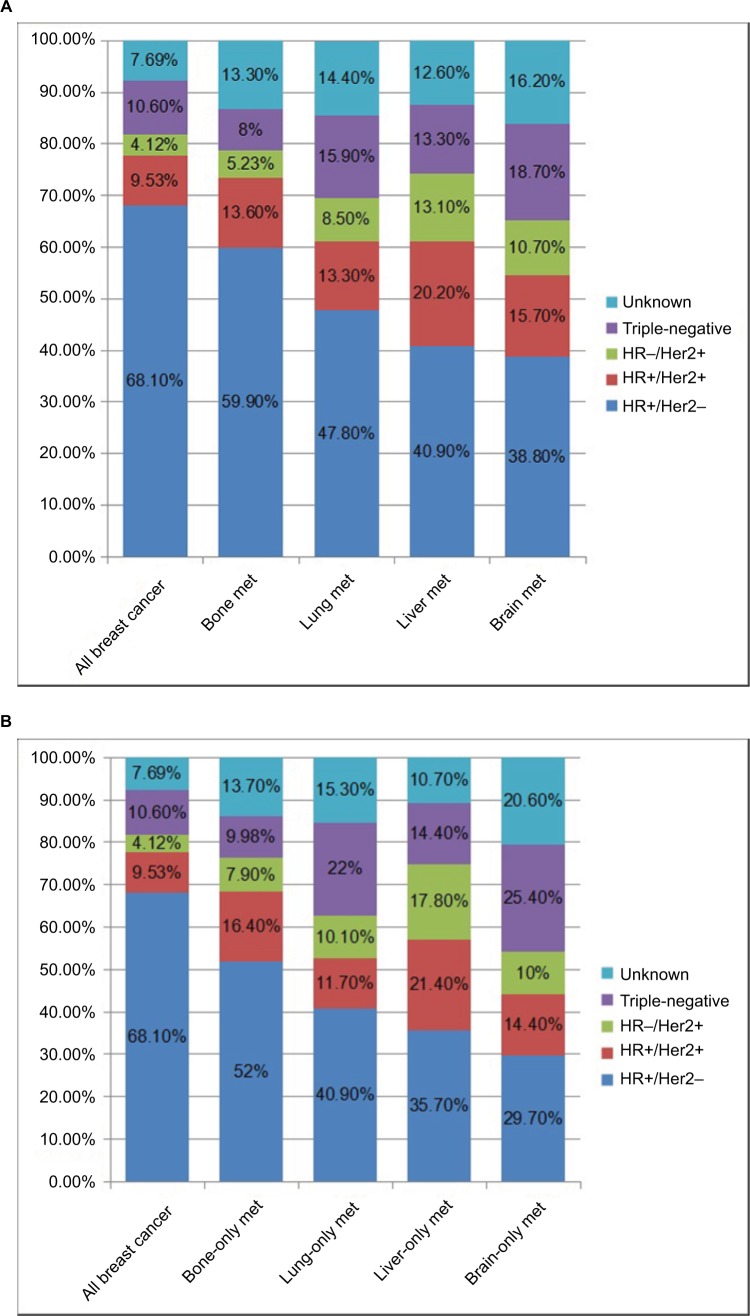
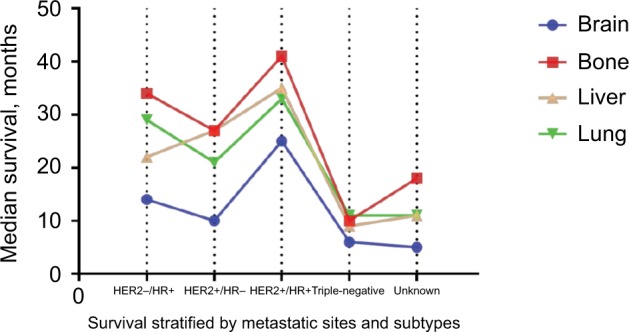
According to our study, 3.28%, 1.52%, 1.20%, and 0.35% of newly diagnosed breast cancers presented bone, lung, liver, and brain metastases at diagnosis, respectively. Both metastatic sites and subtypes significantly affected the OS after metastasis. In multivariate analysis, HR/HER2 subtype (OR as compared with HR/HER2 subtype, 1.30 [95% CI, 1.22-1.39]) significantly correlated with elevated bone metastasis risk, whereas HR/HER2 did not. Both HER2 subtypes (HR/HER2 and HR/HER2) were significantly associated with higher rates of liver, brain, and lung metastases, while the highest OR was observed in liver metastases. Triple-negative tumors had a higher rate of brain (OR, 1.95 [95% CI, 1.61-2.35]), liver (OR, 1.35 [95% CI, 1.20-1.51]), and lung metastases (OR, 1.34 [95% CI, 1.21-1.47]), but a significantly lower rate of bone metastases (OR, 0.64 [95% CI, 0.59-0.69]) than HR/HER2-tumors.
Breast cancer subtypes are associated with different metastatic patterns and confer different prognostic impacts. Molecular subtypes can identify patients at increased risk of site-specific metastases.
尚不清楚乳腺癌亚型是否与特定部位转移风险相关。本研究旨在评估分子亚型与远处转移部位之间的关系及其预后意义。
我们使用监测、流行病学和最终结果数据库,确定了2010年至2014年期间295213例浸润性乳腺癌患者。亚型分为四类:激素受体(HR)/人表皮生长因子受体2(HER2)、HR/HER2、HR/HER2和三阴性(HR/HER2)。采用逻辑回归评估转移部位与亚型之间的关联。多变量Cox模型用于估计相关因素的总生存期(OS)。
根据我们的研究,新诊断的乳腺癌分别有3.28%、1.52%、1.20%和0.35%在诊断时出现骨、肺、肝和脑转移。转移部位和亚型均显著影响转移后的总生存期。在多变量分析中,HR/HER2亚型(与HR/HER2亚型相比,比值比为1.30 [95%置信区间,1.22 - 1.39])与骨转移风险升高显著相关,而HR/HER2则不然。两种HER2亚型(HR/HER2和HR/HER2)均与肝、脑和肺转移率较高显著相关,而肝转移的比值比最高。三阴性肿瘤的脑转移率(比值比,1.95 [95%置信区间,1.61 - 2.35])、肝转移率(比值比,1.35 [95%置信区间,1.20 - 1.51])和肺转移率(比值比,1.34 [95%置信区间,1.21 - 1.47])较高,但骨转移率(比值比,0.64 [95%置信区间,0.59 - 0.69])显著低于HR/HER2肿瘤。
乳腺癌亚型与不同的转移模式相关,并具有不同的预后影响。分子亚型可以识别特定部位转移风险增加的患者。