Ma Jun-Li, Zhao Yan, Guo Chen-Yang, Hu Hong-Tao, Zheng Lin, Zhao Er-Jiang, Li Hai-Liang
Department of Radiology Intervention, Affiliated Tumor Hospital of Zhengzhou University, Zhengzhou 450003, China,
Department of Epidemiology and Biostatistics, Affiliated Tumor Hospital of Zhengzhou University, Zhengzhou 450003, China.
Cancer Manag Res. 2018 Nov 5;10:5395-5410. doi: 10.2147/CMAR.S168413. eCollection 2018.
Several epidemiology studies have explored the association between dietary B vitamins' intake and the risk of esophageal cancer (EC). However, the results remain inconclusive. Thus, we conducted a systematic review with meta-analysis to evaluate such association.
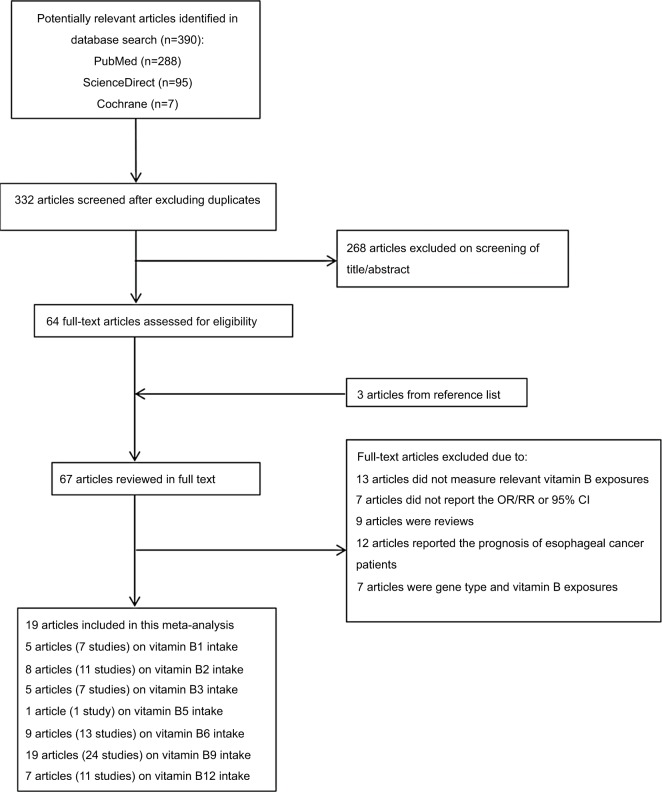
Literature retrieval was performed using PubMed (Medline), ScienceDirect, and Cochrane Library electronic databases for all studies published from database inception to December 2017.
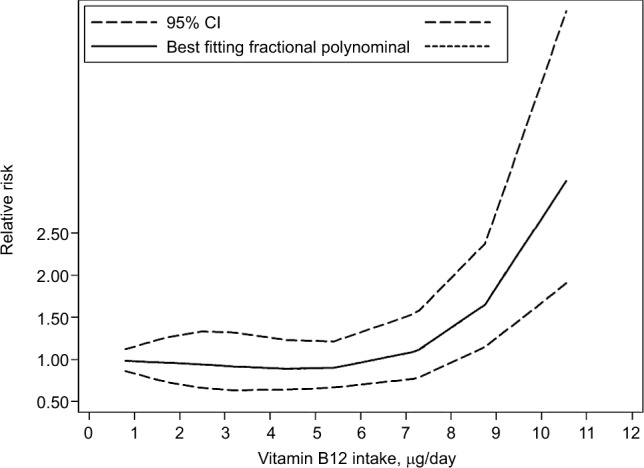
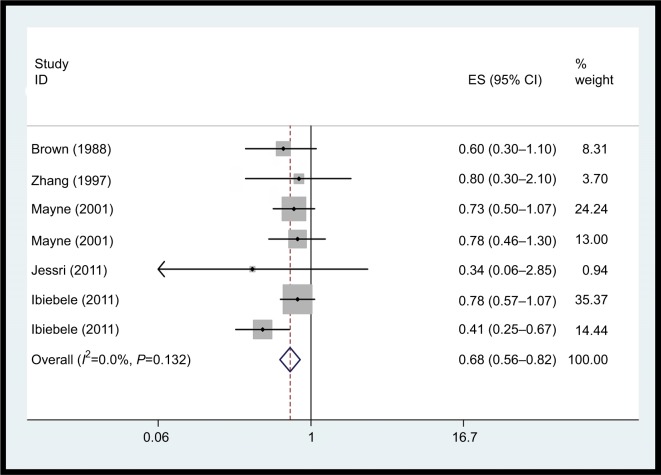
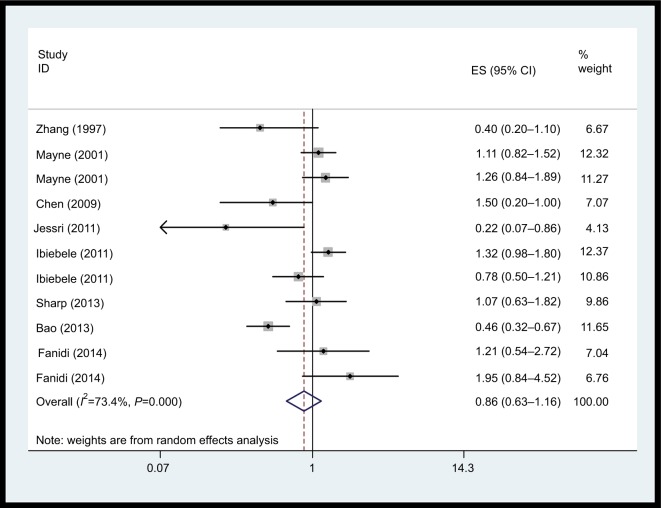
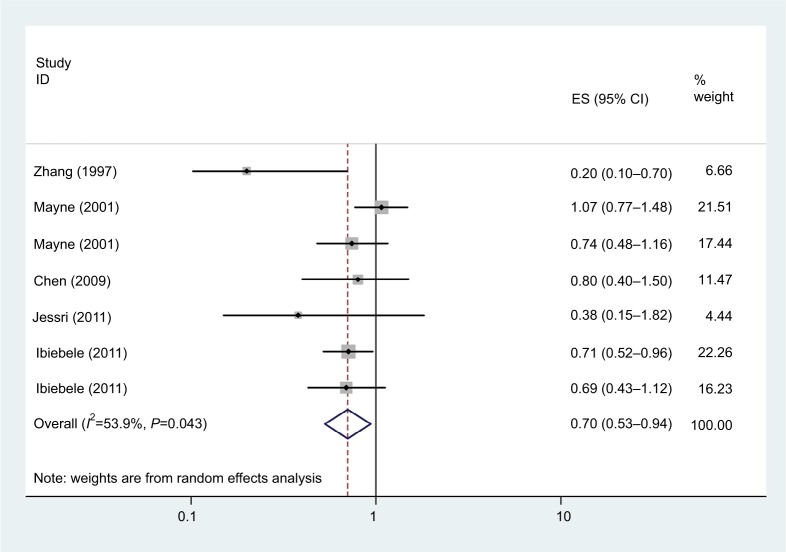
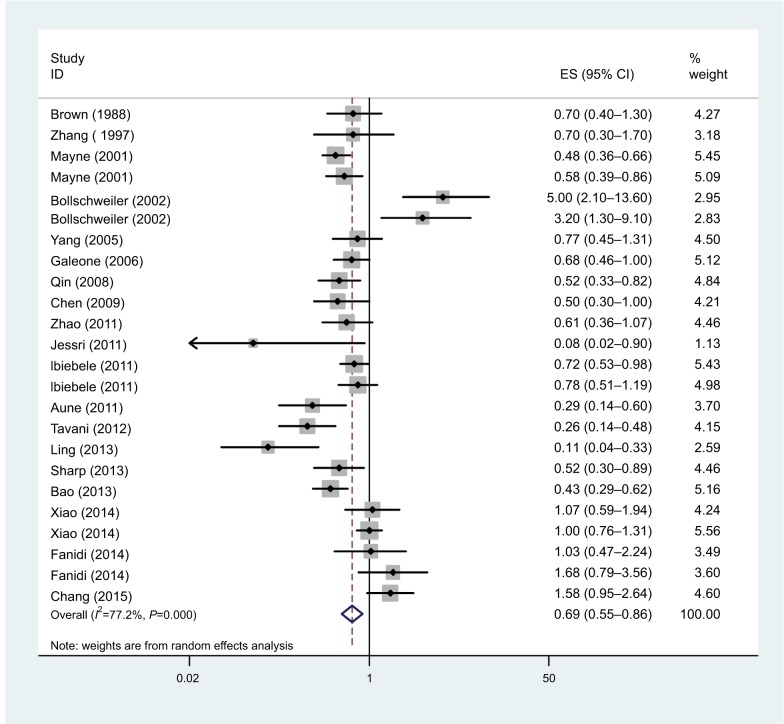
The meta-analysis included 19 studies and showed an overall decreased risk of EC (OR=0.77, 95% CI: 0.68-0.87) in association with multivitamin B (ie, B1, B2, B3, B5, B6, B9, and B12) dietary intake. In a subgroup analysis based on vitamin B subclass, B1, B3, B6, and B9 vitamins were associated with decreased EC risk (vitamin B1: OR=0.68, 95% CI: 0.56-0.82; vitamin B3: OR=0.70, 95% CI: 0.53-0.94; vitamin B6: OR=0.64, 95% CI: 0.49-0.83; and vitamin B9: OR=0.69, 95% CI: 0.55-0.86). By contrast, no association was detected between dietary vitamin B2 and vitamin B5 intake and EC risk (vitamin B2: OR=0.86, 95% CI: 0.64-1.16; vitamin B5: OR=0.49, 95% CI: 0.20-1.20), whereas a potential non-linear dose-response association was found between dietary vitamin B12 intake and EC risk. A statistically significant, inverse association was observed for an increase of 100 µg/day in supplemental vitamin B6 and B9 and EC risk (vitamin B6: OR=0.98, 95% CI: 0.98-0.99; vitamin B9: OR= 0.89; 95% CI: 0.86-0.94).
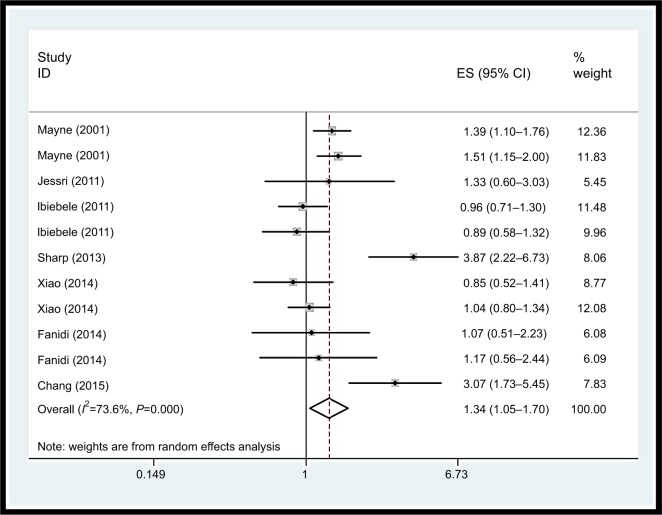
These findings support that vitamin B may have an influence on carcinogenesis of the esophagus. Vitamin B1, B3, B6, B9 showed a decreased risk of EC, and vitamin B12 showed an increased risk of EC.
多项流行病学研究探讨了膳食中B族维生素摄入量与食管癌(EC)风险之间的关联。然而,结果仍无定论。因此,我们进行了一项系统评价和荟萃分析以评估这种关联。
使用PubMed(Medline)、ScienceDirect和Cochrane图书馆电子数据库对从数据库建立到2017年12月发表的所有研究进行文献检索。
荟萃分析纳入了19项研究,结果显示,摄入多种B族维生素(即B1、B2、B3、B5、B6、B9和B12)与食管癌总体风险降低相关(OR=0.77,95%CI:0.68-0.87)。在基于维生素B亚类的亚组分析中,维生素B1、B3、B6和B9与食管癌风险降低相关(维生素B1:OR=0.68,95%CI:0.56-0.82;维生素B3:OR=0.70,95%CI:0.53-0.94;维生素B6:OR=0.64,95%CI:0.49-0.83;维生素B9:OR=0.69,95%CI:0.55-0.86)。相比之下,未发现膳食中维生素B2和维生素B5摄入量与食管癌风险之间存在关联(维生素B2:OR=0.86,95%CI:0.64-1.16;维生素B5:OR=0.49,95%CI:0..20-1.20),而在膳食维生素B12摄入量与食管癌风险之间发现了潜在的非线性剂量反应关联。补充维生素B6和B9每日增加100μg与食管癌风险之间存在统计学显著的负相关(维生素B6:OR=0.98,95%CI:0.98-0.99;维生素B9:OR=0.89;95%CI:0.86-0.94)。
这些发现支持维生素B可能对食管癌的致癌作用有影响。维生素B1、B3、B6、B9显示食管癌风险降低,而维生素B12显示食管癌风险增加。