Ruthsatz Katharina, Dausmann Kathrin H, Peck Myron A, Drees Claudia, Sabatino Nikita M, Becker Laura I, Reese Janica, Hartmann Lisa, Glos Julian
Institute for Zoology, University of Hamburg, Martin-Luther-King-Platz 3, Hamburg, Germany.
Institute of Hydrobiology and Fisheries Science, University of Hamburg, Olbersweg 24, Hamburg, Germany.
Conserv Physiol. 2018 Nov 17;6(1):coy059. doi: 10.1093/conphys/coy059. eCollection 2018.
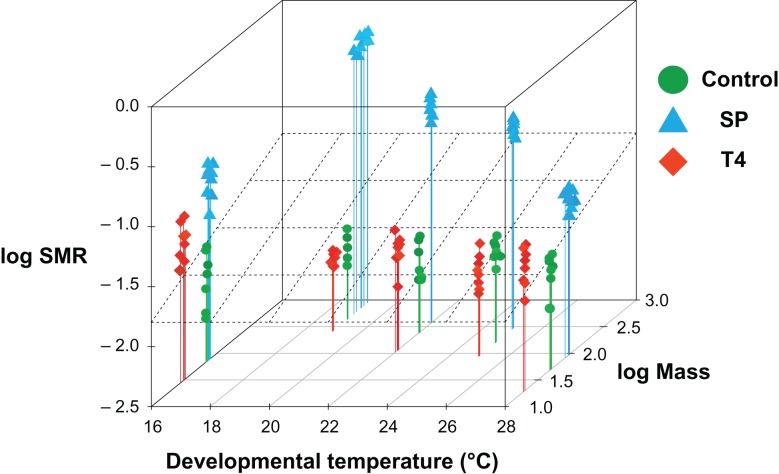
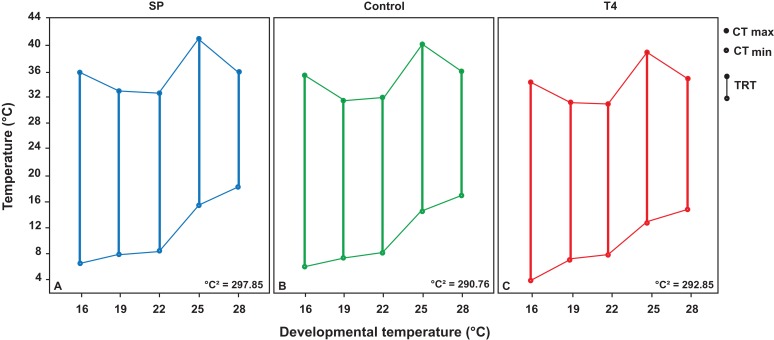
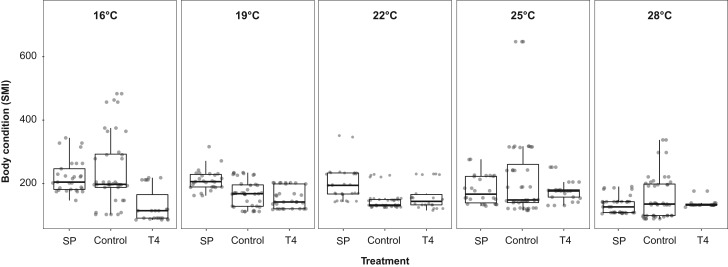
Environmental variation induced by natural and anthropogenic processes including climate change may threaten species by causing environmental stress. Anuran larvae experiencing environmental stress may display altered thyroid hormone (TH) status with potential implications for physiological traits. Therefore, any capacity to adapt to environmental changes through plastic responses provides a key to determining species vulnerability to environmental variation. We investigated whether developmental temperature ( ), altered TH levels and whether the interactive effect of both affect standard metabolic rate (SMR), body condition (BC), survival and thermal tolerance in larvae of the African clawed frog () reared at five temperatures with experimentally altered TH levels. At metamorphosis, SMR, BC and survival were significantly affected by , TH status and their interaction with the latter often intensified impacts. Larvae developing at warmer temperatures exhibited significantly higher SMRs and BC was reduced at warm and high TH levels suggesting decreased ability to acclimate to variation in temperature. Accordingly, tadpoles that developed at warm temperatures had higher maximum thermal limits but more narrow thermal tolerance windows. High and low TH levels decreased and increased upper thermal limits, respectively. Thus, when experiencing both warmer temperatures and environmental stress, larvae may be less able to compensate for changes in . Our results demonstrate that physiological traits in larvae of are strongly affected by increased TH levels and warmer temperatures. Altered TH levels and increasing due to global change may result in a reduced capacity for physiological plasticity. This has far reaching consequences since the energetic requirement at the onset of metamorphosis is known to determine metamorphic success and thus, is indirectly linked to individual fitness in later life stages.
包括气候变化在内的自然和人为过程所引发的环境变化,可能会通过造成环境压力来威胁物种。经历环境压力的无尾两栖类幼体可能会表现出甲状腺激素(TH)状态的改变,这对生理特征可能会产生潜在影响。因此,任何通过可塑性反应来适应环境变化的能力,都是确定物种对环境变化脆弱性的关键。我们研究了发育温度( )、甲状腺激素水平的改变,以及二者的交互作用是否会影响非洲爪蟾( )幼体的标准代谢率(SMR)、身体状况(BC)、存活率和热耐受性,该研究中非洲爪蟾幼体在五种温度下饲养,且甲状腺激素水平经过实验性改变。在变态时,标准代谢率、身体状况和存活率受到发育温度、甲状腺激素状态及其相互作用的显著影响,且后者之间的相互作用往往会加剧影响。在较温暖温度下发育的幼体表现出显著更高的标准代谢率,并且在温暖温度和高甲状腺激素水平下身体状况会降低,这表明适应温度变化的能力下降。因此,在温暖温度下发育的蝌蚪具有更高的最高热限,但热耐受窗口更窄。高甲状腺激素水平和低甲状腺激素水平分别降低和提高了热上限。因此,当同时经历较温暖温度和环境压力时,幼体可能较难补偿甲状腺激素水平的变化。我们的结果表明,非洲爪蟾幼体的生理特征受到甲状腺激素水平升高和温度升高的强烈影响。由于全球变化导致的甲状腺激素水平改变和温度升高,可能会导致生理可塑性降低。这具有深远的影响,因为已知变态开始时的能量需求决定变态的成功,因此与后期生命阶段的个体适应性间接相关。