Casadevall Arturo
Department of Molecular Microbiology and Immunology, The Johns Hopkins School of Public Health, Baltimore, Maryland.
Pathog Immun. 2018;3(2):183-196. doi: 10.20411/pai.v3i2.249. Epub 2018 Sep 25.
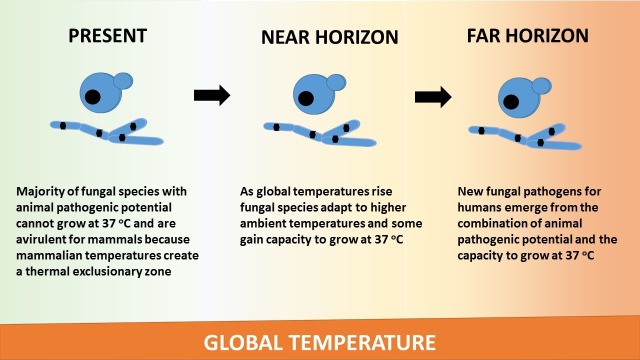
Fungal diseases became a major medical problem in the second half of the 20th century when advances in modern medicine together with the HIV epidemic resulted in large numbers of individuals with impaired immunity. Fungal diseases are difficult to manage because they tend to be chronic, hard to diagnose, and difficult to eradicate with antifungal drugs. This essay considers the future of medical mycology in the 21st century, extrapolating from current trends. In the near horizon, the prevalence of fungal diseases is likely to increase, as there will be more hosts with impaired immunity and drug resistance will inevitably increase after selection by antifungal drug use. We can expect progress in the development of new drugs, diagnostics, vaccines, and immunotherapies. In the far horizon, humanity may face new fungal diseases in association with climate change. Some current associations between chronic diseases and fungal infections could lead to the establishment of fungi as causative agents, which will greatly enhance their medical importance. All trends suggest that the importance of fungal diseases will increase in the 21st century, and enhanced human preparedness for this scourge will require more research investment in this group of infectious diseases.
20世纪下半叶,随着现代医学的进步以及艾滋病的流行,导致大量免疫力受损的个体出现,真菌疾病成为一个主要的医学问题。真菌疾病难以治疗,因为它们往往是慢性的,难以诊断,并且难以用抗真菌药物根除。本文从当前趋势推断,探讨21世纪医学真菌学的未来。在不久的将来,真菌疾病的患病率可能会增加,因为免疫力受损的宿主会更多,并且在使用抗真菌药物进行选择后,耐药性将不可避免地增加。我们可以期待在新药、诊断方法、疫苗和免疫疗法的开发方面取得进展。在遥远的未来,人类可能会面临与气候变化相关的新真菌疾病。目前一些慢性病与真菌感染之间的关联可能会导致真菌被确认为致病因子,这将大大提高它们在医学上的重要性。所有趋势都表明,真菌疾病在21世纪的重要性将会增加,而要增强人类对这一祸害的防范能力,就需要对这类传染病进行更多的研究投资。