School of Environment and Life Sciences, University of Salford, Salford, UK.
School of Earth and Environmental Sciences, University of Manchester, Manchester, UK.
Microbiome. 2018 Nov 22;6(1):207. doi: 10.1186/s40168-018-0593-2.
Microbiome composition is linked to host functional traits including metabolism and immune function. Drivers of microbiome composition are increasingly well-characterised; however, evidence of group-level microbiome convergence is limited and may represent a multi-level trait (i.e. across individuals and groups), whereby heritable phenotypes are influenced by social interactions. Here, we investigate the influence of spatial structuring and social interactions on the gut microbiome composition of Welsh mountain ponies.
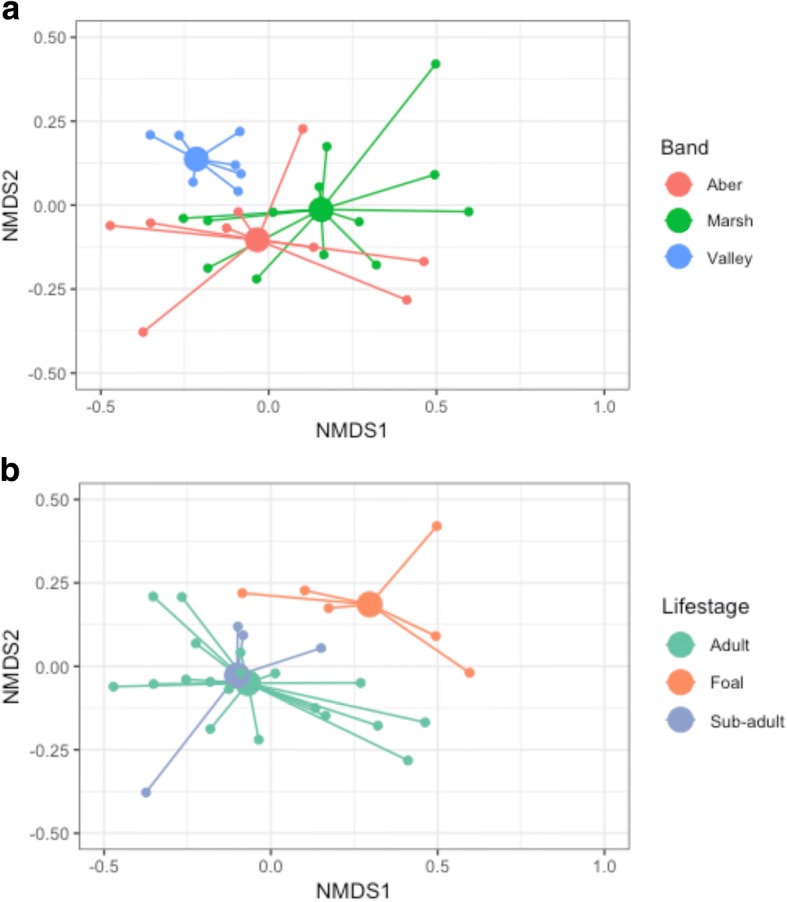
We show that semi-feral ponies exhibit variation in microbiome composition according to band (group) membership, in addition to considerable within-individual variation. Spatial structuring was also identified within bands, suggesting that despite communal living, social behaviours still influence microbiome composition. Indeed, we show that specific interactions (i.e. mother-offspring and stallion-mare) lead to more similar microbiomes, further supporting the notion that individuals influence the microbiome composition of one another and ultimately the group. Foals exhibited different microbiome composition to sub-adults and adults, most likely related to differences in diet.
We provide novel evidence that microbiome composition is structured at multiple levels within populations of social mammals and thus may form a unit on which selection can act. High levels of within-individual variation in microbiome composition, combined with the potential for social interactions to influence microbiome composition, suggest the direction of microbiome selection may be influenced by the individual members present in the group. Although the functional implications of this require further research, these results lend support to the idea that multi-level selection can act on microbiomes.
微生物组的组成与宿主的功能特征有关,包括代谢和免疫功能。微生物组组成的驱动因素越来越明显;然而,群体水平微生物组趋同的证据有限,并且可能代表一种多层次的特征(即个体和群体之间),即遗传表型受社会相互作用的影响。在这里,我们研究了空间结构和社会相互作用对威尔士山地小马肠道微生物组组成的影响。
我们表明,半野生小马根据乐队(群体)成员表现出微生物组组成的变化,此外还有相当大的个体内变化。在乐队内部也发现了空间结构,这表明尽管共同生活,但社会行为仍然影响微生物组的组成。事实上,我们表明,特定的相互作用(即母子和种马母马)导致更相似的微生物组,进一步支持了个体影响彼此微生物组组成的观点,最终影响群体的观点。小马驹的微生物组组成与亚成体和成年马不同,这很可能与饮食差异有关。
我们提供了新的证据,表明微生物组的组成在社会哺乳动物的种群中是多层次的,因此可能形成一个可以选择的单位。微生物组组成的个体内高度变化,加上社会相互作用可能影响微生物组组成的潜力,这表明微生物组选择的方向可能受到群体中存在的个体成员的影响。尽管这需要进一步研究其功能意义,但这些结果支持了多层次选择可以作用于微生物组的观点。