The Warren Alpert Medical School, Brown University, Providence, Rhode Island.
School of Medicine and Public Health, University of Wisconsin, Madison, Wisconsin.
Health Serv Res. 2019 Feb;54 Suppl 1(Suppl 1):206-216. doi: 10.1111/1475-6773.13092. Epub 2018 Nov 23.
To assess the relationship between a composite measure of neighborhood disadvantage, the Area Deprivation Index (ADI), and control of blood pressure, diabetes, and cholesterol in the Medicare Advantage (MA) population.
Secondary analysis of 2013 Medicare Healthcare Effectiveness Data and Information Set, Medicare enrollment data, and a neighborhood disadvantage indicator.
We tested the association of neighborhood disadvantage with intermediate health outcomes. Generalized estimating equations were used to adjust for geographic and individual factors including region, sex, race/ethnicity, dual eligibility, disability, and rurality.
Data were linked by ZIP+4, representing compact geographic areas that can be linked to Census block groups.
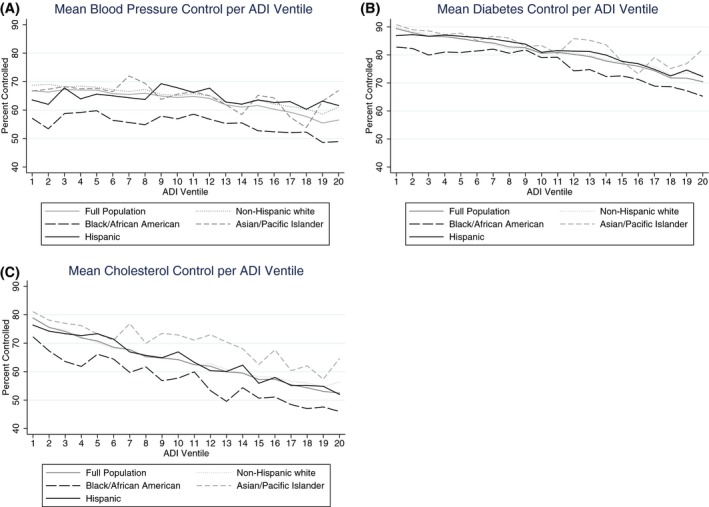
Compared with enrollees residing in the least disadvantaged neighborhoods, enrollees in the most disadvantaged neighborhoods were 5 percentage points (P < 0.05) less likely to have controlled blood pressure, 6.9 percentage points (P < 0.05) less likely to have controlled diabetes, and 9.9 percentage points (P < 0.05) less likely to have controlled cholesterol. Adjustment attenuated this relationship, but the association remained.
The ADI is a strong, independent predictor of diabetes and cholesterol control, a moderate predictor of blood pressure control, and could be used to track neighborhood-level disparities and to target disparities-focused interventions in the MA population.
评估邻里劣势综合指标——区域剥夺指数(ADI)与医疗保险优势计划(MA)人群血压、糖尿病和胆固醇控制之间的关系。
对 2013 年医疗保险医疗效果数据和信息集、医疗保险登记数据以及邻里劣势指标进行二次分析。
我们检验了邻里劣势与中间健康结果的关联。广义估计方程用于调整地理和个体因素,包括区域、性别、种族/民族、双重资格、残疾和农村。
数据通过 ZIP+4 链接,ZIP+4 代表可链接到人口普查街区组的紧凑地理区域。
与居住在劣势最小的邻里的参保者相比,居住在劣势最大的邻里的参保者血压控制的可能性低 5 个百分点(P<0.05),糖尿病控制的可能性低 6.9 个百分点(P<0.05),胆固醇控制的可能性低 9.9 个百分点(P<0.05)。调整削弱了这种关系,但关联仍然存在。
ADI 是糖尿病和胆固醇控制的强有力、独立的预测指标,是血压控制的中度预测指标,可用于跟踪邻里层面的差异,并针对 MA 人群中的差异重点干预措施。