Department of Epidemiology of Microbial Diseases, Yale School of Public Health, New Haven, CT, USA.
Present Address: Division of Epidemiology and Community Health, School of Public Health, University of Minnesota, Minneapolis, MN, USA.
BMC Microbiol. 2018 Nov 23;18(Suppl 1):146. doi: 10.1186/s12866-018-1284-7.
The tsetse fly (Glossina sp.) midgut is colonized by maternally transmitted and environmentally acquired bacteria. Additionally, the midgut serves as a niche in which pathogenic African trypanosomes reside within infected flies. Tsetse's bacterial microbiota impacts many aspects of the fly's physiology. However, little is known about the structure of tsetse's midgut-associated bacterial communities as they relate to geographically distinct fly habitats in east Africa and their contributions to parasite infection outcomes. We utilized culture dependent and independent methods to characterize the taxonomic structure and density of bacterial communities that reside within the midgut of tsetse flies collected at geographically distinct locations in Kenya and Uganda.
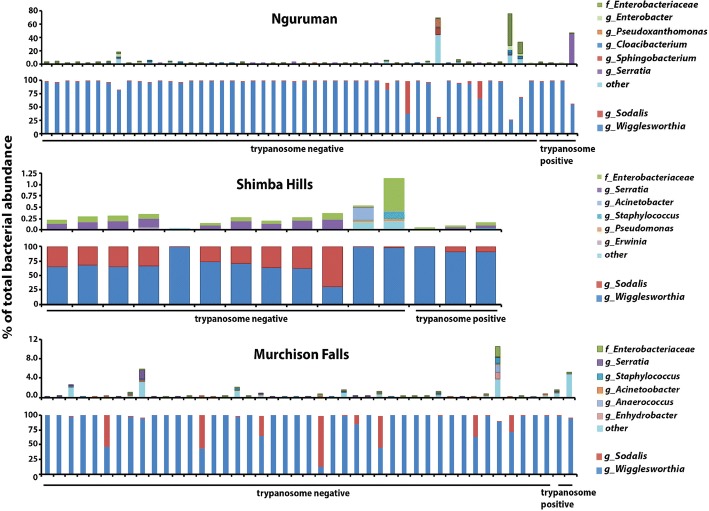
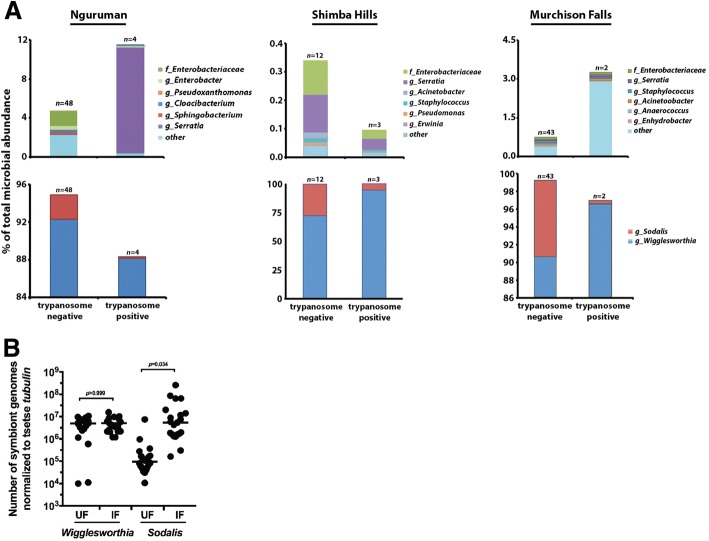
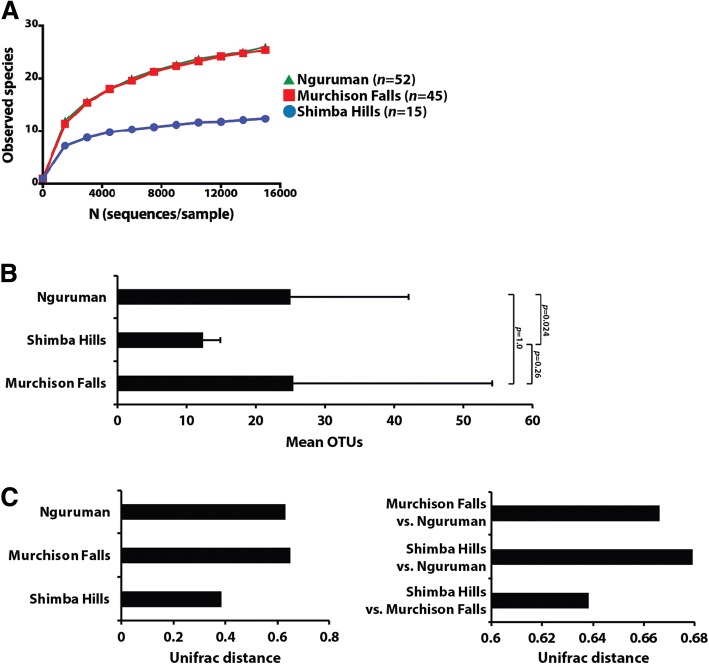
Using culture dependent methods, we isolated 34 strains of bacteria from four different tsetse species (G. pallidipes, G. brevipalpis, G. fuscipes and G. fuscipleuris) captured at three distinct locations in Kenya. To increase the depth of this study, we deep sequenced midguts from individual uninfected and trypanosome infected G. pallidipes captured at two distinct locations in Kenya and one in Uganda. We found that tsetse's obligate endosymbiont, Wigglesworthia, was the most abundant bacterium present in the midgut of G. pallidipes, and the density of this bacterium remained largely consistent regardless of whether or not its tsetse host was infected with trypanosomes. These fly populations also housed the commensal symbiont Sodalis, which was found at significantly higher densities in trypanosome infected compared to uninfected flies. Finally, midguts of field-captured G. pallidipes were colonized with distinct, low density communities of environmentally acquired microbes that differed in taxonomic structure depending on parasite infection status and the geographic location from which the flies were collected.
The results of this study will enhance our understanding of the tripartite relationship between tsetse, its microbiota and trypanosome vector competence. This information may be useful for developing novel disease control strategies or enhancing the efficacy of those already in use.
采采蝇( Glossina sp.)的中肠被母体传递和环境获得的细菌定植。此外,中肠是寄生于感染蝇体内的致病性非洲锥虫的栖息地。采采蝇的细菌微生物群会影响其生理的许多方面。然而,由于地理上的差异,关于东非不同采采蝇栖息地的中肠相关细菌群落的结构及其对寄生虫感染结果的影响,人们知之甚少。我们利用依赖培养和独立的方法来描述在肯尼亚和乌干达地理位置不同的地点采集的采采蝇中肠内细菌群落的分类结构和密度。
使用依赖培养的方法,我们从在肯尼亚的三个不同地点捕获的四种不同的采采蝇( G. pallidipes 、 G. brevipalpis 、 G. fuscipes 和 G. fuscipleuris )中分离出 34 株细菌。为了增加这项研究的深度,我们对从肯尼亚的两个不同地点和乌干达的一个地点采集的未感染和感染锥虫的个体 G. pallidipes 的中肠进行了深度测序。我们发现,采采蝇的必需共生菌 Wigglesworthia 是 G. pallidipes 中肠中最丰富的细菌,无论其采采蝇宿主是否感染锥虫,这种细菌的密度都基本保持一致。这些蝇种群还容纳了共生共生体 Sodalis ,它在感染锥虫的蝇中存在的密度明显高于未感染的蝇。最后,从野外捕获的 G. pallidipes 中肠中定植了具有独特低密度的环境获得微生物群落,这些微生物的分类结构取决于寄生虫感染状态和采集蝇的地理位置。
本研究的结果将增强我们对采采蝇、其微生物群和锥虫媒介能力之间三方关系的理解。这些信息可能有助于开发新的疾病控制策略或增强现有的控制策略的效果。