Department of Epidemiology of Microbial Diseases, Yale School of Public Health, New Haven, CT, United States of America.
Department of Ecology and Evolutionary Biology, Yale University, New Haven, CT, United States of America.
PLoS Negl Trop Dis. 2019 Aug 1;13(8):e0007340. doi: 10.1371/journal.pntd.0007340. eCollection 2019 Aug.
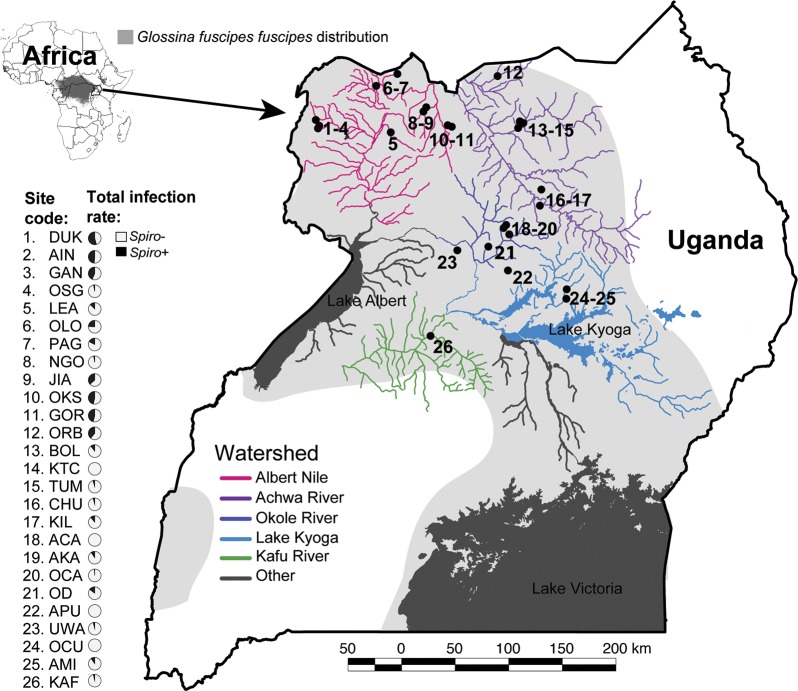
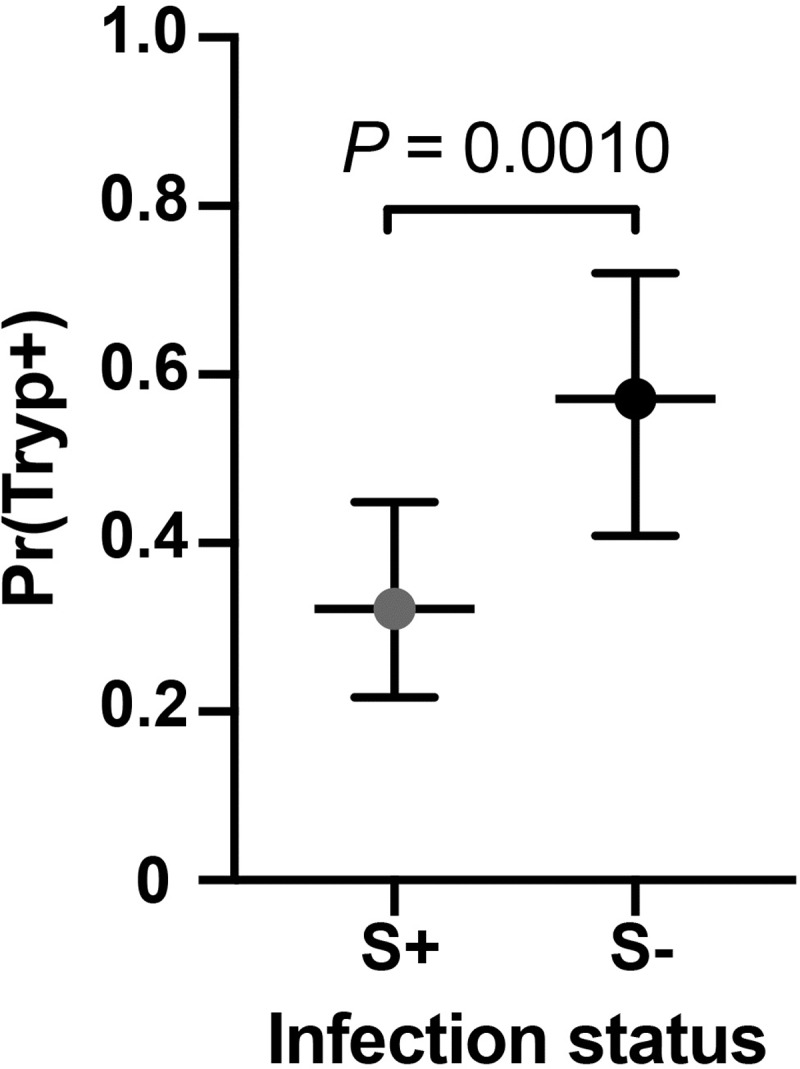
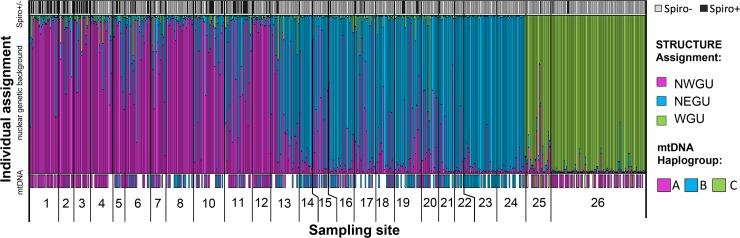
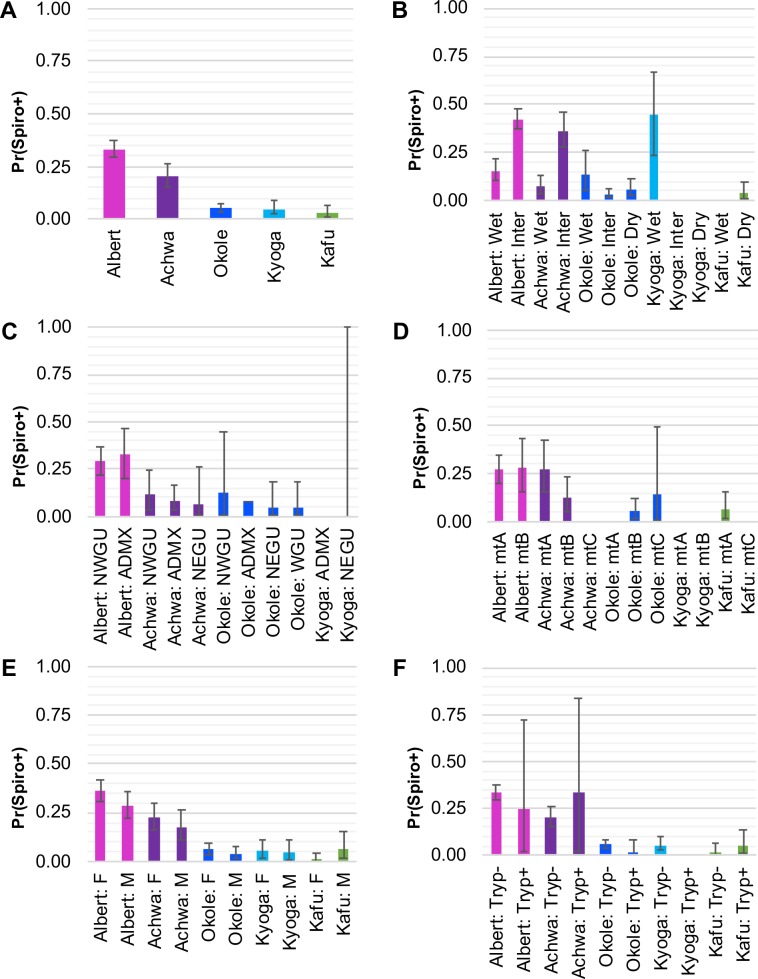
Tsetse flies (Glossina spp.) are vectors of parasitic trypanosomes, which cause human (HAT) and animal African trypanosomiasis (AAT) in sub-Saharan Africa. In Uganda, Glossina fuscipes fuscipes (Gff) is the main vector of HAT, where it transmits Gambiense disease in the northwest and Rhodesiense disease in central, southeast and western regions. Endosymbionts can influence transmission efficiency of parasites through their insect vectors via conferring a protective effect against the parasite. It is known that the bacterium Spiroplasma is capable of protecting its Drosophila host from infection with a parasitic nematode. This endosymbiont can also impact its host's population structure via altering host reproductive traits. Here, we used field collections across 26 different Gff sampling sites in northern and western Uganda to investigate the association of Spiroplasma with geographic origin, seasonal conditions, Gff genetic background and sex, and trypanosome infection status. We also investigated the influence of Spiroplasma on Gff vector competence to trypanosome infections under laboratory conditions. Generalized linear models (GLM) showed that Spiroplasma probability was correlated with the geographic origin of Gff host and with the season of collection, with higher prevalence found in flies within the Albert Nile (0.42 vs 0.16) and Achwa River (0.36 vs 0.08) watersheds and with higher prevalence detected in flies collected in the intermediate than wet season. In contrast, there was no significant correlation of Spiroplasma prevalence with Gff host genetic background or sex once geographic origin was accounted for in generalized linear models. Additionally, we found a potential negative correlation of Spiroplasma with trypanosome infection, with only 2% of Spiroplasma infected flies harboring trypanosome co-infections. We also found that in a laboratory line of Gff, parasitic trypanosomes are less likely to colonize the midgut in individuals that harbor Spiroplasma infection. These results indicate that Spiroplasma infections in tsetse may be maintained by not only maternal but also via horizontal transmission routes, and Spiroplasma infections may also have important effects on trypanosome transmission efficiency of the host tsetse. Potential functional effects of Spiroplasma infection in Gff could have impacts on vector control approaches to reduce trypanosome infections.
采采蝇( Glossina spp.)是寄生锥虫的媒介,在撒哈拉以南非洲地区引起人类( HAT)和动物非洲锥虫病( AAT)。在乌干达, Glossina fuscipes fuscipes( Gff)是 HAT的主要媒介,在西北部传播冈比亚锥虫病,在中部、东南部和西部传播罗得西亚锥虫病。内共生体可以通过赋予宿主对寄生虫的保护作用来影响寄生虫通过其昆虫媒介的传播效率。已知细菌 Spiroplasma 能够保护其果蝇宿主免受寄生线虫的感染。这种内共生体还可以通过改变宿主的繁殖特征来影响宿主的种群结构。在这里,我们使用了在乌干达北部和西部 26 个不同的 Gff 采样点的实地采集来调查 Spiroplasma 与地理起源、季节条件、Gff 遗传背景和性别以及锥虫感染状态的关联。我们还研究了 Spiroplasma 对实验室条件下 Gff 媒介对锥虫感染能力的影响。广义线性模型( GLM)表明, Spiroplasma 的概率与 Gff 宿主的地理起源和采集季节有关,在 Albert Nile(0.42 对 0.16)和 Achwa River(0.36 对 0.08)流域的苍蝇中发现更高的流行率,并且在中间季比雨季采集的苍蝇中发现更高的流行率。相比之下,一旦在广义线性模型中考虑了 Gff 宿主遗传背景或性别的因素, Spiroplasma 的流行率与 Gff 宿主遗传背景或性别的相关性就不显著。此外,我们发现 Spiroplasma 与锥虫感染之间存在潜在的负相关,只有 2%的感染 Spiroplasma 的苍蝇携带锥虫共感染。我们还发现,在 Gff 的一个实验室系中,寄生锥虫在携带 Spiroplasma 感染的个体中不太可能在中肠中定植。这些结果表明,采采蝇中的 Spiroplasma 感染不仅可以通过母性途径维持,还可以通过水平传播途径维持, Spiroplasma 感染也可能对宿主采采蝇的锥虫传播效率产生重要影响。 Spiroplasma 感染在 Gff 中的潜在功能效应可能对减少锥虫感染的媒介控制方法产生影响。